Selecting the correct material for a stamped metal part directly impacts performance, tool life, production cost, and manufacturing feasibility. Understanding how to choose the right material for metal stamping requires evaluating part geometry, mechanical requirements, operating environments, and secondary processing steps against the physical characteristics of candidate metals.
Successful metal stamping material selection is not about finding a single “best” metal for every application. Each material family—whether carbon steel, stainless steel, aluminum, or copper alloys—presents specific trade-offs between tensile strength, formability, corrosion resistance, weight, and raw material cost. A material that functions well for a static structural bracket may fail during deep drawing or lack the elasticity required for an electrical contact.
To make an informed selection, OEM buyers and product engineers must systematically align part functionality, stamping formability, material temper, and finishing requirements before committing to tooling and production.
Key Takeaways
Strength–formability trade-off: Higher-strength material grades often provide less forming margin, so bend severity, draw depth, temper, and springback should be evaluated together.
Specify temper and condition: Requesting a general material family (like “304 stainless steel” or “5052 aluminum”) is insufficient; temper, hardness, and heat treatment condition directly dictate stamping behavior.
Evaluate finishing costs early: Lower-cost base metals like carbon steel often require plating or powder coating for corrosion protection, which can make pre-coated or naturally corrosion-resistant alloys more economical overall.
Account for secondary processing: Applications requiring welding, soldering, or precise electrical conductivity must balance base metal selection with post-stamping operations.
Validate via DFM review: Early Design for Manufacturability (DFM) reviews with a metal stamping manufacturer identify material formability risks before tooling design begins.
Metal Stamping Material Selection Quick Guide
Application Requirement
Common Material Choice
Main Reason
High structural strength
Carbon Steel
High strength with low material cost
Corrosion resistance
Stainless Steel
Natural corrosion protection
Weight reduction
Aluminum
High strength-to-weight ratio
Electrical conductivity
Copper / Brass
Low electrical resistance
Spring characteristics
Phosphor Bronze
Fatigue resistance and elastic recovery
Outdoor protection with lower cost
Galvanized Steel
Zinc coating provides corrosion resistance
What Factors Determine Material Selection for Metal Stamping?
Determining the proper raw material for a stamped component requires an evaluation of engineering, environmental, and financial criteria. Balancing these factors during the early design stage helps reduce the risk of tool wear issues, part failure, and unnecessary material expenses.
Part Function and Mechanical Requirements
The mechanical loads a component encounters dictate the required yield strength, tensile strength, and fatigue resistance of the base metal. Structural components demand metals with high yield strength to prevent permanent deformation under load, whereas spring-loaded parts require high elastic limits to maintain tension over repeated cycles.
Wear resistance and hardness must also be considered for components subjected to friction. However, higher mechanical strength typically corresponds with reduced ductility, making the part harder to form during stamping operations.
Formability and Ductility
Formability refers to a metal’s capacity to undergo permanent deformation—such as bending, stretching, or drawing—without cracking or necking. Ductility, often measured by percentage elongation, dictates how severely a material can be deformed inside a stamping die.
When evaluating material formability for metal stamping, geometry plays a major role. Complex features, deep drawn cups, and tight bend radii demand high ductility. Metals with low ductility require larger bend radii or multi-station progressive tooling to form features gradually without exceeding the material’s failure limit.
Corrosion and Operating Environment
Operating environments dictate a material’s required corrosion resistance. Components exposed to outdoor weather, marine conditions, moisture, or harsh chemicals require base metals that naturally resist oxidation, such as stainless steel or aluminum.
Alternatively, non-corrosion-resistant metals like carbon steel require protective secondary coatings, such as electro-galvanizing, hot-dip galvanizing, or post-stamping plating. Evaluating corrosion resistant materials for metal stamping involves balancing the upfront cost of corrosion-resistant alloys against the processing cost of secondary surface treatments.
Electrical and Thermal Conductivity
Electrical and electronic components—such as terminals, busbars, contacts, and heat sinks—require high electrical or thermal conductivity. Copper and copper-based alloys are standard for these applications due to their low electrical resistance.
When thermal dissipation is the primary requirement, aluminum provides strong thermal conductivity while offering significant weight savings compared to copper.
Weight Requirements
In industries such as automotive, aerospace, and portable electronics, reducing overall assembly weight is a core design constraint. Lightweight metals allow engineers to reduce mass without compromising structural integrity.
Aluminum alloys offer a high strength-to-weight ratio, making them a primary alternative to heavier steel alloys when mass reduction is required.
Material Cost and Availability
Raw material costs often constitute a significant percentage of the total unit cost of a stamped part, particularly in high-volume production runs. However, initial material price per pound must be evaluated alongside scrap rates, processing difficulty, and tool maintenance costs.
For the broader relationship between material cost, tooling investment, production quantity, secondary operations, and final part price, see our metal stamping cost guide.
Material availability in standard commercial gauges and coil widths also affects lead times and unit pricing. Specifying rare or non-standard alloys can lead to long lead times and high minimum order quantities (MOQs) from steel mills.
Secondary Operations and Surface Finishing
Post-stamping processes influence base material selection. If a part requires secondary welding, the selected metal must possess good weldability without developing brittle microstructures.
If the component requires secondary plating (such as tin, nickel, or gold plating) for conductivity or solderability, the base metal must accept the chemical plating process cleanly. In many cases, selecting a pre-coated material—such as pre-galvanized steel coil—eliminates secondary finishing entirely.
For a broader comparison of plating, coating, anodizing, corrosion protection, dimensional buildup, and finish specification, see our metal stamping surface finish selection guide.
Common Materials Used for Metal Stamping
A broad range of ferrous and non-ferrous alloys are processed through stamping dies. This section serves as an overview of standard sheet metal stamping materials used in OEM applications.
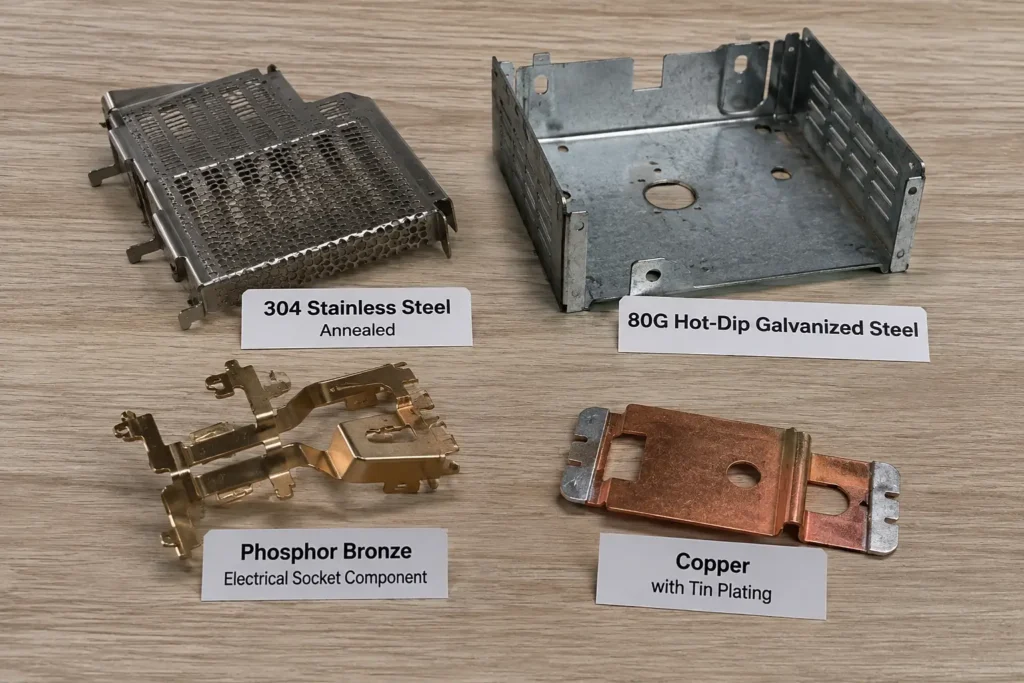
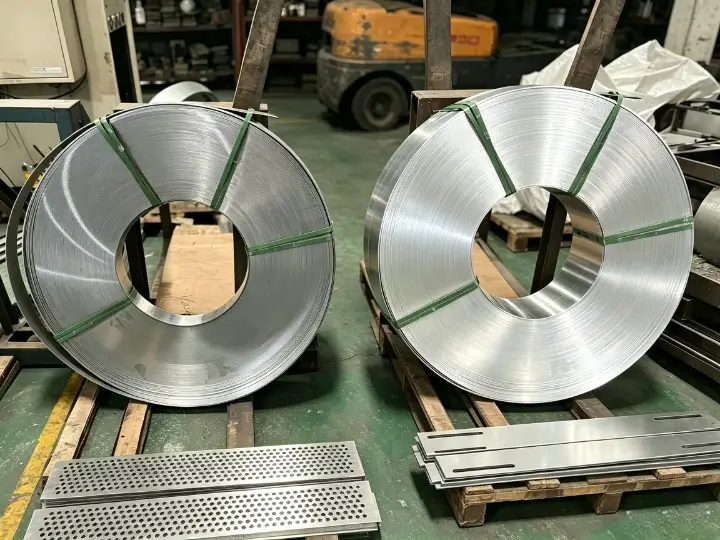
Stamped components made from different metal families commonly used in OEM metal stamping applications.
Carbon Steel
Carbon steel is one of the most widely used metals in stamping due to its balance of strength, formability, and low cost. Low-carbon steels (such as 1008 and 1010) offer excellent ductility and formability, making them ideal for complex shapes, shallow draws, and general structural brackets.
Higher carbon grades provide greater strength and hardness after heat treatment but exhibit lower cold formability, requiring larger bend radii during press operations.
Stainless Steel
Stainless steel is selected primarily for its inherent corrosion resistance, mechanical strength, and clean aesthetic surface finish. Austenitic grades like 304 and 316 offer exceptional corrosion resistance and high ductility, though they work-harden rapidly during stamping.
Martensitic and ferritic grades provide higher magnetic response or heat-treatable strength, but lower overall ductility. Stainless steel is commonly applied in medical devices, food equipment, marine hardware, and high-temperature automotive exhaust components.
Aluminum
Aluminum alloys are favored for light weighting, high strength-to-weight ratios, natural oxidation resistance, and thermal conductivity. Non-heat-treatable alloys (such as the 3000 and 5000 series) provide good cold formability and moderate strength, making them popular for enclosures and structural panels.
Heat-treatable alloys (such as the 6000 series) deliver higher structural strength but require careful temper selection to avoid cracking along bend lines.
Copper
Pure copper (such as C11000) offers exceptional electrical and thermal conductivity combined with natural corrosion resistance and ductility. It is soft and easily formed, though its softness requires careful die design to avoid burrs and surface marking.
Copper is commonly selected for electrical terminals, busbars, power distribution components, and heat exchangers where electrical or thermal transfer is paramount.
Brass
Brass, an alloy of copper and zinc, combines good electrical conductivity with higher mechanical strength and wear resistance than pure copper. Grades like C26000 (Cartridge Brass) possess excellent cold-working ductility, enabling deep drawing and severe bending operations.
Brass is widely used in electrical connectors, architectural hardware, plumbing fittings, and decorative stamped components.
Phosphor Bronze
Phosphor bronze alloys (such as C51000 and C52100) contain copper, tin, and phosphorus. They are specified for their high fatigue strength, wear resistance, low coefficient of friction, and spring properties.
Unlike pure copper, phosphor bronze retains its elasticity under repeated mechanical flexing, making it a standard choice for spring contacts, electrical switch blades, sockets, and connectors subjected to continuous insertion cycles.
Galvanized Steel
Galvanized steel consists of a carbon steel base coated with a protective layer of zinc via hot-dip or electro-galvanizing processes. It provides localized corrosion protection at a lower cost than stainless steel.
During stamping, the soft zinc layer forms along with the base steel, though die clearances and lubrication must be managed to prevent zinc flaking or buildup inside the tool. It is widely used for electrical enclosures, HVAC components, and automotive structural brackets.
Metal Stamping Material Selection Matrix
The following matrix provides a preliminary comparison of primary material families processed in sheet metal stamping. Qualitative ratings reflect typical commercial grades within each family.
Note: The matrix is intended for preliminary material screening. Final selection depends on the specific grade, temper or condition, thickness, part geometry, tolerances, and manufacturing requirements.
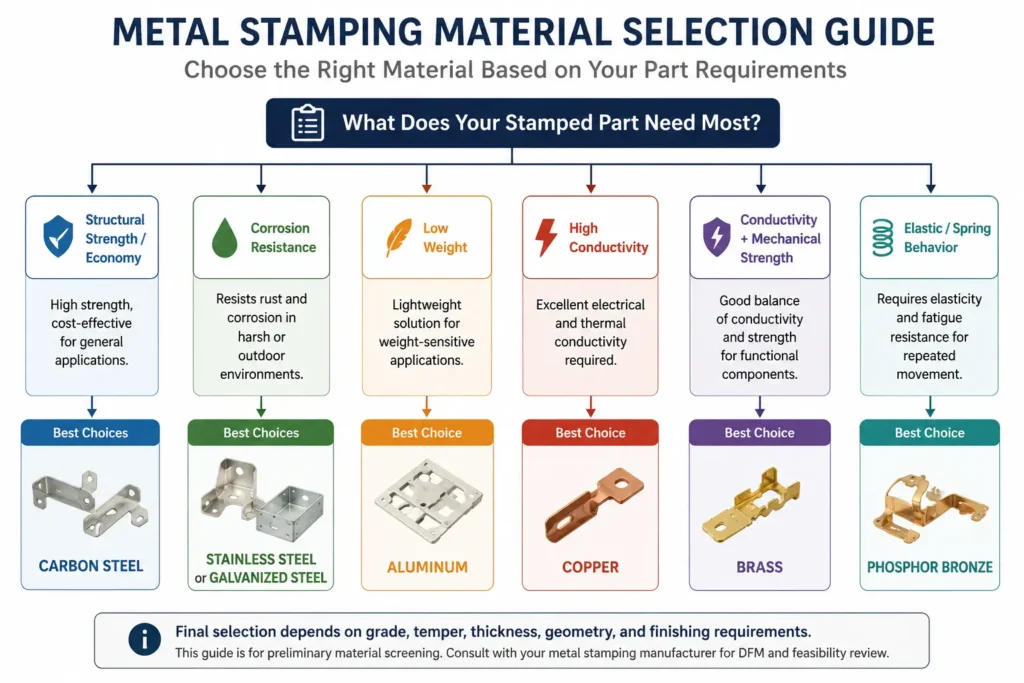
Material selection guide matching common stamped-part requirements with suitable metal families for preliminary evaluation.
Why Material Grade, Temper, and Condition Matter in Stamping
A common sourcing mistake is specifying a general material name on an engineering drawing without defining its alloy grade, temper, or heat-treatment condition. Material behavior inside a stamping die is determined as much by its metallurgical condition as by its base elemental family.
Material Family Is Not a Complete Specification
Simply designating “aluminum” or “stainless steel” leaves critical manufacturing variables open to interpretation. For example, 1100 aluminum is extremely soft and easy to form, whereas 7075 aluminum is extremely strong and prone to cracking under tight bends.
Similarly, designating “stainless steel” without identifying 304 versus 430 grade ignores vast differences in corrosion resistance, magnetic response, and work-hardening rates. A complete manufacturing specification must clearly outline:
Base Material Family & Specific Grade/Alloy (e.g., Stainless Steel 304)
Temper or Hardness Condition (e.g., Annealed, Half-Hard, Full-Hard)
Nominal Thickness and Thickness Tolerances
Surface Coating or Pre-plating Requirements (e.g., Hot-Dip Galvanized 80G)
How Temper and Annealing Affect Formability
Temper defines the hardness, strength, and ductility imparted to a metal through work hardening (cold working) or thermal heat treatment. Understanding stamping material temper and condition is vital when designing parts with tight bends or drawn geometry.
Annealed Condition (Soft): Thermal annealing relieves internal stresses, maximizing ductility and percentage elongation while lowering yield strength. This condition allows deep drawing and severe bending without cracking, though it lowers the final strength of the unformed areas.
Quarter-Hard / Half-Hard Condition: The metal has undergone moderate cold rolling. It offers higher yield strength and stiffness than annealed stock while retaining sufficient ductility for standard 90-degree bends with reasonable bend radii.
Full-Hard Condition: The material exhibits high yield strength, springiness, and wear resistance, but minimal elongation. Bending full-hard stock requires large bend radii to prevent fracture, and the material exhibits significant springback.
Material Temper Comparison for Metal Stamping
Material Condition
Formability
Strength
Typical Application
Annealed
Highest ductility
Lower strength
Deep drawing and severe forming
Half-Hard
Balanced strength and ductility
Medium
Standard bends and formed parts
Full-Hard
Limited formability
Highest strength
Springs and rigid components
Factory Example — Annealed 304 Stainless Steel Forming
In a manufacturing project handled at Metal Stamp Factory, a custom component featured a formed structure made from 304 stainless steel.
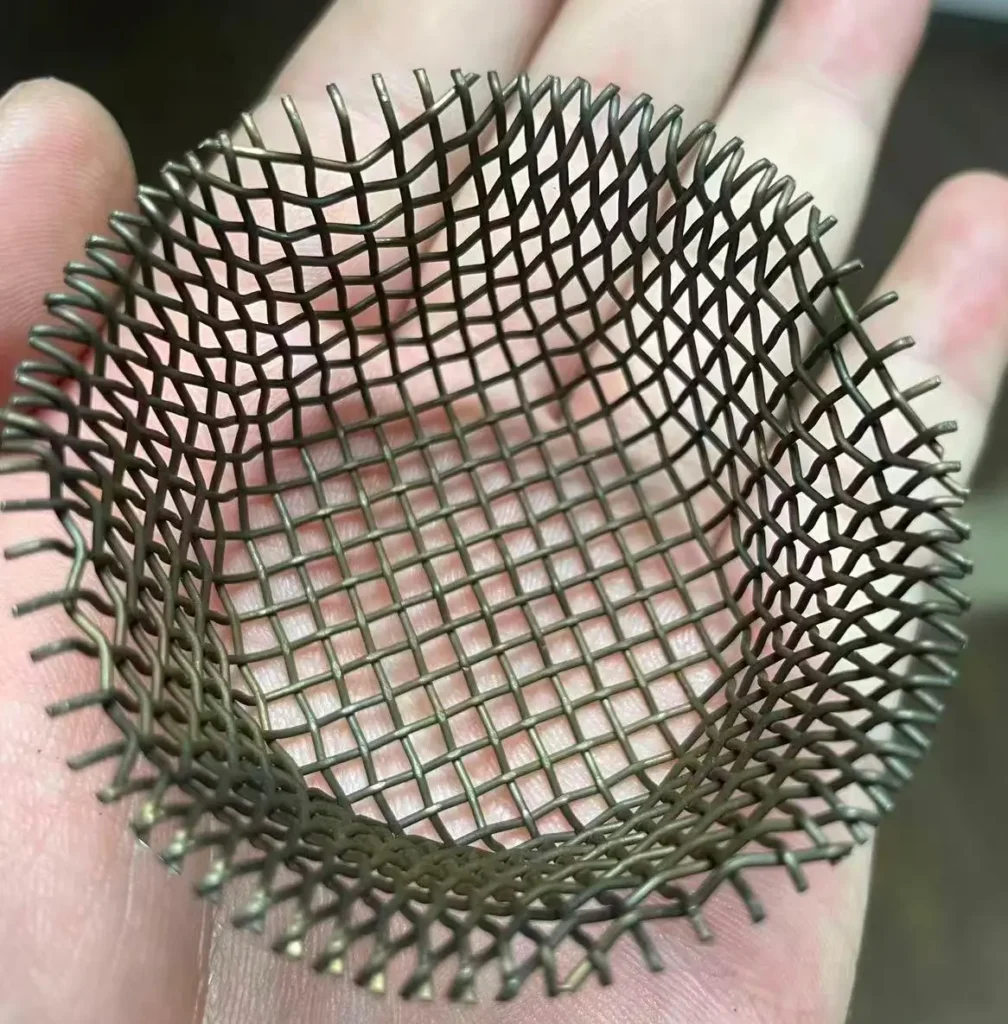
For this specific component, the non-annealed material condition was not suitable for the required forming operations. The component required thermal annealing to satisfy its forming requirements. Following the annealing process, the thermal treatment caused the surface of the stainless steel to darken.
Annealed 304 stainless steel formed component. Material condition was important for the forming requirements of this specific part.
This case demonstrates that in complex forming applications, material condition acts as a critical process parameter alongside raw alloy selection.
How to Choose the Right Material for Metal Stamping: 7-Step Framework
To simplify metal stamping material selection, engineers and buyers can follow a structured 7-step evaluation process before finalizing part drawings or requesting tooling quotes.
7-Step Material Selection Framework
Define Part Functionality & Operating Requirements
Balance Base Material Cost with Secondary Finishing Economics
Validate Selection via DFM & Stamping Press Review
Step 1 — Define the Part’s Functional Requirements
Begin by listing the primary job the stamped part must perform. Determine whether the component is a static structural support, an elastic contact, an enclosure protecting sensitive electronics, or a thermal dissipation plate. Defining the core function narrows the choice down to one or two material families.
Step 2 — Define the Operating Environment
Document the environmental conditions the finished assembly will encounter throughout its service life. Note exposure factors such as:
Indoor atmospheric exposure versus outdoor weather
Exposure to saltwater, high humidity, or chemical vapors
Operating temperature extremes
Requirements for electrical insulation or grounding
If corrosion risk is high, evaluate whether a naturally resistant metal (like stainless steel or aluminum) or a pre-coated/post-plated steel is more appropriate.
Step 3 — Identify Required Mechanical and Physical Properties
Translate functional needs into engineering requirements. Establish target boundaries for:
Minimum yield and tensile strength
Required elasticity or fatigue resistance (for spring components)
Electrical conductivity (e.g., % IACS rating)
Maximum allowable component weight
Step 4 — Evaluate Stamping Formability
Analyze the proposed part geometry against the formability of prospective metals. Review features such as internal bend radii, draw depth, hole edge distance, and coining details.
Ensure the material’s percentage elongation supports the required sharp bends or deep draws without cracking. Assess springback risk—materials with high yield-to-tensile strength ratios exhibit greater springback, requiring specialized die geometry to compensate for elastic recovery.
Step 5 — Specify Grade, Temper, Thickness, and Surface Condition
Select the exact alloy grade, temper, and raw material thickness. Verify that the specified thickness aligns with standard commercial coil and sheet gauge tolerances. Confirm whether the metal should be supplied in a cold-rolled, annealed, pre-galvanized, or pre-painted state.
Step 6 — Compare Material and Finishing Economics
Evaluate total manufacturing cost rather than focusing exclusively on raw material price per pound. A cheaper raw material like carbon steel may require secondary degreasing, plating, and baking operations that drive the total unit price higher than if the part were stamped from pre-galvanized steel or aluminum.
Factor scrap rate into the economic evaluation, as complex parts stamped from expensive copper alloys yield high-value scrap that affects net project pricing.
Step 7 — Validate the Selection Through DFM and Production Requirements
Share the preliminary material selection, part drawing, and expected annual production volume with your metal stamping manufacturer for a Design for Manufacturability (DFM) review.
The stamping engineer evaluates the drawing against press tonnage, progressive die station layouts, strip feeding limits, and tool wear expectations. Validating the material prior to tool build ensures smooth production startups and helps reduce the risk of costly die modifications.
Real Material Selection Examples from Metal Stamping Projects
The following engineering examples illustrate how specific material characteristics, tempers, and secondary finishes were selected to meet functional requirements in real production applications.
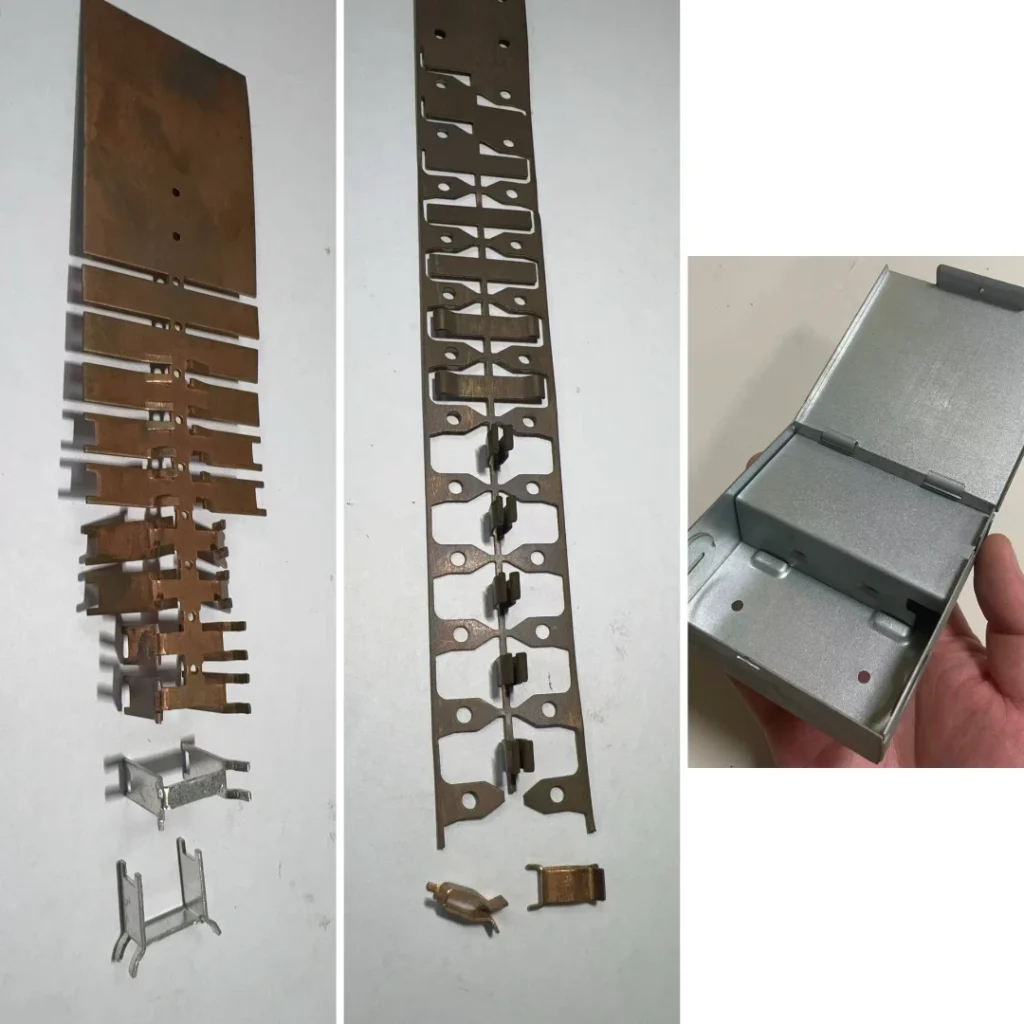
Real stamped components produced from phosphor bronze, copper with post-stamping tin plating, and 80G hot-dip galvanized steel.
Phosphor Bronze Electrical Socket Component
In an electrical power strip project, an internal socket component called for a material with elastic spring characteristics.
Material Selected: Phosphor bronze
Manufacturing Process:Progressive die stamping from continuous strip stock to the finished component
Selection Rationale: Phosphor bronze was specified for this internal socket component due to its inherent elastic and spring properties. As a general engineering principle, electrical contacts subjected to repeated mechanical engagement benefit from copper alloys that resist loss of clamping force under cyclic deflection.
Copper Component with Tin Plating
An electrical terminal component required tin plating following the primary metal stamping operations.
Material Selected: Copper strip with post-stamping tin plating
Manufacturing Process: Progressive die stamping from continuous strip stock to the finished component, followed by secondary tin plating
Selection Rationale: The component possessed no specific requirement for spring elasticity, making copper a suitable base metal. Post-stamping tin plating was specified as a secondary finishing step. In general electrical applications, secondary tin plating is commonly used to mitigate surface oxidation, enhance solderability, and maintain low contact resistance over time.
80G Hot-Dip Galvanized Steel Power Box
An enclosure project involved manufacturing an electrical power box using pre-coated sheet metal.
Material Selected: Hot-dip galvanized steel sheet with an 80G coating specification
Manufacturing Process: Progressive die manufacturing involving multiple operations from raw sheet material to the finished component
Selection Rationale: The 80G hot-dip galvanized coating was part of the incoming material specification for this power-box component. This example shows why coating type and coating specification should be considered as part of the material definition before stamping.
Annealed 304 Stainless Steel Formed Component
As introduced in Section 4, a custom component featured a formed structure that presented strict material ductility demands.
Material Selected: Annealed 304 stainless steel
Manufacturing Process: Form die stamping
Selection Rationale: Standard non-annealed 304 stainless steel was not suitable for the required forming parameters of this specific component. Specifying the annealed condition provided the material ductility necessary to complete the forming operations successfully.
Common Material Selection Mistakes in Metal Stamping
Avoiding common sourcing errors saves significant development time and tooling expense. The following mistakes frequently result in manufacturing delays or component failures:
Choosing material based on price alone: Selecting the lowest-cost base metal without accounting for secondary plating, high scrap rates, or excessive die wear often results in a higher final unit cost.
Specifying only the material family: Indicating “aluminum” or “stainless steel” on a drawing without specifying the exact alloy grade, temper, and thickness tolerance leads to inconsistent production quality and potential part failure.
Ignoring formability during part design: Designing tight internal bend radii or deep drawn features without matching them to a material with sufficient elongation causes cracking and high scrap rates during production.
Ignoring corrosion protection and finishing: Failing to plan for environmental exposure during initial material selection often forces costly secondary plating steps late in the production cycle.
Changing material specifications without manufacturing review: Substituting a material grade or thickness on an established part drawing without consulting the stamping manufacturer can cause severe die damage, excessive springback, or press overload due to differing yield strengths.
What Material Information Should You Include in a Stamping RFQ?
Providing complete material specifications in a Request for Quote (RFQ) enables stamping manufacturers to evaluate material feasibility, prepare accurate pricing, and provide relevant DFM feedback. The following checklist summarizes the key material information OEM buyers should include when requesting a stamping quote.
Material Specification RFQ Checklist
Required Information
Example
Why It Matters
Material Family & Alloy Grade
Aluminum 5052-H32, Stainless Steel 304
Defines mechanical and forming characteristics
Temper / Hardness
Annealed, Half-Hard, T6
Controls strength and ductility
Thickness
1.5mm ±0.05mm
Affects tooling and dimensional control
Surface Condition
Galvanized, Tin Plated
Defines finishing requirements
Functional Requirements
Spring force, conductivity
Ensures material meets application needs
Secondary Operations
Plating, welding, deburring
Determines complete process flow
CAD & Drawings
2D drawings, 3D models
Enables DFM evaluation
Production Volume
Annual quantity
Supports material sourcing and production planning
If you are uncertain about the exact alloy grade or temper for a new design, identify your functional requirements and request a material feasibility review from the manufacturing team.
Frequently Asked Questions About Metal Stamping Material Selection
What is the most common material used for metal stamping?
Low-carbon steel is one of the most commonly used materials in metal stamping. It offers an excellent balance of ductility, ease of forming, structural strength, and low raw material cost. It is widely applied across the automotive, appliance, hardware, and industrial equipment sectors for structural brackets and enclosures.
How do I choose between steel, stainless steel, and aluminum for a stamped part?
Selection comes down to strength, corrosion resistance, weight, and budget:
Carbon Steel is best when high structural strength and low base material cost are primary, and corrosion can be handled via secondary finishing.
Stainless Steel is selected when high corrosion resistance, high strength, or heat resistance are required without secondary plating.
Aluminum is chosen when light weighting or thermal conductivity are critical design goals.
Why does material temper matter in metal stamping?
Temper determines the yield strength, hardness, and percentage elongation of the metal. A soft or annealed temper provides high ductility for complex drawing and tight bending, but lower final structural strength. A hard temper provides high strength and spring properties, but limits formability and increases springback during pressing.
What materials are suitable for electrical stamped components?
Pure copper (such as C11000) is commonly selected for high-conductivity applications like busbars and heavy terminals. Brass (such as C26000) offers good conductivity with higher mechanical strength for connectors and switch components. Phosphor bronze (such as C51000) is commonly used for spring contacts, switch blades, and sockets that require electrical conductivity combined with fatigue resistance and elastic spring retention.
Can galvanized steel be stamped without damaging the coating?
Yes, pre-galvanized and electro-galvanized steel sheets are routinely processed in stamping dies. The zinc coating is ductile and forms alongside the base steel during bending and shallow drawing. However, stamping die clearances, radii, and press lubrication must be properly maintained to prevent zinc buildup on the die tooling.
How does material thickness affect metal stamping?
Material thickness directly dictates the press tonnage required to shear and form the metal. Thicker materials require larger bend radii to prevent outer-wall cracking and increase tool wear. Thinner sheet materials can be formed into tighter radii but are more susceptible to oil-canning, wrinkling during drawing operations, and burr formation if die clearances are not tightly maintained.
Should I specify the exact material grade before requesting a stamping quote?
While specifying an exact grade (e.g., Stainless Steel 304 Annealed) is ideal, it is not strictly mandatory for an initial RFQ. If you are open to recommendations, you can provide the base material family along with your mechanical, environmental, and functional requirements. A metal stamping manufacturer can then suggest standard, readily available commercial grades that meet your engineering criteria at a lower material cost.
Conclusion
Selecting the appropriate material for a metal stamping project requires balancing functional performance, environmental exposure, formability, secondary finishing, and manufacturing economics. By evaluating these factors through a structured framework and defining the material grade, temper, thickness, and condition early, OEM buyers and engineers can optimize part performance while helping reduce the risk of manufacturing issues.
Relying on Design for Manufacturability (DFM) reviews and collaborating with an experienced metal stamping manufacturer ensures that your material selection translates smoothly into reliable, cost-effective volume production.