If you’ve never sourced custom metal parts before, “tooling” might be the most confusing line item on a quote. Why does one supplier quote RMB 800 for tooling and another quote RMB 15,000 for what looks like the same part? The answer comes down to understanding what a stamping die actually is — and which type your project needs.
What is a Stamping Die?
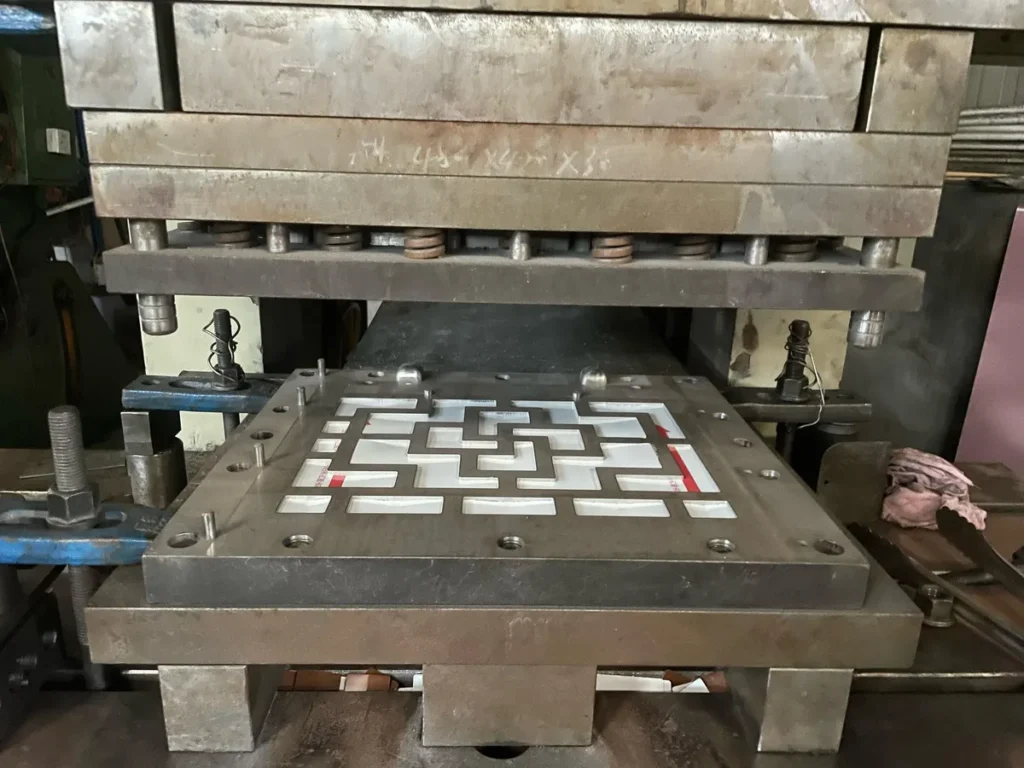
A stamping die is a custom-made tool — typically built from hardened steel — that shapes flat sheet metal into a finished part when pressure is applied by a stamping press. Think of it as a highly precise cookie cutter, except instead of cutting dough, it can punch, bend, pierce, and form metal in a single controlled stroke.
Every die is built specifically for one part design. This is why tooling is almost always a separate cost from the per-piece price of your parts — you are paying for a custom tool that exists only to produce your specific component.
How a Stamping Die Works
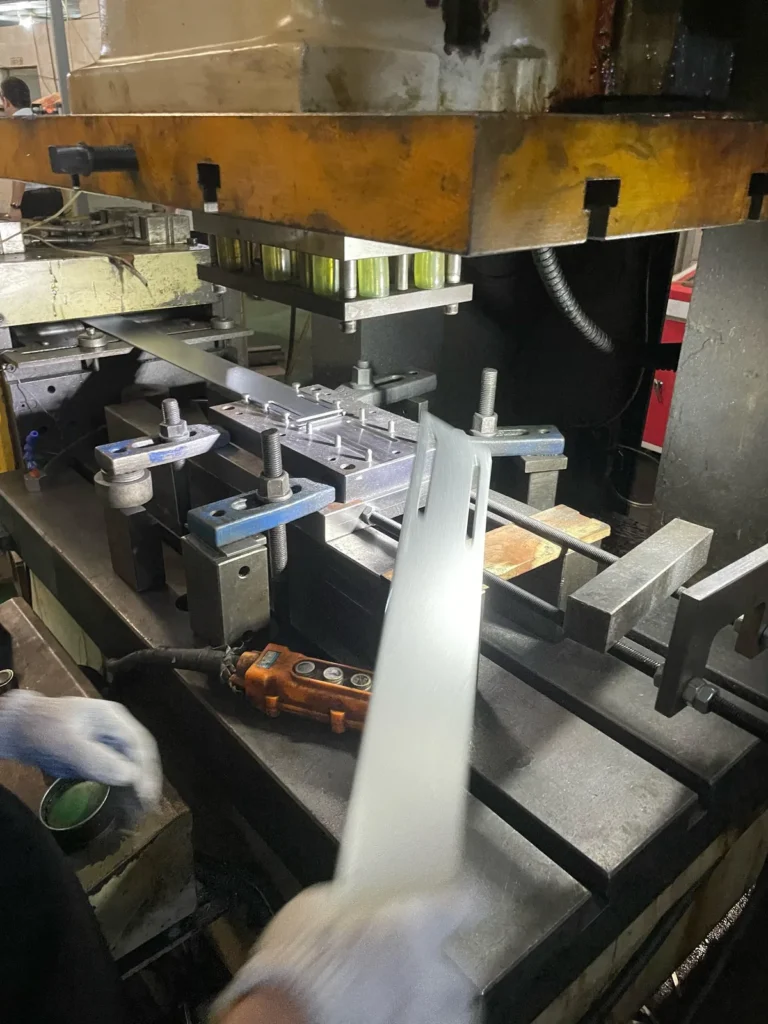
A die is made of two main halves: the punch (upper half) and the die block (lower half). When the press cycles, the punch drives down into the die block, and the metal sheet caught between them takes the shape engineered into the tool.
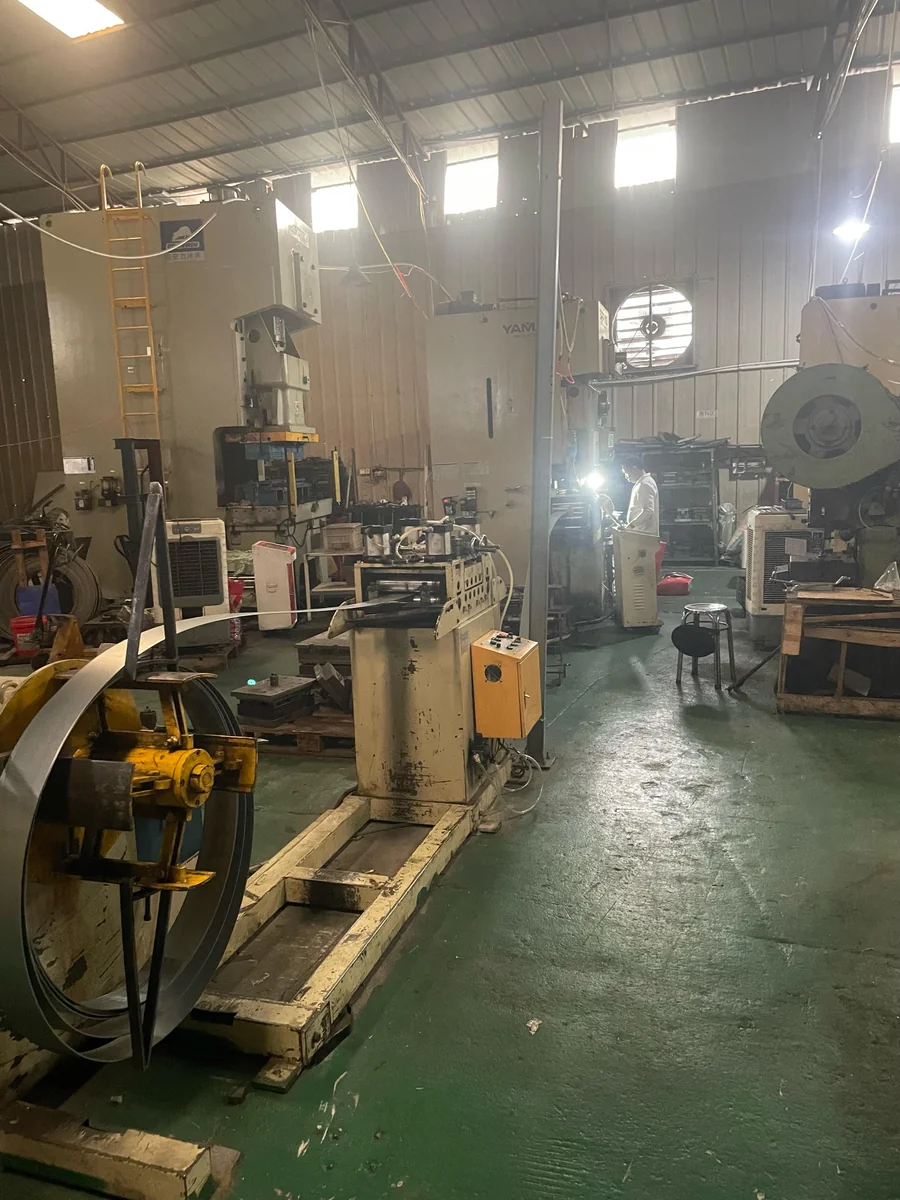
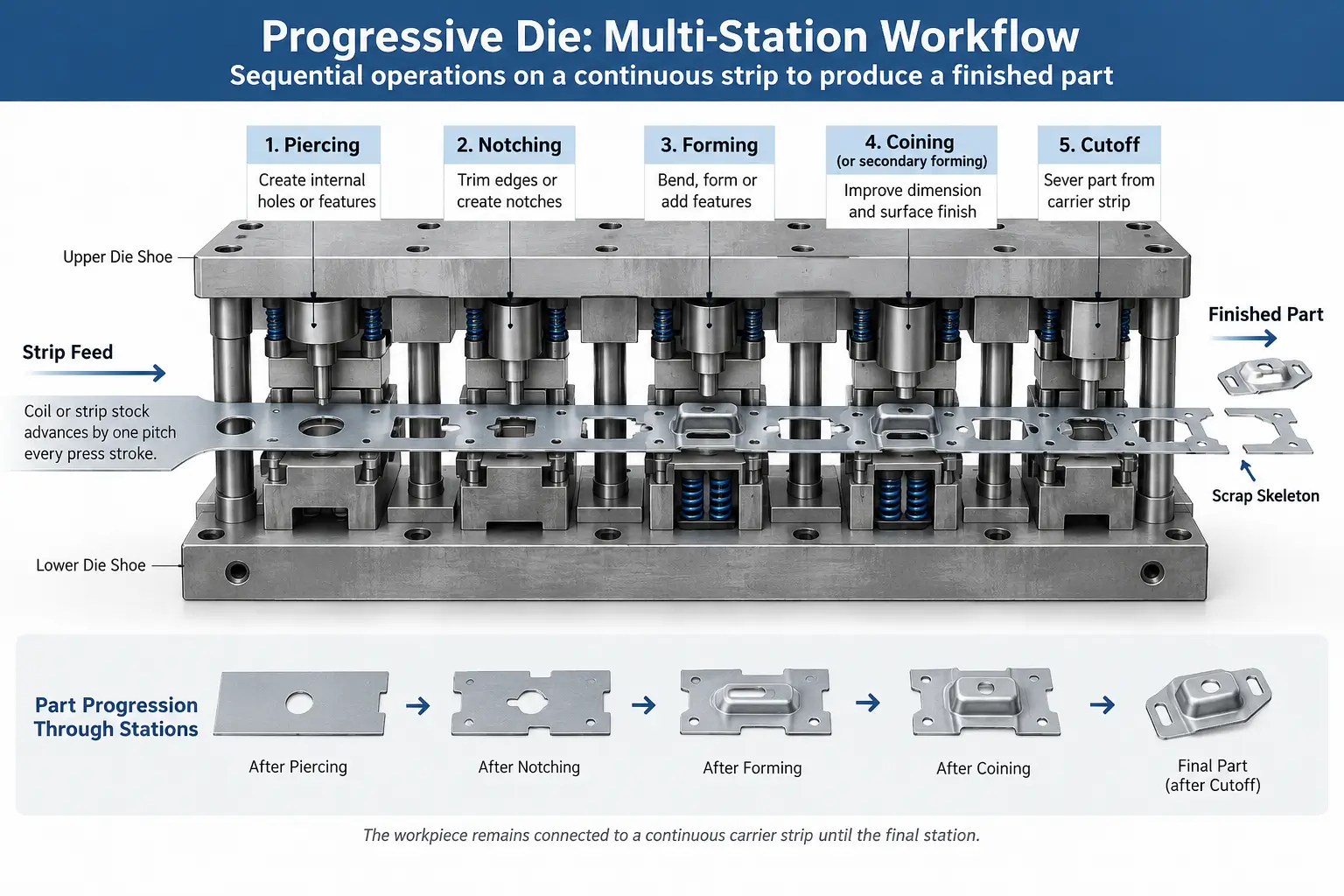
Depending on part complexity, this can happen in a single stroke (simple parts) or across multiple stations as the metal strip advances through the die (progressive dies, used for more complex parts requiring several operations — cutting, bending, piercing — completed in one continuous pass).
A stamping die isn’t limited to one type of action — depending on how it’s engineered, it can perform several distinct cutting and forming operations, often in combination:
Blanking
Cutting a flat profile out of sheet metal, where the removed piece (the blank) is the part you keep — the surrounding scrap is discarded.
Piercing
The reverse of blanking — a hole or slot is punched out, and this time the punched-out piece is the scrap, while the surrounding material is the part.
Trimming
Cutting away excess material from the outer edge of a formed part to bring it to its final profile.
Notching
Cutting a specific profile progressively into the edge of a strip as it advances through a progressive die.
Lancing
Slitting the metal to free up material without fully separating it from the strip — often used to create a flexible carrier section in progressive dies.
Shearing
Cutting the metal along a straight line, commonly used to produce simple rectangular or square blanks.
The gap between the punch and die — called the cutting clearance — controls how clean or rough the cut edge comes out. A common starting point is roughly 10% of material thickness, though the right clearance depends on the specific material and the edge condition required.
Types of Stamping Dies
Stamping dies generally fall into four categories, depending on
part complexity and production volume:
Single-station dies — one operation per press stroke, used for
simple parts or low-volume prototype runs.
Progressive dies — the metal strip advances through multiple
stations in one continuous pass, combining cutting, bending, and
piercing. This is the most efficient method for high-volume
parts. Learn more in our guide: What is Progressive Die Stamping?
Compound dies — multiple operations happen simultaneously in a
single stroke, used for simpler parts requiring high accuracy.
Transfer dies — similar in purpose to progressive dies, but
instead of the strip staying connected as it advances, the part
is physically transferred (mechanically or robotically) between
separate stations. This suits larger or more complex parts that a
progressive die strip can’t easily carry.
Sample Tooling vs Production Tooling — Why the Cost Difference
When you’re testing a new part design, you don’t always need full production tooling right away. Many buyers start with sample tooling — a simplified, lower-cost die used to produce a small batch of samples for approval before committing to mass production.
Sample tooling typically costs RMB 800–3,000 (roughly USD 110–415), depending on part complexity. This is far less than full production tooling, which can run RMB 10,000 (roughly USD 1,400) or more for parts requiring multiple stations, tight tolerances, or complex bending and forming.
The trade-off: sample tooling is built for speed and approval, not high-volume durability. Once your design is confirmed, production tooling is engineered to withstand tens of thousands — or millions — of stamping cycles without losing precision.
If you’re not yet certain about your final specification,
starting with sample tooling is often the smarter first step.
Why Tooling Cost Varies by Part Complexity
Several factors push tooling cost up or down:
Number of stations — a simple flat bracket may need only one
forming station. A part requiring cutting, bending, and piercing
in sequence needs a multi-station progressive die, which costs
significantly more to design and machine.
Material thickness and hardness — thicker or harder materials
require tooling steel that can withstand more stress, increasing
both material and machining cost.
Tolerance requirements — tighter dimensional tolerances mean
more precise machining during die-making, which takes more time
and skilled labor.
Expected production volume — a die built for 10,000 pieces can
use lighter-duty tooling steel than a die expected to run
millions of cycles without wearing out.
How Long Does Tooling Take?
Standard tooling lead time runs 15–25 days from drawing
confirmation to first sample, depending on die complexity. Simple
single-station dies can sometimes be completed faster; multi-
station progressive dies for complex parts may take longer.
This is why confirming your drawing before tooling begins matters
— a design change after the die is already cut means rework time
and additional cost.
Get Tooling Feedback Before You Commit
Send us your drawing or sample, and we’ll tell you honestly
whether your part needs sample tooling or full production
tooling — along with a realistic cost estimate before any work
begins.
New to metal stamping in general? Start with our guide: What is Metal Stamping? — or learn about the most efficient process for high-volume parts in What is Progressive Die Stamping?