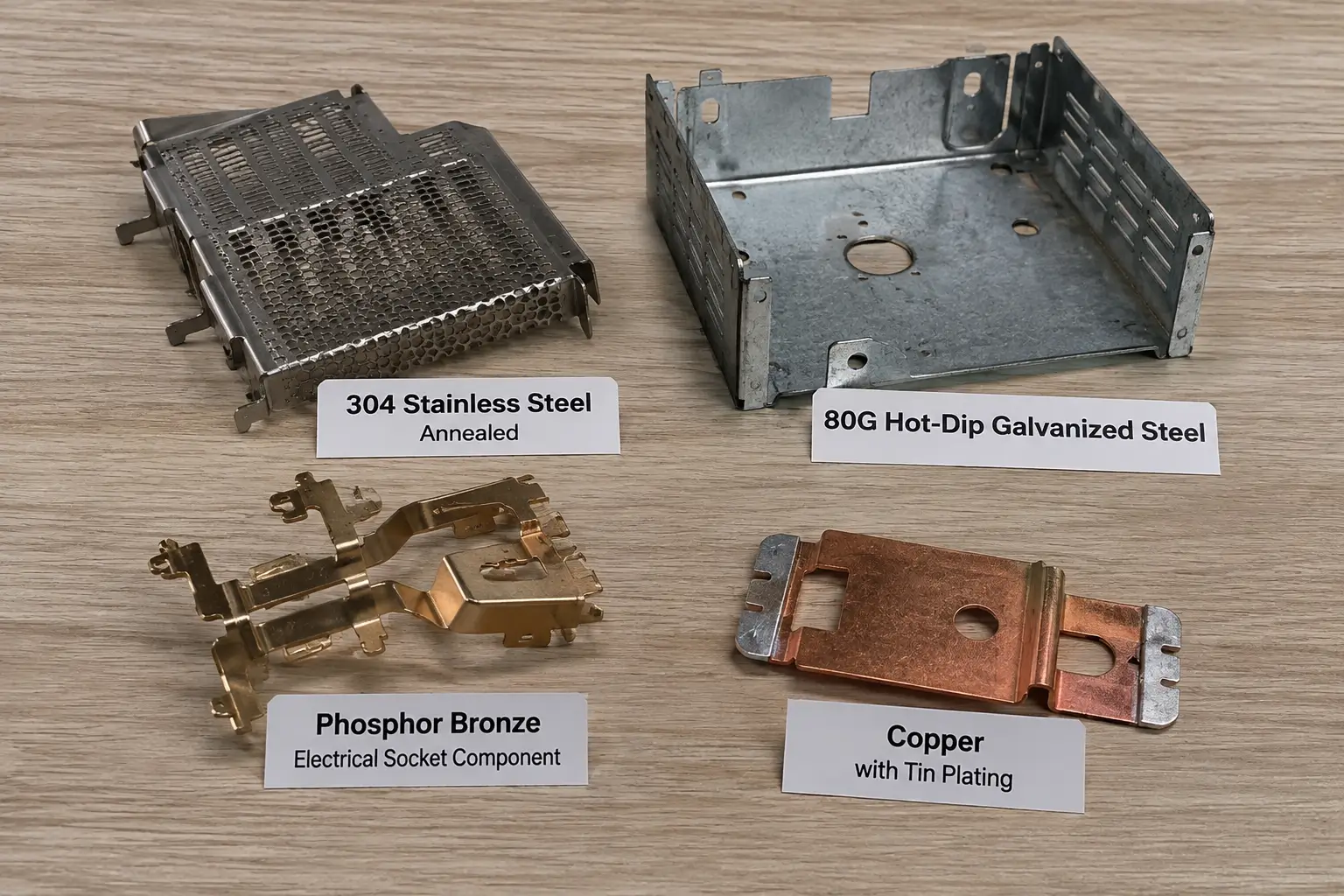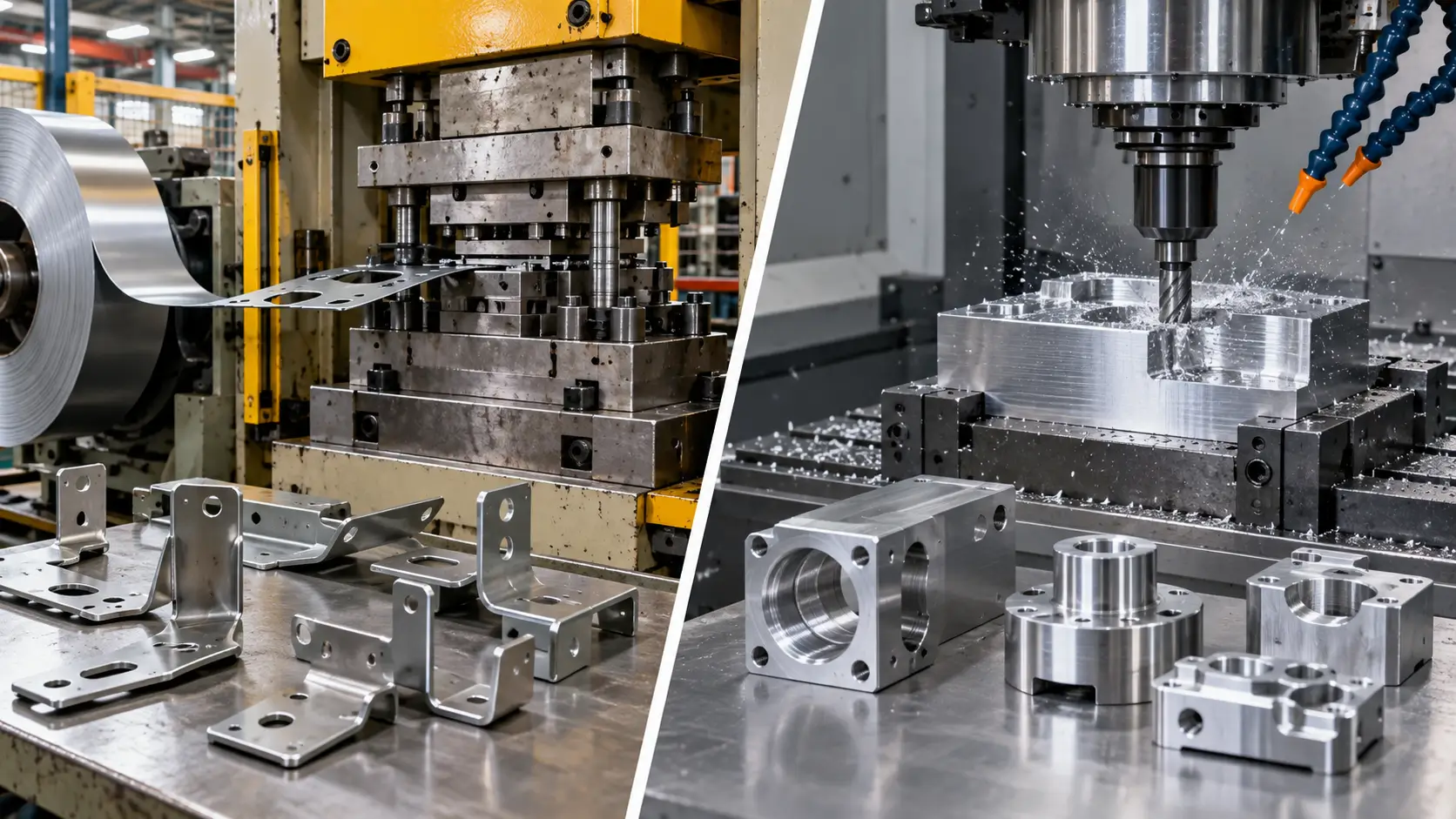
Answer Summary: Metal stamping is a cold-forming manufacturing process that uses a stamping press and a custom-built die to shape flat metal sheets or coils into precise, repeatable parts. It covers operations such as punching, bending, forming, and drawing, and is widely used for producing repeatable metal parts efficiently at high production volumes.
Metal stamping — key points:
1. Metal is shaped cold (no melting) using a press and die, unlike casting or machining
2.Common types include progressive die, transfer die, deep draw, and four-slide stamping
3.Works with carbon steel, stainless steel, galvanized steel, aluminum, copper, and brass
4.Tooling is the main upfront cost; per-part cost drops sharply as volume increases
5.Repeatability and production efficiency make metal stamping well-suited to many high-volume OEM parts.
What Is Metal Stamping?
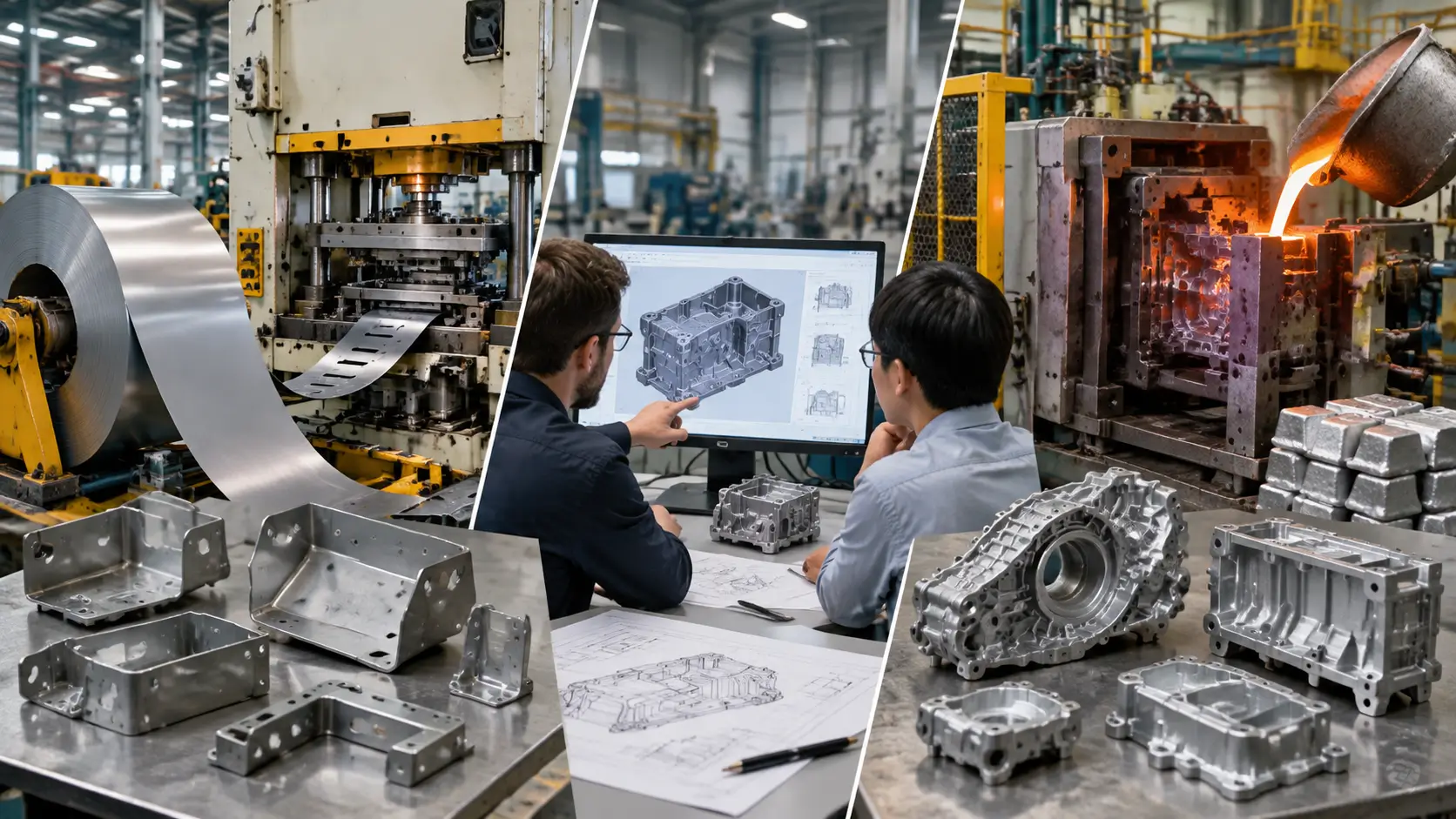
Metal stamping is a manufacturing process that places flat sheet metal – in coil or blank form – into a stamping press, where tooling cuts or forms the material into the required shape. It is generally a cold-forming process, meaning the metal is shaped without melting, using controlled force applied through the press and tooling.
The process covers a range of operations, including punching, blanking, bending, forming, coining, and drawing. Depending on part complexity, these operations can happen in a single press stroke or across a sequence of stations in one die.
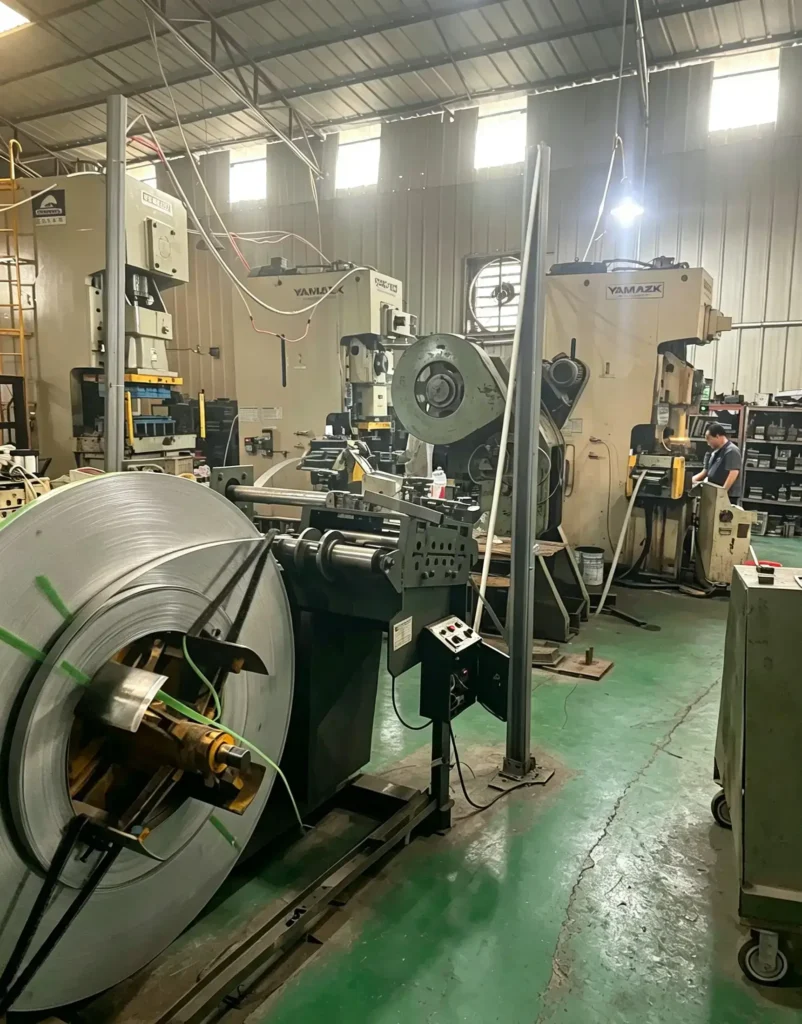
At Metal Stamp Factory, we provide custom metal stamping services from a dedicated facility in Xiamen, Fujian, China, running a full range of stamping presses from 16 to 400 tons — including mechanical presses and a 300-ton hydraulic press — with automatic coil feeding for continuous, high-speed production.
How Does Metal Stamping Work?
At its core, metal stamping works by feeding flat metal – as a coil or pre-cut sheet – into a press, where a die closes on the material to cut, bend, or form it into shape. Die design is one of the most important factors in the process because it influences part geometry, dimensional consistency, production sequence, and how multiple operations are integrated into the stamping cycle.
From the factory floor: At Metal Stamp Factory, we have found that successful metal stamping projects usually start long before production begins. Before recommending a stamping process, our engineering team reviews customer drawings, material requirements, tolerances, production quantities, and expected application conditions.
In many OEM projects, customers initially focus only on the part design. However, manufacturability is equally important. Factors such as bend radius, material thickness, stamping direction, and die structure can directly affect tooling cost, production stability, and final part quality.
For example, during a custom metal stamping project, our team identified that the original design required additional adjustments before tooling development. By reviewing the drawing and discussing production requirements with the customer in advance, we helped avoid potential tooling modifications after production started.
What Are the Main Steps of the Metal Stamping Process?
Here’s a high-level overview of the process — for a complete step-by-step breakdown, see our full metal stamping process guide.
Step 1 — Raw Material Preparation Metal coils or sheets are selected based on customer specifications. Common materials include cold rolled steel, stainless steel, aluminum, and copper.
Step 2 — Die Design and Tooling A custom stamping die is designed and manufactured based on the customer’s drawing or physical sample. At Metal Stamp Factory, all dies are designed and built in-house.
Step 3 — Sample Production Before mass production begins, sample parts are produced and submitted to the customer for dimensional approval.
Step 4 — Mass Production Once samples are approved, full production begins. Automatic coil feeding systems feed raw material continuously into the press for high-speed, consistent output.
Step 5 — Quality Inspection Finished parts undergo visual inspection and dimensional checks before packaging.
Step 6 — Packaging and Export Parts are packaged and prepared for international shipment.
What Equipment Is Used in Metal Stamping?
Stamping presses fall into a few main categories, each suited to different part types:
Mechanical presses — fast, repeatable strokes, well-suited to high-volume production of small to mid-size stamped parts
Hydraulic presses — apply force more gradually and with greater control, better suited to deeper forming operations and thicker materials
Servo presses — allow precise control over stroke position and speed, useful for more complex forming sequences
Metal Stamp Factory operates a full range of stamping presses from 16 to 400 tons — including GOANWIN mechanical presses (400T, 110T, 80T, 45T), WORLD mechanical presses (63T, 40T, 25T, 16T), and a 300T hydraulic press — with automatic coil feeding systems for continuous high-speed production. This range covers material thickness from 0.3mm up to 6.0mm across steel, stainless steel, aluminum, and copper.
What Are the Different Types of Metal Stamping?
Different part geometries and production volumes call for different stamping methods. Here’s how the main types compare:
| Type | Best For | Tooling Cost | Production Volume |
|---|---|---|---|
| Progressive Die | High-volume small/medium parts, multiple features | High | Very high |
| Transfer Die | Larger or more complex geometry parts | Medium–high | High |
| Deep Draw | Cylindrical or hollow parts (enclosures, cans) | Medium | Medium–high |
| Four-Slide | Small precision parts with multiple bends | Medium | Medium |
| Single-Station | Simple parts, prototypes, low volume | Low | Low |
Progressive Die Stamping Explained
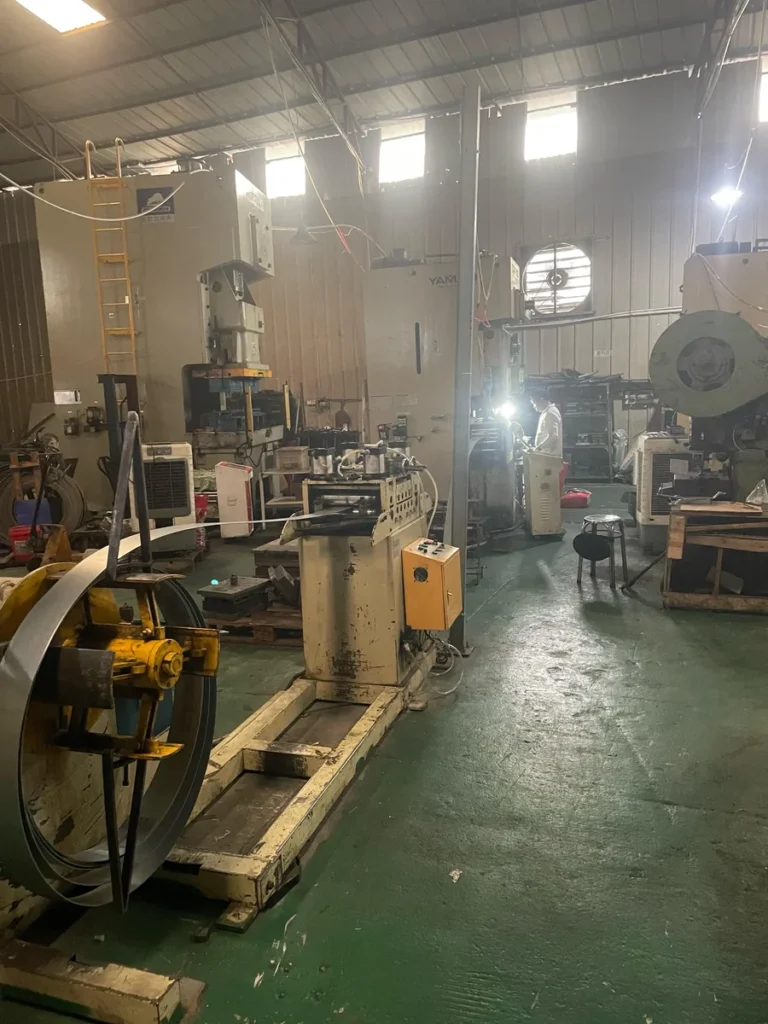
Progressive die stamping is the most efficient method for high-volume production. A continuous strip of metal feeds through multiple stations within a single die, with each station performing a different operation — punching, bending, or forming — as the strip advances. By the time the part exits the final station, it’s fully formed.
This method is ideal for parts that need multiple features formed consistently at scale, since tooling cost is spread across a large unit count. Metal Stamp Factory designs and builds progressive dies in-house — you can read more in our dedicated guide on progressive die stamping.
Transfer Stamping Explained
Transfer die stamping moves individual blanks between separate stations, typically using mechanical fingers or a robotic arm, rather than keeping the part attached to a continuous strip. This gives more flexibility for larger or more complex parts that don’t fit well into a progressive die — including parts that need forming in multiple directions.
Transfer stamping can support part geometries and forming sequences that may not be practical with a strip-fed progressive die. Tooling and equipment requirements depend on part size, geometry, number of forming operations, transfer method, and expected production volume, so the appropriate process should be evaluated from the specific part and production requirements.
Deep Draw Stamping Explained
Deep draw stamping uses a punch to draw a flat sheet-metal blank into a die cavity, forming a hollow or recessed shape such as a cup, enclosure, or housing. Depending on the geometry and material, the required depth may be produced in one draw or through multiple drawing stages. The process is widely used when a stamped part requires significant material flow into a three-dimensional shape.
Deep drawing is primarily a die design question rather than a separate class of equipment — the key elements are the draw ring, blank holder, and punch geometry, which can be built into a die for a standard mechanical or hydraulic press. Our 16–400 ton press range, including the 300-ton hydraulic press, can accommodate deep draw tooling for a range of part sizes. Feasibility depends on the draw ratio (depth relative to diameter) and material — send us your drawing and we’ll confirm whether a single draw or multiple draw stages are needed.
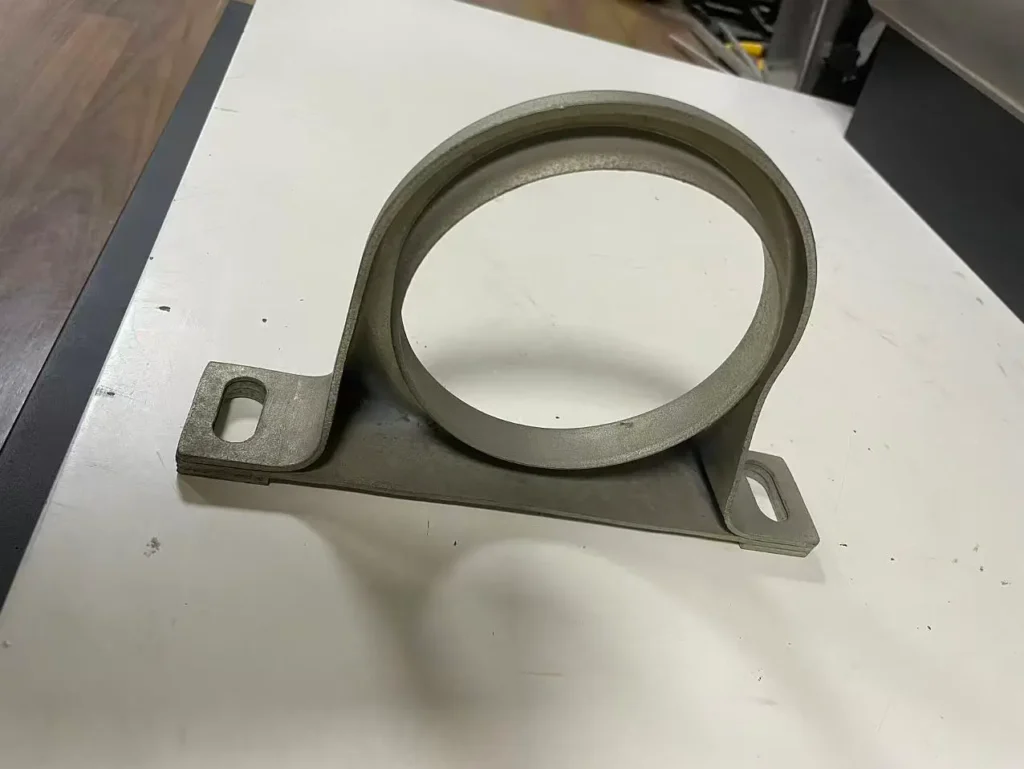
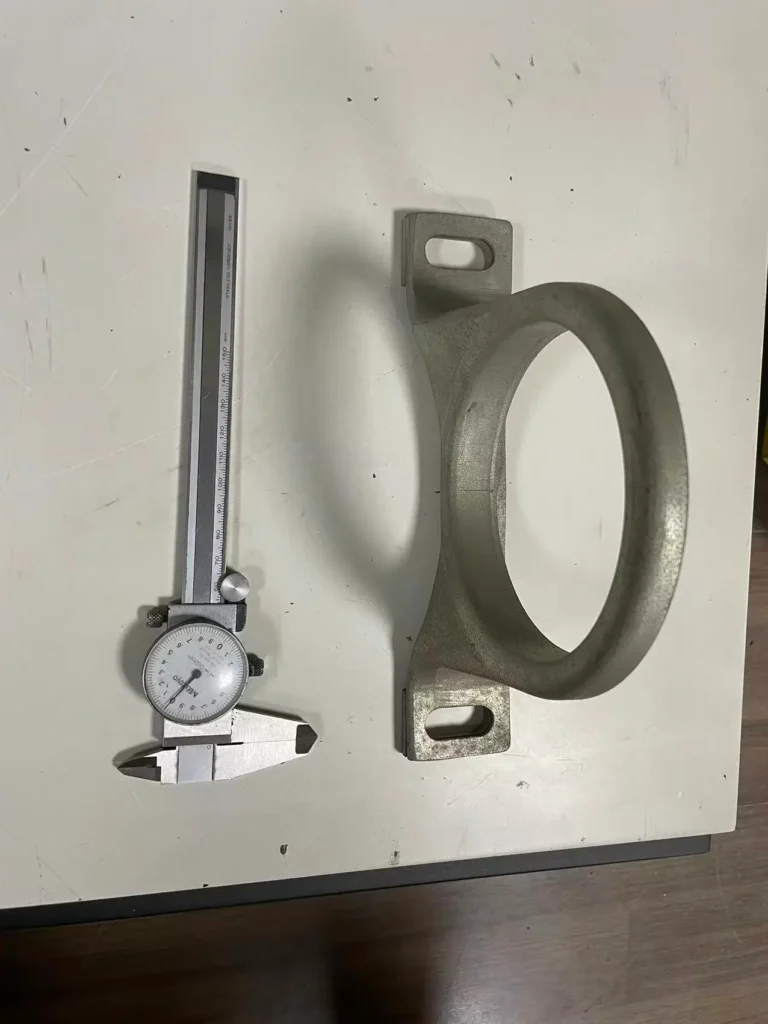
From the factory floor — deep draw example: One example from our production experience is a heavy-duty truck bearing housing. The part starts as a flat metal sheet and is formed through deep drawing. After stamping, the component requires additional processes including zinc plating, plastic overmolding, and projection welding to meet the final application requirements.
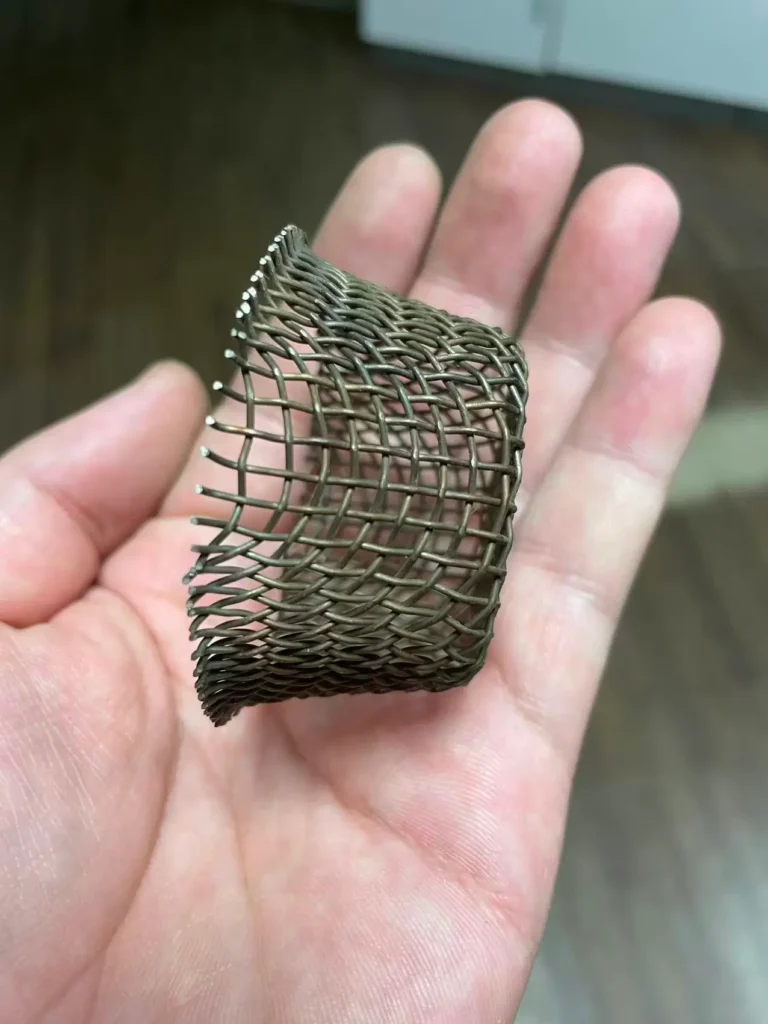
Material condition matters as much as die design. During deep drawing of 304 stainless steel, work hardening can reduce material ductility. In our process experience, annealing is sometimes required between forming operations to restore material flexibility and prevent cracking during further drawing — this is the case for a 304 stainless steel sheet mesh component we produce, which requires an anneal step before it can be drawn further.
Four Slide Stamping Explained
Four-slide (or multi-slide) stamping uses four tools arranged horizontally, each acting as a separate slide, to shape a part with multiple bends in different directions within a single cycle. It’s commonly used for small precision parts such as springs, clips, and retainers that need several bends formed simultaneously.
Four-slide machines are a distinct class of equipment from standard stamping presses. Metal Stamp Factory does not currently operate dedicated four-slide machinery — our in-house capability is centered on progressive die, transfer die, and deep draw stamping on our 16–400 ton press range. If your part was designed around a four-slide process, send us the drawing: in many cases an equivalent part can be produced using progressive die tooling with sequential bending stations, and where that isn’t possible, we can help evaluate options through our partner network.
What Materials Can Be Used for Metal Stamping?
Metal stamping works with a wide range of metals, each suited to different mechanical, electrical, or corrosion-resistance requirements:
| Material | Key Property | Common Use |
|---|---|---|
| Iron / Mild Steel (Q235, SPHC) | Basic strength, low cost, easy to form | General brackets, structural parts |
| Cold Rolled Steel (SPCC) | Better surface finish and formability than hot-rolled | Brackets, enclosures |
| Galvanized Steel (SGCC+Z, Z80/Z120) | Corrosion resistance | Outdoor hardware, solar mounting |
| Zinc-Aluminum-Magnesium Steel (ZAM) | Enhanced corrosion resistance | Outdoor and coastal applications |
| Stainless Steel (SUS304/SUS316) | Corrosion resistance, hygiene | Medical, food, outdoor equipment |
| Spring Steel | High yield strength, elasticity, wear resistance | Clips, retainers, spring contacts |
| Aluminum (incl. anodized) | Lightweight, corrosion resistance | Solar, electronics, automotive |
| Copper / Phosphor Bronze | Electrical conductivity | Connectors, terminals |
| Brass (nickel-plated / nickel+tin-plated) | Conductivity + corrosion resistance | Battery contacts, connectors |
At Metal Stamp Factory, we verify incoming material grade against the mill test certificate before production — this matters most with stainless steel, where 200-series material (such as 201) is sometimes substituted for 304 to cut cost. See our grade verification guide for how to check this. Material specifications may also reference standards published by ASTM International.
For a more detailed comparison of steel, stainless steel, aluminum, copper, brass, and other stamping materials, see our complete metal stamping materials guide.
What Products Are Made Using Metal Stamping?
Metal stamping produces a wide range of finished and component parts, including:
1.Brackets, clips, and mounting hardware
2.Enclosures, shields, and housings
3.Electrical terminals, connectors, and contacts
4.Structural reinforcements and panels
5.Battery covers and contact plates
Metal Stamping Applications Across Industries
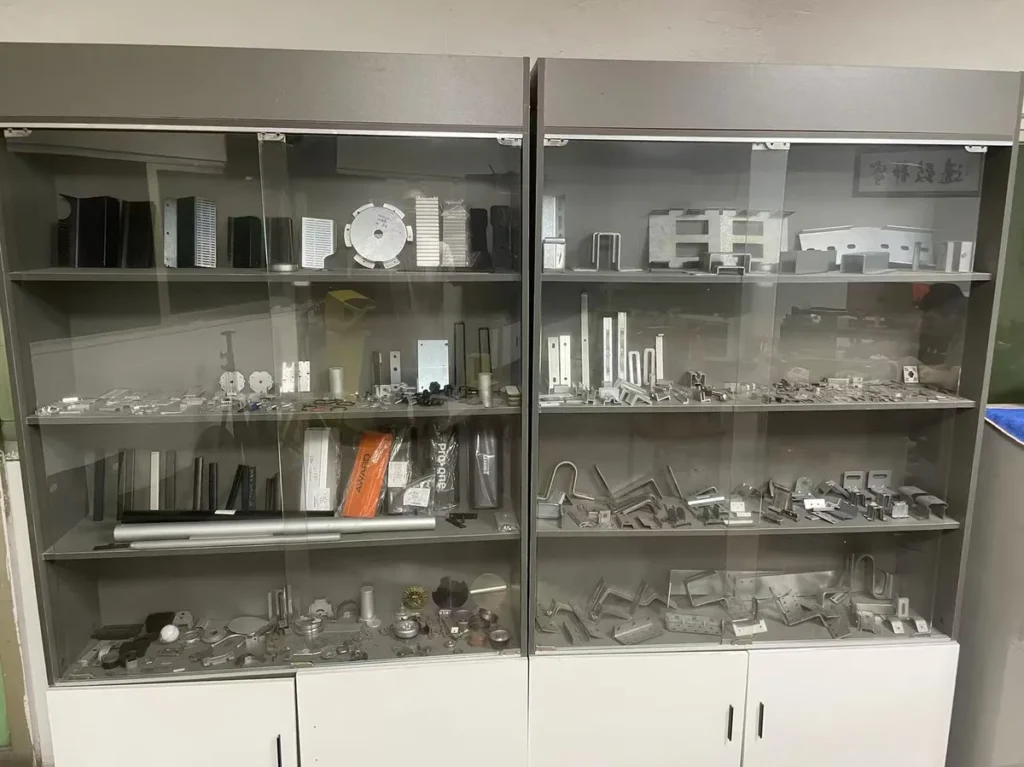
Metal Stamp Factory produces custom stamped parts for a range of industries:
Solar & Photovoltaic — mounting brackets, end clamps, mid clamps, rail components
Automotive & Motorcycle — structural brackets, reinforcements, connectors
Lithium Battery — battery cover plates and contact components
Electrical & Electronics — enclosures, terminals, shields
Industrial Hardware — custom stamped components for machinery and equipment
You can browse examples of finished projects on our case studies page.
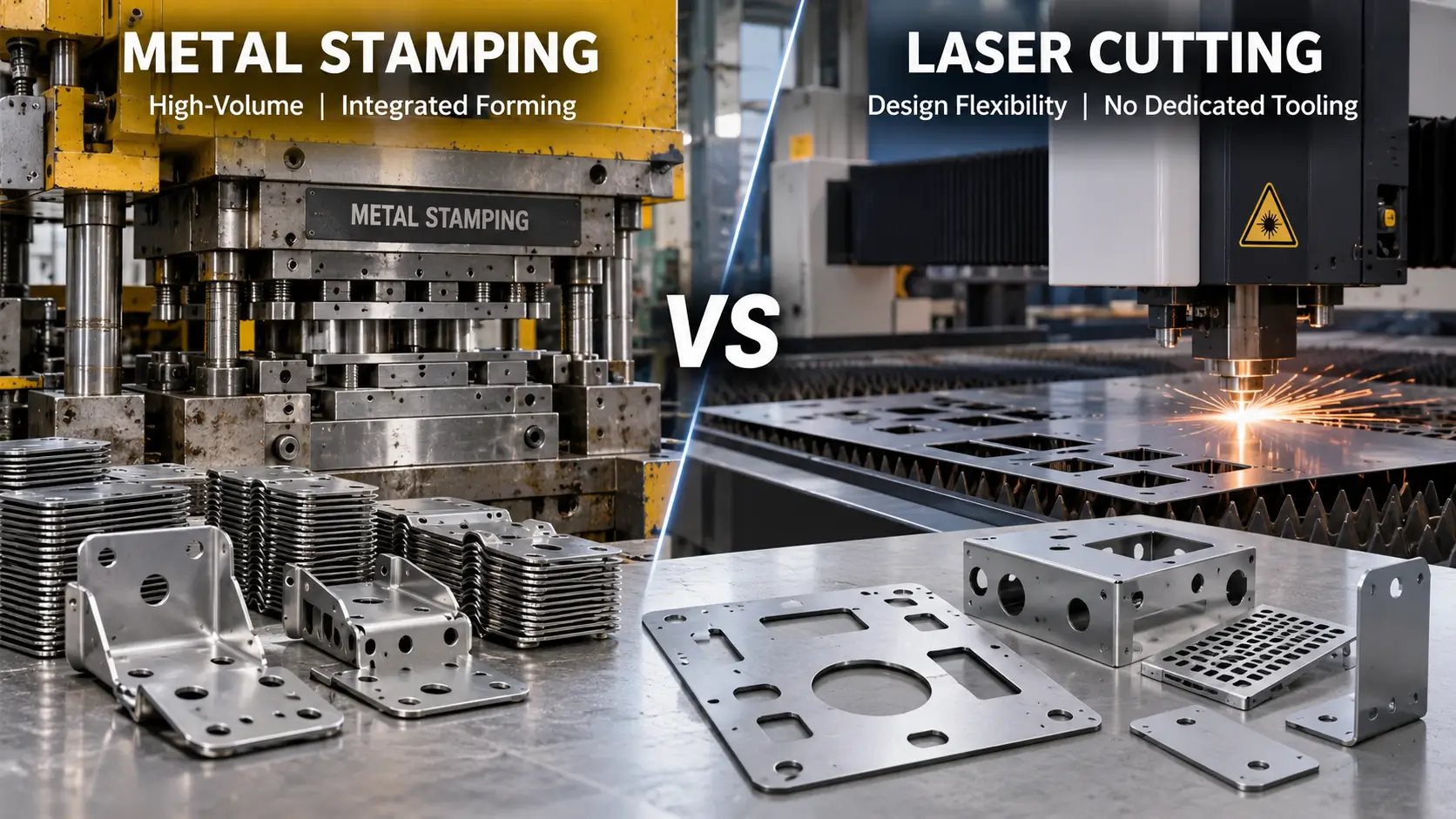
Metal Stamping vs Other Manufacturing Processes
| Process | Material State | Best For | Production Volume |
|---|---|---|---|
| Metal Stamping | Solid sheet metal | High-volume repeatable parts | Very high |
| CNC Machining | Material removal | Precision, low-volume parts | Low–medium |
| Casting | Molten metal | Complex, thick-walled parts | Medium–high |
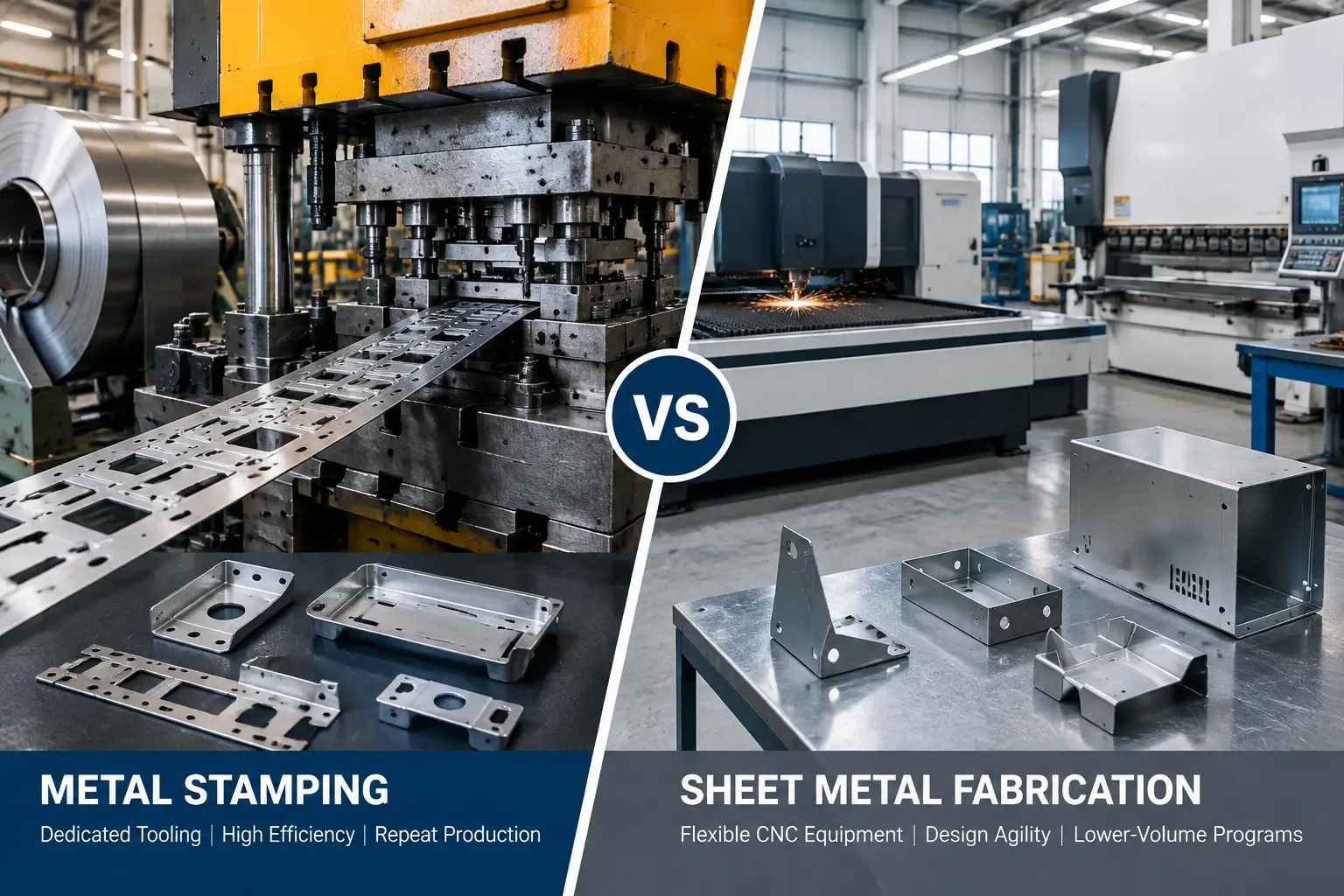
| Sheet Metal Fabrication | Solid sheet metal | Low-volume, custom one-offs | Low |
Metal stamping and sheet metal fabrication are often confused, but they serve different production needs — see how the two compare for a full breakdown.
What Factors Affect Metal Stamping Quality?
Metal stamping quality depends on several engineering factors, including material selection, die design, stamping force, dimensional tolerance, surface requirements, and quality inspection methods.
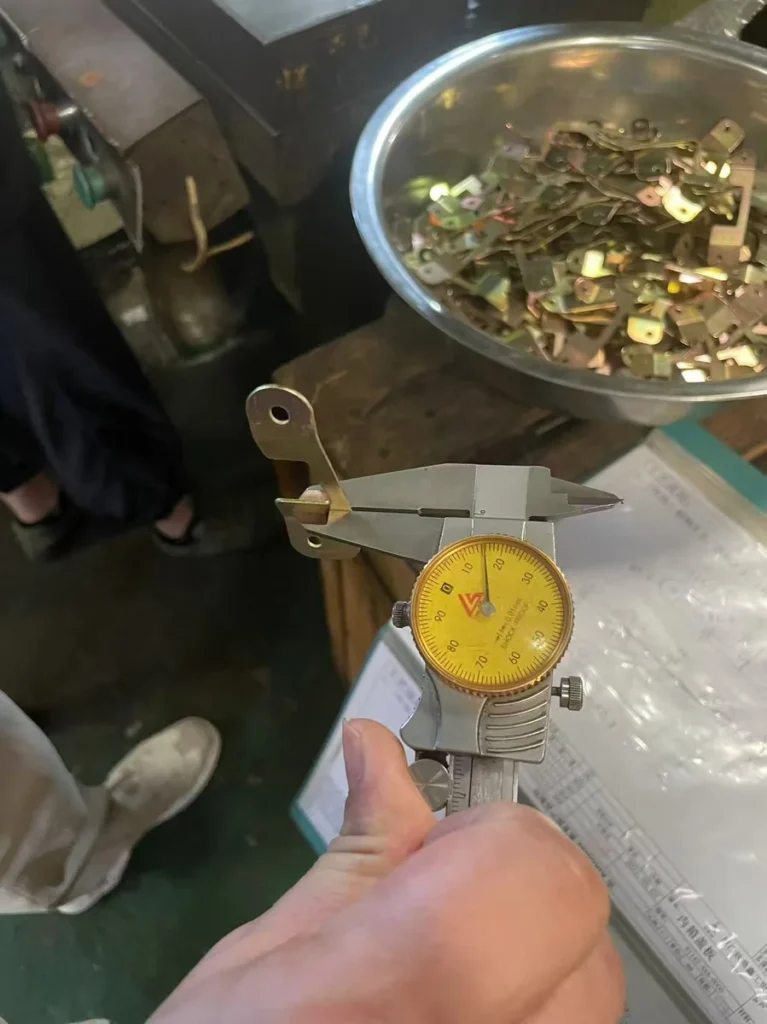
During production, manufacturers typically control critical dimensions according to customer drawings and inspect parts using appropriate measuring equipment. For precision components, controlling tooling wear and production consistency is especially important during high-volume manufacturing.
How Manufacturers Control Metal Stamping Quality?
At Metal Stamp Factory, every batch of stamped parts is checked against the customer’s drawing before shipment, using vernier calipers and micrometers for dimensional verification. Our process includes:
Incoming material inspection — confirming grade, thickness, and coating against the mill test certificate
First article inspection (FAI) — checking the first parts off a new or adjusted die against the drawing before mass production continues
In-process dimensional checks — periodic sampling during the production run to catch tool wear before it affects part quality
Final inspection before shipment — quantity, packaging, and appearance check
Achievable tolerance depends on part geometry, material characteristics, tooling design, and inspection requirements. Tolerance capability is evaluated during the drawing review stage before tooling development, rather than quoted as a single blanket number for every part. For a full breakdown of how tolerances are specified and verified, see our tolerances and quality standards guide.
What Are Common Metal Stamping Defects?
Understanding common defects helps buyers ask better questions during supplier evaluation:
1.Burrs — rough edges from cutting operations, usually controlled through die clearance and maintenance
2.Springback — the material’s tendency to partially return to its original shape after bending, which die design must compensate for
3.Wrinkling — folds that form during deep drawing when blank holder pressure isn’t properly controlled
4.Dimensional drift — gradual deviation from spec as a die wears, which is why in-process inspection matters
5.Cracking — occurs when material is stretched beyond its formability limit, often from bend radius that’s too tight for the material thickness
How Much Does Metal Stamping Cost?
Metal stamping quotes are built from several cost layers:
| Cost Factor | Impact |
|---|---|
| Tooling | Largest upfront cost; amortized per part as volume increases |
| Material | Grade, thickness, and coating affect raw material cost |
| Production Volume | Higher volume lowers per-part cost |
| Part Complexity | More stations, tighter tolerances increase tooling and cycle cost |
| Surface Treatment | Plating, coating, or anodizing add per-part cost |
Because tooling is the dominant upfront cost, metal stamping becomes more cost-effective as volume increases — it’s rarely the lowest-cost option for a handful of parts, but per-part cost drops sharply once a die is amortized across a full production run.
Advantages of Metal Stamping for OEM Production
High production speed — presses can produce parts continuously once a die is running
Consistent dimensional accuracy — every part off the same die is built to the same geometry
Lower per-unit cost at volume — tooling cost is spread across the full production run
Material efficiency — progressive die layouts minimize scrap on the metal strip
Wide material compatibility — steel, stainless steel, aluminum, copper, and more
Scalability — the same tooling supports both sample runs and mass production
How to Choose a Metal Stamping Manufacturer?
Choosing the right manufacturer comes down to a few core factors: whether they design and build tooling in-house, how they handle quality inspection, what their realistic lead time looks like, and how transparent their cost breakdown is.
We cover this in full detail in our companion guide: Buyer Guide: How to Choose a Metal Stamping Manufacturer, which walks through the complete evaluation framework for OEM buyers.
Frequently Asked Questions About Metal Stamping
What is metal stamping used for? Metal stamping is used to produce brackets, enclosures, electrical terminals, structural reinforcements, and other precision metal parts at high volume, for industries including automotive, solar, electronics, and industrial equipment.
How does metal stamping work? A stamping press forces flat sheet metal through a die, which cuts, bends, or forms it into the desired shape. Depending on part complexity, this happens in a single press stroke or across multiple stations in one die.
What materials can be stamped? Common materials include carbon steel, galvanized steel, stainless steel (SUS304/SUS316), aluminum, copper, and brass — material choice depends on strength, corrosion resistance, and conductivity requirements.
Is metal stamping suitable for high volume production? Yes — metal stamping is specifically well-suited to high-volume production, since tooling cost is spread across a large number of parts, keeping per-unit cost low once the die is running.
How do I choose a metal stamping manufacturer? Evaluate whether the manufacturer designs and builds tooling in-house, how they inspect incoming material and finished parts, and whether they give a realistic lead-time breakdown rather than a single estimate. See our full Buyer Guide for the complete framework.
Conclusion: Working With an Experienced Metal Stamping Manufacturer
Metal Stamp Factory was established in 2014 in Xiamen, China, specializing in custom metal stamping parts and precision hardware manufacturing for OEM customers worldwide. The founder of Metal Stamp Factory, Shengtong Chen, started learning mold making and metal stamping at the age of 17 and has accumulated more than 25 years of hands-on manufacturing experience in tooling development, metal stamping, and OEM production.
Every custom metal stamping project at Metal Stamp Factory follows a structured process from drawing review and tooling evaluation to sample approval and mass production. We communicate production requirements clearly with customers before starting tooling to reduce risks and improve project efficiency.
Ready to start your metal stamping project? Send us your drawing, material requirement, and estimated quantity. Our engineering team will review the project and provide feedback on tooling requirements and production feasibility.