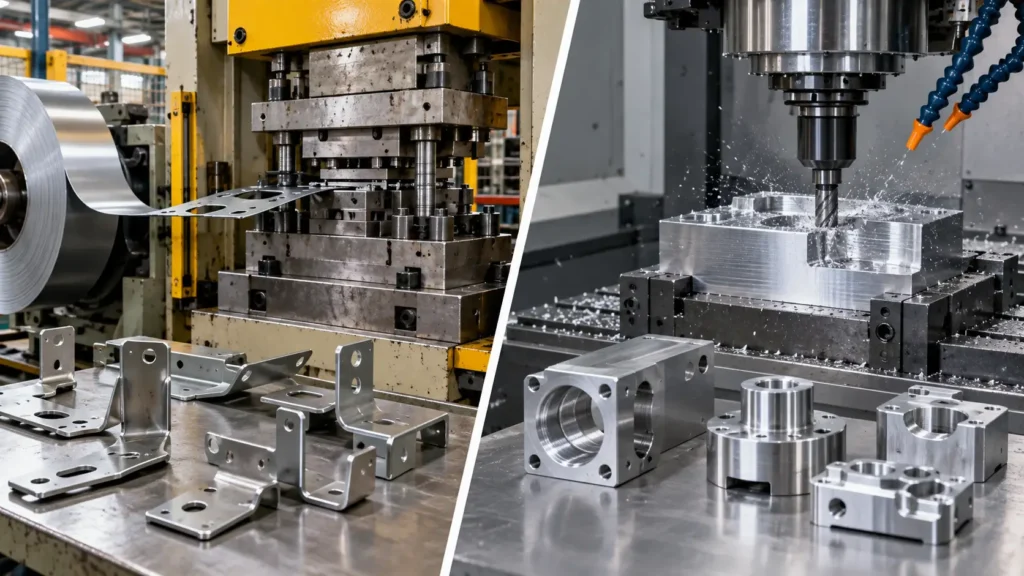
For OEM buyers, product designers, and procurement managers, selecting between metal stamping and CNC machining is rarely about which manufacturing process is universally superior. Instead, the decision hinges on identifying which process aligns best with your part geometry, required tolerances, target unit economics, design stability, and overall program volume.
Choosing the wrong manufacturing route can lead to unnecessary tooling investment, higher production costs, or delays when a design changes. Committing to custom stamping tooling too early for an evolving design can create additional modification costs later. Conversely, continuing to machine a sheet-metal-compatible component throughout a large repeat-production program may result in higher total manufacturing costs than necessary.
Neither process is better in every scenario. CNC machining provides strong design flexibility and is naturally suited to many complex three-dimensional geometries. Metal stamping can provide high repeatability and favorable production economics when the geometry is suitable and dedicated tooling can be amortized across sufficient production quantity.
Evaluating the core differences across cost structure, geometry, tooling, production requirements, and design maturity will help determine the right process for a specific application.
Metal Stamping vs CNC Machining: Quick Comparison
Comparison Factor
Metal Stamping
CNC Machining
Tooling Investment
Requires dedicated stamping die with higher upfront tooling cost.
No dedicated stamping die required, but programming, fixtures, and setup contribute to initial cost.
Unit Cost at Volume
Lower per-part cost after tooling investment is distributed across repeat production quantities.
Higher per-part cost due to machining time, cutting operations, tooling, and material removal.
Production Volume
Best suited for medium to high-volume production with stable part designs.
Better suited for prototypes, low-volume production, and frequent design changes.
Production Speed
Extremely fast production cycles after tooling and process setup are completed.
Production speed depends on geometry, machining operations, tool paths, and setup requirements.
Design Changes
Design changes after die completion may require tooling modification or redevelopment.
Design changes are generally easier through CAD/CAM updates and programming adjustments.
Geometry Compatibility
Ideal for sheet metal parts using blanking, piercing, bending, drawing, and forming operations.
Suitable for complex 3D shapes, pockets, cavities, and precision machined features.
Material Efficiency
High material efficiency for properly designed stamped sheet metal components.
Material waste can be higher because machining removes material to create the final geometry.
Best Applications
Brackets, clips, housings, electrical components, and repeat OEM production parts.
Precision components, prototypes, complex parts, and low-volume manufacturing applications.
Tooling Investment (NRE)
Metal Stamping:
Requires dedicated tooling engineered for the specific part geometry. Initial Non-Recurring Engineering (NRE) costs can therefore be higher and require upfront capital allocation.
CNC Machining:
Uses cutting tools, CAD/CAM programming, machine setup, and workholding. It does not require a dedicated stamping die, although programming, fixtures, tooling, and setup still contribute to initial cost.
Unit Economics
Metal Stamping:
Can achieve favorable per-part economics when dedicated tooling is distributed across sufficient repeat-production quantity.
CNC Machining:
Per-part economics remain strongly influenced by machine time, material, cutting operations, tooling, and setup requirements.
Production Scalability
Metal Stamping:
Once dedicated tooling and the material-feed process are established, stamping can support rapid and highly repeatable production cycles for suitable parts.
CNC Machining:
Each part requires programmed machining operations and machine time, so throughput depends heavily on geometry, material, toolpaths, and setup.
Part Geometry Compatibility
Metal Stamping:
Best suited to components that can be manufactured from sheet or coil stock using cutting and forming operations such as piercing, bending, drawing, or coining.
CNC Machining:
Well suited to solid three-dimensional shapes, variable cross-sections, pockets, cavities, and other features that require controlled material removal.
Tolerance and Surface Requirements
Metal Stamping:
Can maintain repeatable dimensions across production runs when the material, tooling, part geometry, and process are properly controlled. Mechanically sheared edges have characteristic edge conditions that must be considered during design.
CNC Machining:
Can provide tight dimensional control and machined surfaces on features that are well suited to subtractive manufacturing.
Design Flexibility
Metal Stamping:
Design revisions after dedicated tooling is completed may require modification or rework of the physical die.
CNC Machining:
Many design revisions can be implemented through CAD/CAM, programming, tooling, and setup changes, although fixtures and process validation may also be affected.
Understanding the Core Manufacturing Difference
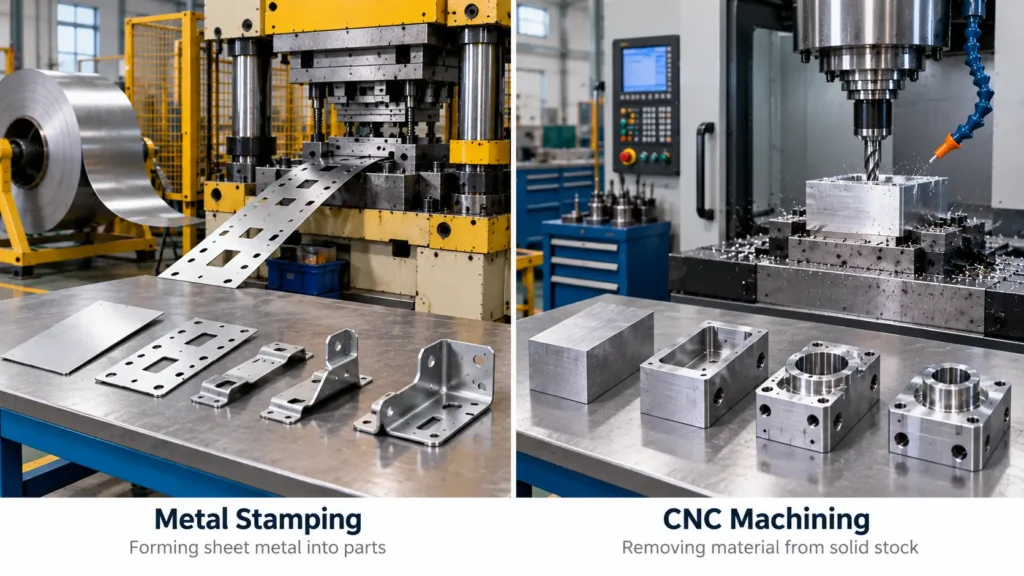
Metal stamping forms sheet metal with dedicated tooling, while CNC machining removes material from solid stock.
The fundamental difference between the metal stamping process and CNC machining is how each process creates the final geometry.
How Metal Stamping Produces Parts
Metal stamping uses a press and dedicated tooling to cut and form sheet or coil material into the required geometry. Depending on the part and tooling strategy, operations may include blanking, piercing, bending, coining, drawing, and other forming processes.
Once the die and production process are established, the same tooling can repeatedly produce the required geometry, making stamping particularly relevant to repeat-production programs.
How CNC Machining Produces Parts
CNC machining is a subtractive manufacturing process. Starting with material such as billet, bar, plate, or another suitable stock form, programmed cutting tools remove material until the required geometry is produced.
CNC milling, turning, drilling, and related operations can create complex three-dimensional features without requiring a dedicated forming die for the part.
Tooling Investment vs Unit Cost
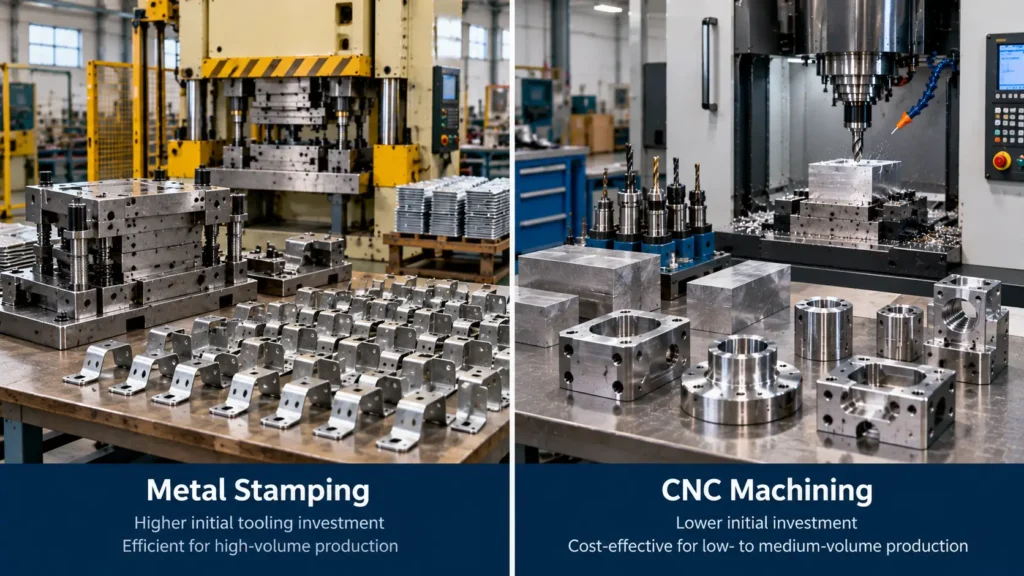
One of the most important differences between metal stamping and CNC machining is how manufacturing costs are distributed throughout a production program.
Metal stamping generally has a more front-loaded cost structure. A dedicated die must be designed, manufactured, tested, and qualified for the component. This tooling investment must be considered before production economics can be evaluated.
Tool Life, Maintenance and Long-Term Production Considerations
Factor
Metal Stamping
CNC Machining
Production Tool
Requires dedicated die designed for repeated cycles
Uses machining tools and fixtures
Maintenance
Die maintenance may be required during long production runs
Cutting tools and fixtures require replacement or adjustment
Cost Impact
Tool maintenance should be considered in long-term programs
Tooling cost is distributed through machining operations
Best Fit
Stable, repeat-production components
Flexible production with changing requirements
CNC machining generally avoids the dedicated production die required by stamping, but it still involves programming, setup, workholding, cutting tools, inspection, and machine time.
The important comparison is therefore not simply:
“Which process has the lower first-order price?”
Instead, OEM buyers should evaluate total program cost:
Initial tooling or setup investment + per-part manufacturing cost across the expected program quantity.
This is why the most economical process can change as expected production requirements change.
Cost Structure Comparison: Metal Stamping vs CNC Machining
Cost Factor
Metal Stamping
CNC Machining
Initial Investment
Higher upfront cost due to die design and manufacturing
Lower tooling investment but requires programming and setup
Unit Cost
Decreases significantly at higher production volumes
Usually remains influenced by machining time and operations
Material Cost
Efficient for properly designed sheet metal parts
Material waste may increase due to stock removal
Engineering Cost
Higher during tooling development stage
Higher during repeated programming and setup changes
Long-Term Cost
Often favorable for stable repeat-production programs
Often favorable for prototypes and lower-volume production
How to Calculate the Economic Break-Even Point
The economic crossover between stamping and CNC machining depends on project-specific tooling, setup, and per-part costs.
Rather than relying on a generic rule such as “CNC for low volume and stamping for high volume,” procurement teams can calculate a project-specific crossover point.
A useful conceptual framework is:
Break-Even Quantity = (Stamping Tooling Cost – CNC Initial Setup Cost) / (CNC Unit Cost – Stamping Unit Cost)
In this framework:
Stamping Tooling Cost represents the upfront investment required to design, manufacture, test, and qualify the stamping tooling.
CNC Initial Setup Cost represents project-specific programming, workholding, setup, and other initial manufacturing costs.
CNC Unit Cost is the quoted manufacturing cost per machined part.
Stamping Unit Cost is the quoted manufacturing cost per stamped part.
The result estimates the quantity at which the total cost of the two manufacturing routes becomes equal, assuming the quoted cost inputs remain applicable.
This is a decision framework, not a universal production threshold.
The crossover can change substantially with part geometry, material, tooling complexity, machining requirements, secondary operations, inspection requirements, and other project-specific factors.
Buyers should also evaluate expected lifetime program volume rather than focusing solely on the first purchase order. A recurring multi-year program may justify dedicated tooling differently from a one-time production requirement.
Part Geometry: Which Process Fits the Design?
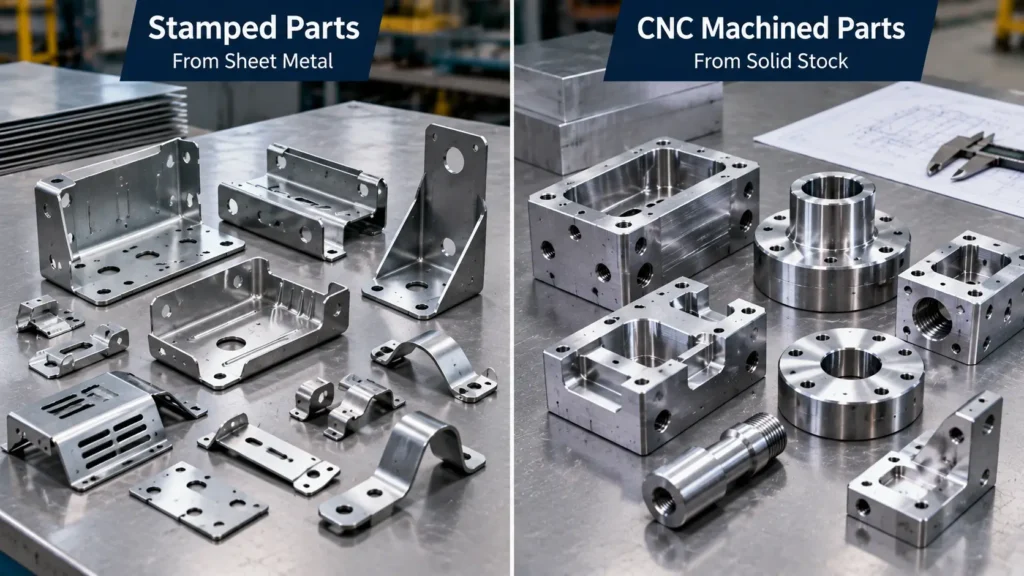
Stamped parts are typically designed around sheet-metal forming, while CNC machining accommodates many solid three-dimensional geometries.
Geometric feasibility is often the first technical filter in process selection. Not every machined component can be converted into a stamping, and not every sheet-metal-compatible part should be machined from solid stock.
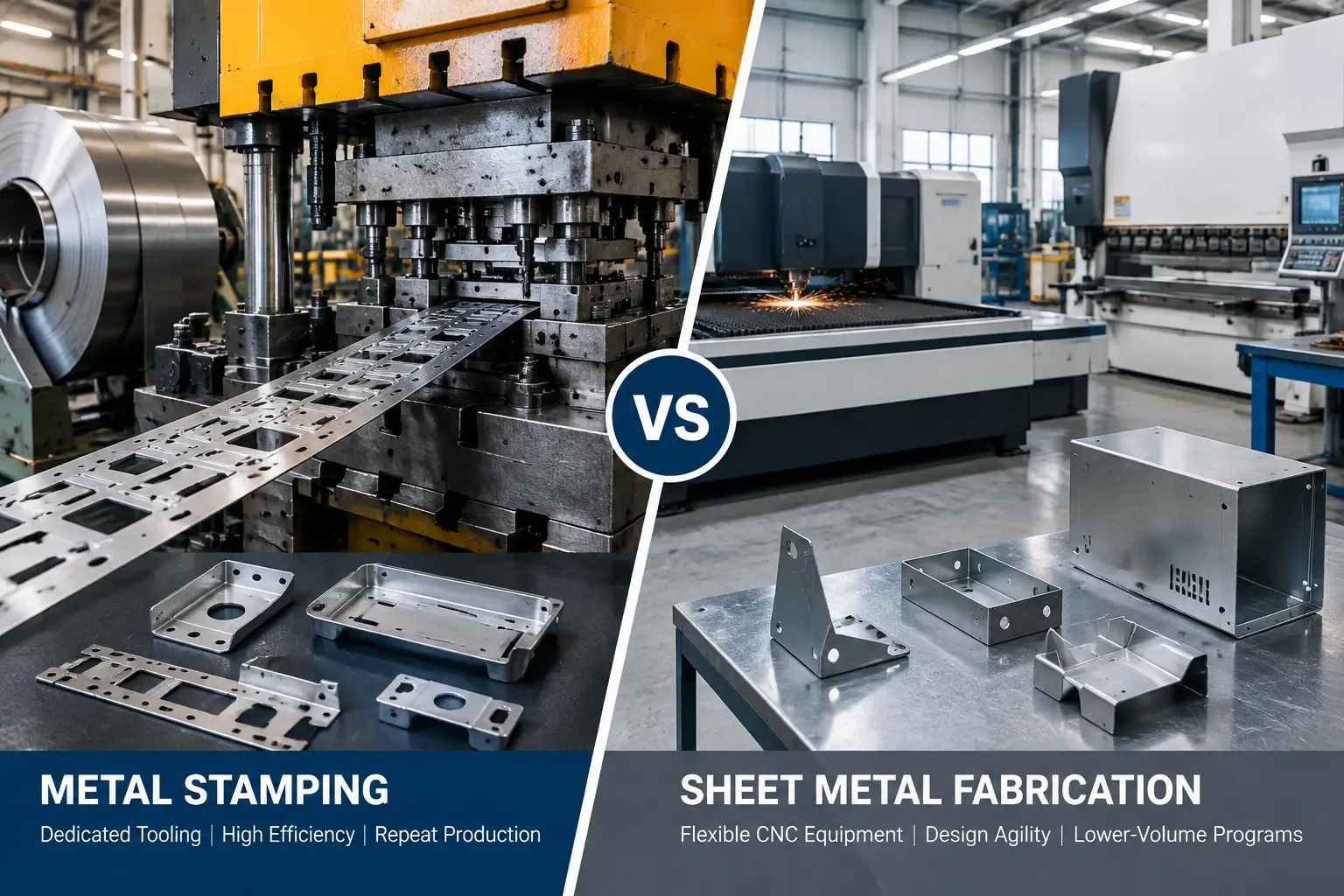
If the alternative route is conventional sheet metal fabrication rather than machining from solid stock, see our metal stamping vs sheet metal fabrication comparison.
Metal stamping naturally favors components that can be produced from sheet or coil material.
Typical features may include:
Bends and flanges Pierced holes and slots Cutouts and notches Formed ribs and dimples Drawn forms or shells Coined or embossed features
Material Utilization and Manufacturing Waste
Factor
Metal Stamping
CNC Machining
Material Usage
Uses sheet/coil material with optimized nesting
Removes material from stock
Waste Source
Scrap from blanking and nesting design
Chips from machining operations
Optimization Method
Strip layout and die design
Tool path and stock selection
Whether a particular geometry can be stamped depends on factors such as material behavior, thickness, bend requirements, feature spacing, forming severity, tooling strategy, and dimensional requirements.
CNC machining is naturally suited to many solid three-dimensional geometries.
Typical features may include:
Variable cross-sections Solid structural sections Pockets and cavities Machined bores Threads Contoured surfaces Features requiring controlled material removal
A component originally designed for machining may therefore require substantial redesign before it becomes suitable for sheet-metal forming.
Tolerance, Edge Quality and Critical Features
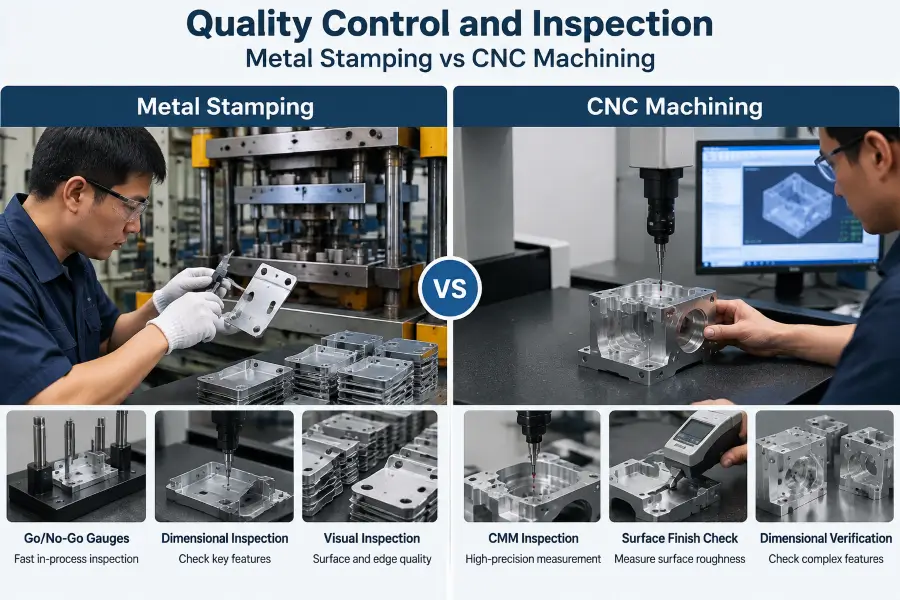
Quality Control and Inspection Considerations
Quality Factor
Metal Stamping
CNC Machining
Dimensional Control
Requires tooling stability, material control, and process monitoring
Controlled through machining parameters and inspection methods
Surface Condition
Depends on material, tooling, and forming process
Depends on cutting tools, speeds, feeds, and finishing operations
Tolerance should not be evaluated using a universal “stamping tolerance versus CNC tolerance” number.
Actual manufacturing capability depends on the material, part thickness, geometry, tooling, process sequence, setup, machine capability, inspection method, and the specific feature being controlled. For OEM projects with critical dimensional requirements, understanding practical metal stamping tolerances is essential before finalizing part drawings.
Metal stamping and CNC machining require different quality control methods based on part geometry, tolerance requirements, and production processes.
CNC machining can provide tight dimensional control and fine machined surfaces on features suited to subtractive manufacturing.
Metal stamping can maintain highly repeatable dimensions across production runs when the part, material, die design, and process are properly controlled.
However, mechanically sheared edges have characteristic conditions that differ from machined surfaces. Depending on the material and process, a stamped cut edge may include rollover, a shear zone, a fracture zone, and burr.
For many brackets, clips, electrical components, enclosures, and similar stamped parts, this edge condition may be entirely suitable for the application.
Other functional features may require additional operations. For example, a particular bearing interface, thread, sealing surface, or other critical feature may require reaming, tapping, machining, deburring, or another secondary process.
This does not mean stamped parts always require machining. Secondary operations should be determined from the actual drawing and functional requirements.
Production Speed and Scalability
Production throughput is another important difference between the two manufacturing routes.
CNC machining requires machine time for each component because cutting tools must follow programmed toolpaths and remove material operation by operation. Throughput therefore depends on geometry, material, setup, cutting parameters, and the number of machining operations required.
Metal stamping uses repeated press cycles after the tooling and material-feed process are established. For suitable repeat-production parts, this can provide substantially higher throughput than machining the complete geometry from solid stock.
The actual production-rate difference is project-specific and should be evaluated from the proposed manufacturing process rather than from a universal cycle-time assumption.
Design Changes and Engineering Flexibility
Product designs frequently evolve during development and sometimes continue to change after production begins.
This matters because CNC machining and metal stamping respond differently to engineering revisions.
Before stamping tooling is manufactured, drawing changes can be incorporated into the tooling design.
After the die has been built and qualified, however, some dimensional or geometric changes may require modification of physical tooling.
The impact depends on the change. A relatively localized feature change may require modification or replacement of a tooling component, while a major geometry change can affect multiple tooling operations or require more extensive rework.
CNC machining generally provides greater flexibility while a design is still evolving. Many changes can be addressed through updates to the CAD model, CAM program, machining sequence, cutting tools, or setup.
However, CNC changes are not necessarily cost-free. Workholding, inspection programs, cutting tools, process validation, and other manufacturing requirements may also need revision.
For products that remain under active engineering development, this flexibility can make CNC machining an appropriate manufacturing route before committing to dedicated production tooling.
When Metal Stamping Is Usually the Better Choice
Metal stamping becomes a strong candidate when several conditions align:
The component geometry is compatible with sheet or coil material. Expected repeat-production quantity can justify dedicated tooling. The design is sufficiently stable before tooling investment. Long-term unit economics are important. Production repeatability and scalability are important requirements. The required features can be produced through an appropriate stamping and secondary-operation strategy.
There is no universal production quantity at which these conditions automatically become true.
Tooling economics should be evaluated against the actual program requirements.
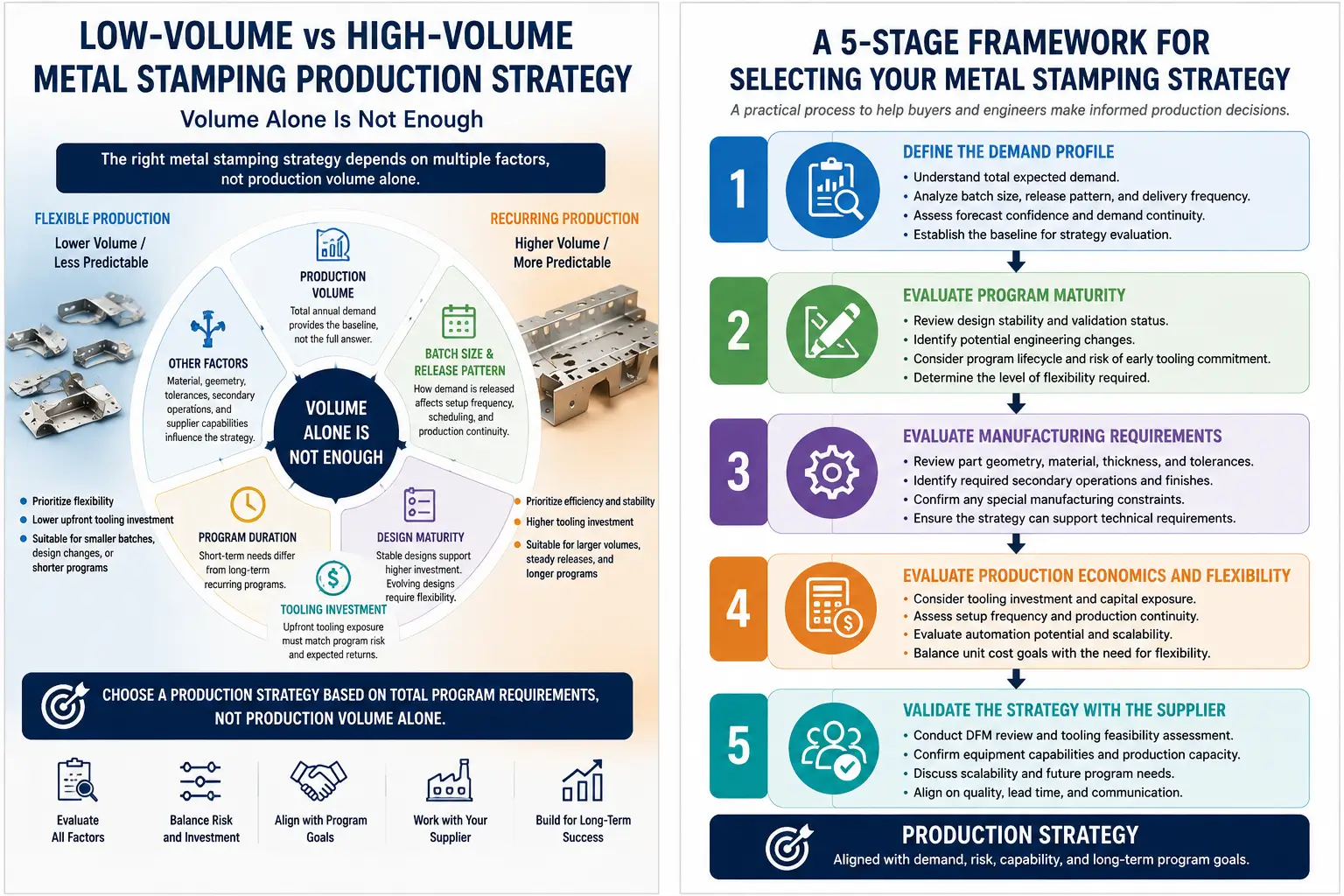
Once stamping has been selected as the manufacturing route, the next decision is which tooling and production strategy is appropriate.
When CNC Machining Is Usually the Better Choice
CNC machining may be the better choice when:
Production requirements do not justify dedicated stamping tooling. The component remains in a prototype or early development stage. Engineering changes are still expected. The geometry requires solid sections, variable cross-sections, pockets, cavities, or other features suited to material removal. Critical features require dimensional or surface characteristics better suited to machining. The design cannot reasonably be converted to sheet-metal forming without compromising function.
The decision should therefore be based on both engineering feasibility and program economics rather than production quantity alone.
Can a CNC Machined Prototype Be Converted to Metal Stamping?
Sometimes, but conversion is rarely a direct one-to-one process substitution.
A component designed specifically for CNC machining may contain geometry that does not translate directly into a stamped part.
Moving from machining to stamping can therefore require a Design for Manufacturability (DFM) redesign.
Important considerations include:
Wall Thickness
Machined parts can contain variable cross-sections and substantial solid features. A stamped design generally begins with sheet material of a defined thickness, so the geometry may need to be re-engineered accordingly.
Bend and Form Geometry
Features must be designed around the forming behavior of the selected material, including appropriate bend geometry and feature placement.
Structural Reinforcement
A machined solid feature may sometimes be replaced by formed ribs, flanges, embossments, or other sheet-metal reinforcement strategies, depending on structural requirements.
Assembly Strategy
In some applications, a solid machined component may be redesigned as multiple formed components that are subsequently joined.
Whether this produces better overall economics depends on tooling, production quantity, joining requirements, handling, inspection, and other manufacturing factors.
Design for Manufacturability Before Tooling
DFM review is particularly important before committing to dedicated stamping tooling.
The review should determine whether the proposed material, geometry, bend conditions, holes, formed features, tolerances, and secondary operations are compatible with the intended manufacturing strategy.
Resolving these issues before tooling is built reduces the risk of expensive engineering changes later in the program.
Hybrid Stamping and CNC Machining
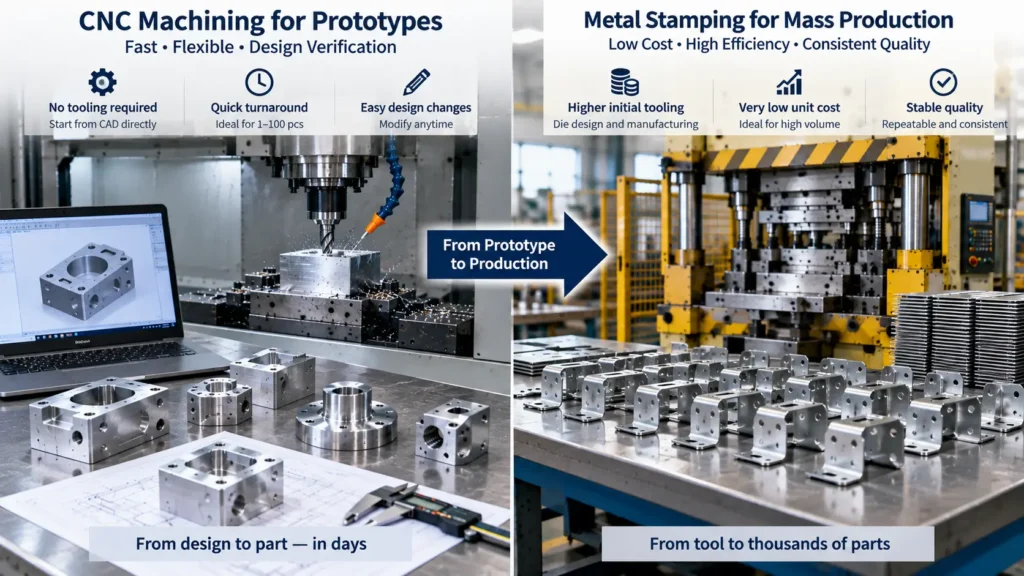
A CNC-machined prototype may require DFM redesign before its geometry can be produced efficiently through metal stamping.
Manufacturing does not always require an either-or choice.
Some components can use stamping for the primary geometry while selected functional features are produced through secondary machining.
For example, a stamped component may subsequently require machining, reaming, or tapping where a particular feature cannot be produced appropriately in the stamping sequence.
This approach can combine the repeat-production advantages of stamping with machining where selected functional features require it.
Whether a hybrid process improves total manufacturing economics depends on the part design, production quantity, tooling, secondary operations, and inspection requirements.
Metal Stamping vs CNC Machining: How OEM Buyers Should Decide
Manufacturing Process Selection Checklist
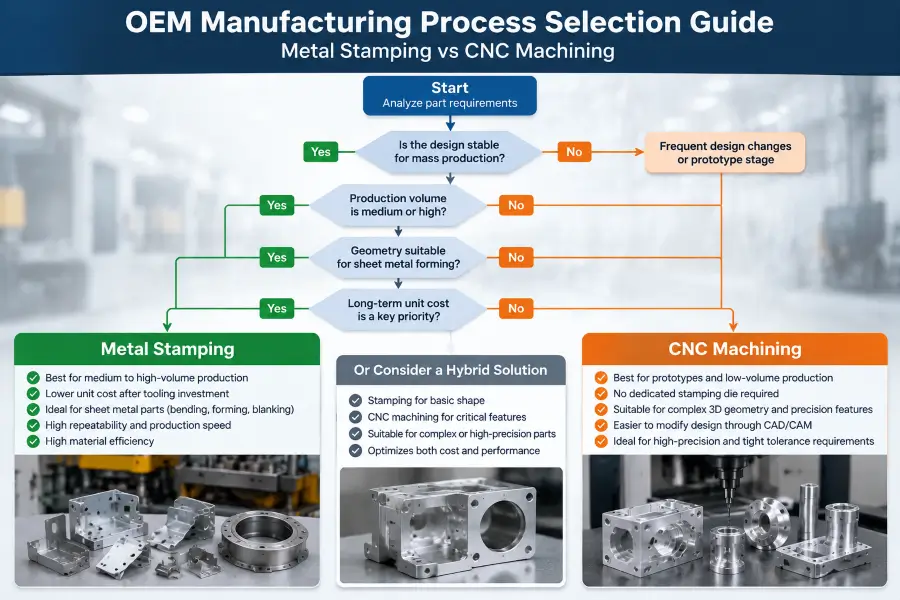
OEM buyers can select the appropriate manufacturing process by evaluating design stability, production volume, geometry, and long-term cost requirements.
Question
Consider Metal Stamping When
Consider CNC Machining When
Is the design stable?
Yes, production design is mature
No, design changes are expected
Production quantity?
Medium/high volume
Prototype or low volume
Part geometry?
Sheet metal forming compatible
Complex 3D geometry
Cost priority?
Long-term unit cost
Low initial investment
Engineering support?
DFM and tooling review available
Flexible programming required
A practical selection process can be organized into the following steps.
Step 1: Evaluate Geometric Compatibility
Start with the drawing or CAD model.
Determine whether the component can realistically be manufactured from sheet or coil material, or whether its functional geometry fundamentally requires material removal from solid stock.
Step 2: Define Expected Program Quantity
Do not evaluate only the first purchase order.
Estimate expected production requirements across the anticipated life of the program.
Step 3: Compare Total Program Costs
Obtain project-specific quotations for the realistic manufacturing alternatives.
Compare initial tooling or setup investment, per-part manufacturing cost, material, secondary operations, inspection requirements, and other relevant costs across the expected program quantity.
Use the break-even calculation to understand how the economics change as production quantity increases.
Step 4: Assess Design Maturity
Determine whether the component design is sufficiently stable for dedicated tooling.
If substantial engineering changes remain likely, the flexibility of CNC machining may reduce the risk of committing to tooling too early.
Step 5: Review Critical Features
Identify the features that control function.
Determine whether their tolerance, surface, geometry, thread, edge, or inspection requirements can be produced by stamping, require machining, or suggest a hybrid process.
Step 6: Request a DFM Review
Before releasing production tooling, review the drawing against the proposed manufacturing process.
If stamping is selected, the next step is determining the appropriate tooling architecture and production strategy.
Frequently Asked Questions
Is metal stamping always cheaper than CNC machining?
No. Metal stamping can achieve favorable per-part economics when a suitable component is produced in sufficient quantity to amortize the required tooling. CNC machining may remain more economical when quantities are limited, the design is still changing, or the geometry is better suited to machining.
At what production volume does metal stamping become cheaper than CNC machining?
There is no universal volume threshold. The crossover depends on tooling investment, CNC setup cost, unit prices, geometry, material, secondary operations, inspection requirements, and expected lifetime quantity. Buyers should calculate the break-even point using project-specific quotations.
Can a CNC machined prototype be converted to a stamped part?
Sometimes. The component must first be evaluated for sheet-metal-forming feasibility. Conversion may require changes to wall thickness, bends, reinforcement features, material, tolerances, or assembly strategy.
Can stamped parts still require CNC machining?
Yes. Some stamped components use secondary machining for selected critical features. Whether this is necessary depends on the drawing and functional requirements.
Which process is better for complex geometry?
It depends on the type of complexity. CNC machining is well suited to many solid three-dimensional features created through material removal. Metal stamping is well suited to many sheet-metal geometries involving cutting and forming operations. The drawing must be evaluated to determine which manufacturing approach fits the actual geometry.
Conclusion
Choosing between metal stamping and CNC machining comes down to matching the component’s technical requirements with the economics of the complete production program.
CNC machining generally provides greater flexibility for changing designs and for geometries naturally suited to subtractive manufacturing.
Metal stamping can provide high repeatability and favorable production economics when the part geometry is suitable and the tooling investment can be justified across the expected program quantity.
The correct decision should therefore come from the drawing, design maturity, expected lifetime quantity, tooling requirements, unit quotations, and functional requirements—not from a generic volume rule.
If you are evaluating a new part or considering whether an existing CNC-machined component could be redesigned for repeat-production stamping, request a DFM review and project quotation from Metal Stamp Factory.