Founder of Metal Stamp Factory with more than 25 years of hands-on experience in tooling development, metal stamping, and OEM production.
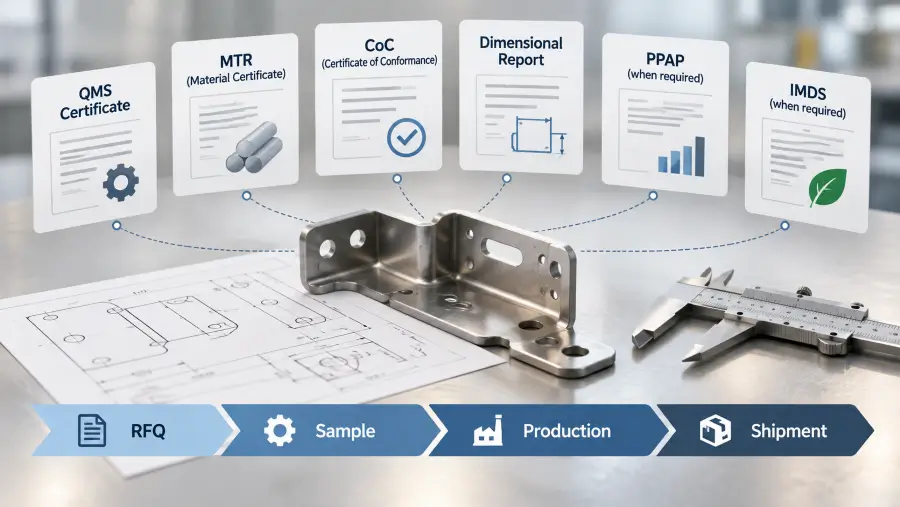
When sourcing custom metal stamped components, procurement engineers, OEM buyers, and supplier quality teams face a common administrative temptation: requesting every possible quality record, test report, and compliance document for every part number. In practice, blanketing a Request for Quotation (RFQ) with universal documentation demands can add cost, delay review, and create administrative work without necessarily improving project control.
Effective metal stamping procurement relies on structured metal stamping supplier documentation planning. Different parts serve different industrial contexts. A structural automotive bracket, an electrical copper contact, a commercial appliance enclosure, and a medical device component carry distinct risk profiles, material specifications, and regulatory expectations. Rather than applying a one-size-fits-all paperwork checklist, buyers should select compliance documents based on engineering drawings, material specifications, customer-specific requirements, end-use application, purchase order terms, and the exact sourcing stage.
Compliance Documents for Metal Stamping: Quick Decision Matrix
The following decision matrix outlines the primary compliance records encountered during custom metal stamping procurement, their typical origin sources, what they support, their limitations, and the stage at which they are typically managed.
Table 1: Metal Stamping Compliance Document Matrix
| Document / Record | Typical Source | What It Supports | What It Does Not Replace | Typical Stage |
|---|---|---|---|---|
| QMS Certificate | Certification body | Evidence that a defined quality management system, site, and scope have been assessed against the applicable standard. | Part-level drawing verification, MTRs, CoCs, or PPAP packages. | RFQ / Onboarding |
| MTR / Material Certificate | Material producer or documented supply-chain source | Raw-material identification and available test information where applicable. | Finished-part dimensional inspection, CoCs, or secondary-process records. | Material Planning |
| Certificate of Conformance (CoC) | Supplier or manufacturer | Supplier or manufacturer declaration against an identified scope of order, drawing, or specification requirements. | Raw-material test data, dimensional reports, or independent test results. | Shipment |
| Dimensional Inspection Report | Manufacturer or inspection resource | Measured part features against applicable drawing and tolerance requirements. | Raw-material evidence, QMS certification, or a customer-required PPAP submission. | Sample / Production |
| First Article / Sample Inspection Record | Manufacturer or inspection resource | Initial sample measurement evidence against agreed drawing requirements. | Ongoing production records or a customer-required PPAP package. | Sample Approval |
| PPAP Package | Supplier submission to customer | Production-approval evidence defined by the applicable customer or program requirements. | Ongoing inspection, shipment declarations, or unrelated compliance records where separately required. | Pre-Production |
| IMDS Submission | Responsible supply-chain party | Automotive material and substance reporting through IMDS where required. | MTRs, CoCs, dimensional inspection, or QMS certification. | Pre-Production |
| REACH / RoHS Documentation | Supplier, material source, or external test source depending on the evidence | Support for applicable substance-compliance evaluation. | Dimensional inspection, QMS certification, or material test data unrelated to substance requirements. | RFQ / Review |
| Secondary-Process Record | Relevant plating, coating, heat-treatment, or other processor | Documentation related to the specified secondary operation where required. | Base-material records, dimensional inspection, or supplier QMS certification. | Production |
| External Test Report | External laboratory or inspection resource | Independent test results for the specified test scope. | Routine dimensional inspection, MTRs, or supplier QMS certification. | Validation |
Start with the Project Requirement, Not a Generic Document Checklist
Establishing an effective quality plan begins by evaluating the technical and regulatory requirements of the component itself. A commercial enclosure stamped from standard commercial steel requires a different documentation approach than a functional component subjected to high mechanical loads or specialized environmental exposure.
Procurement teams should review drawing notes, material callouts, industry standards, and end-use environments before defining required deliverables. Aligning documentation expectations with actual risk ensures that suppliers focus on critical parameters—such as material grade, critical dimensions, and coating thickness—rather than compiling redundant paperwork.
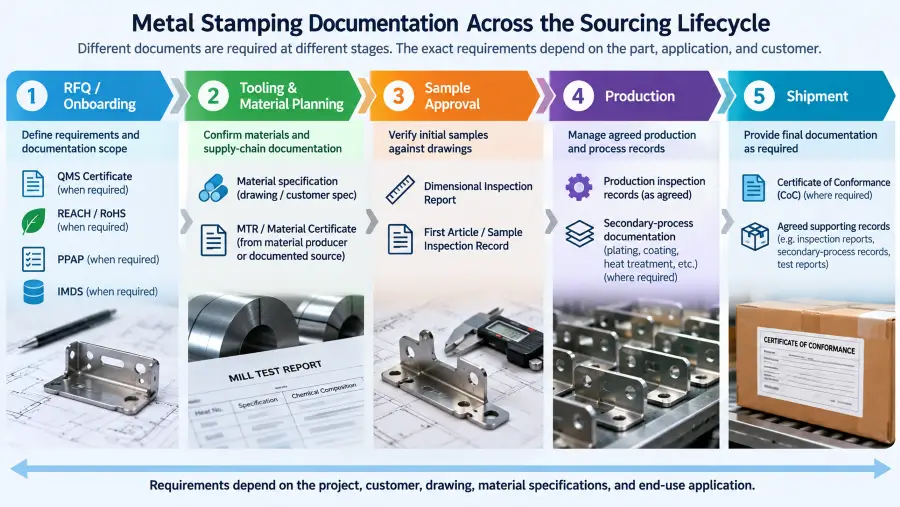
Which Documents Should Be Defined During the RFQ Stage?
Clarifying documentation expectations during the initial RFQ and supplier selection stage prevents misunderstandings after tooling is cut or production orders are placed. Sourcing teams should define the following elements during bid review:
- QMS Certification Requirements: Whether the project requires a specific quality management system certification (such as ISO 9001, IATF 16949, or AS9100) as a supplier-qualification condition.
- Material Certification Expectations: Whether Mill Test Reports (MTRs) or other material certificates are required for each applicable production lot.
- Substance Compliance Expectations: Whether REACH, RoHS, or other material declarations must be provided.
- Pre-Production Approval Requirements: Whether a PPAP submission, first-article or sample inspection record, or another customer-specific approval package is required.
- Database Reporting Requirements: Whether an IMDS (International Material Data System) submission is required prior to production release.
- Sample Inspection Protocols: The format and scope required for initial sample inspection reports.
- Specialized Testing: Whether independent testing or inspection must be coordinated for a defined chemical, mechanical, coating, corrosion, or other requirement.
- Secondary-Process Documentation: Requirements for plating, coating, passivation, heat-treatment, painting, or other outsourced-process records.
- Customer-Specific Forms: Any specialized forms, supplier portals, or formatting rules mandated by the purchasing organization.
Material Documentation: MTRs and Material Certificates
Mill Test Reports (MTRs) or material certificates provide raw-material identification and available test information from the material producer or documented supply chain. The exact content depends on the material, specification, and record supplied for the coil, sheet, strip, or other stock used for stamping.
- What They Support: Reviewing material identification and available test information against the specified material requirements.
- What They Do Not Support: MTRs do not verify post-stamping dimensional accuracy, tool forming execution, or secondary electroplating properties.
- Procurement Rule: Request MTRs or material certificates when required by the drawing, material specification, customer requirement, or purchase order rather than assuming they are necessary for every stamped part.
Certificates of Conformance (CoCs)
A Certificate of Conformance (CoC) is a written declaration issued by the supplier or manufacturer against an identified scope of purchase-order, drawing, specification, or other agreed requirements.
- What They Support: Providing a shipment- or order-specific supplier declaration tied to the identified requirements and traceability information included on the document.
- What They Do Not Support: A CoC is a declaration, not a test report. It does not automatically provide raw material chemical breakdowns or detailed dimensional inspection data unless those records are attached or explicitly referenced.
- Procurement Rule: Define the exact scope of the CoC during RFQ planning to ensure it matches purchase order requirements.
Dimensional Inspection and First-Article Records
Dimensional inspection records and first-article or sample inspection records provide measured evidence for selected part features against the applicable drawing and tolerance requirements.
- What They Support: Reviewing measured part geometry during tooling trials, sample approval, or production inspection.
- Important Distinction: Ordinary first-article or sample inspection records used in commercial contract manufacturing may document measured features using conventional tools such as vernier calipers, micrometers, and height gauges. They are not equivalent to an AS9102 aerospace First Article Inspection package unless that specific requirement has been separately agreed and supported.
- Procurement Rule: Clarify inspection reporting formats and sample sizes during RFQ review.
PPAP: When Production Approval Is Required
PPAP for metal stamping parts is a structured production-approval process used where required by the applicable customer or program.
- Project-Specific Scope: PPAP is commonly associated with automotive supply chains and may also be required in other programs when specified by the customer. It is not universally required for every custom metal stamping project.
- Submission Levels and Elements: The required submission level and supporting elements depend on the customer or program requirements.
- What PPAP Does Not Do: A PPAP submission does not automatically replace ongoing production inspection records, material documentation, or shipment-specific declarations where those are separately required.
IMDS, RoHS, and REACH Documentation
Material compliance documentation tracks chemical substances and restricted materials within manufactured components.
- IMDS Submissions: See IMDS for metal stamping parts for the dedicated guide. IMDS is used where required in automotive supply chains to report material and substance information through the IMDS system.
- REACH and RoHS Documentation: See REACH compliance for metal stamping parts and RoHS compliance for stamped metal components for dedicated guidance. Supporting documentation or supplier statements may be provided where requested to assist customers in evaluating substance restrictions.
- Procurement Rule: These records support material or substance reporting and compliance evaluation; they do not replace dimensional inspection, material-strength evidence, or QMS certification.
Quality Management System Certificates
ISO 9001 vs IATF 16949 vs AS9100 explains the supplier-qualification differences in more detail. Quality management system standards—such as ISO 9001, IATF 16949, and AS9100—establish the organizational frameworks that manufacturers use to control processes, maintain document control, manage corrective actions, and address customer requirements.
- Supplier-Level Qualification: QMS certificates apply to the organization, site, and defined operational scope.
- What They Do Not Do: Holding a QMS certificate does not certify individual stamped parts, nor does it guarantee that every production lot is free of non-conformances. Procurement teams must evaluate QMS certification as a supplier-vetting criterion separate from part-level quality verification.
Who Actually Generates Each Record?
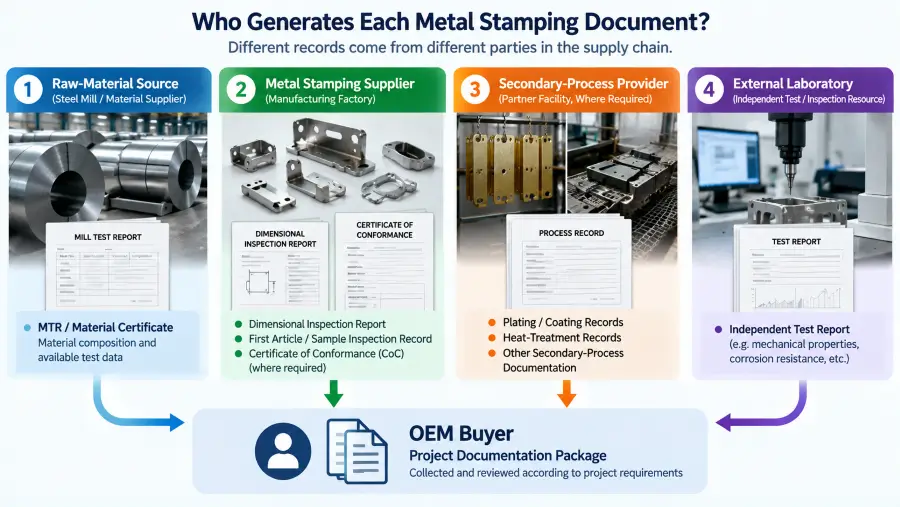
Understanding the origin of compliance documents prevents administrative confusion and clarifies accountability across the supply chain:
- Raw-Material Source: Provides MTRs or material certificates for raw coil, sheet, strip, or other stock where available and required.
- Metal Stamping Supplier: May prepare dimensional inspection records, first-article or sample inspection records, Certificates of Conformance (CoCs), and other project-specific supplier records.
- Secondary-Process Provider: May provide plating, passivation, heat-treatment, coating, or other process records where those records are required and available.
- External Laboratory / Inspection Resource: Provides independent test or inspection reports for the specifically commissioned scope.
What Compliance Documents Cannot Replace
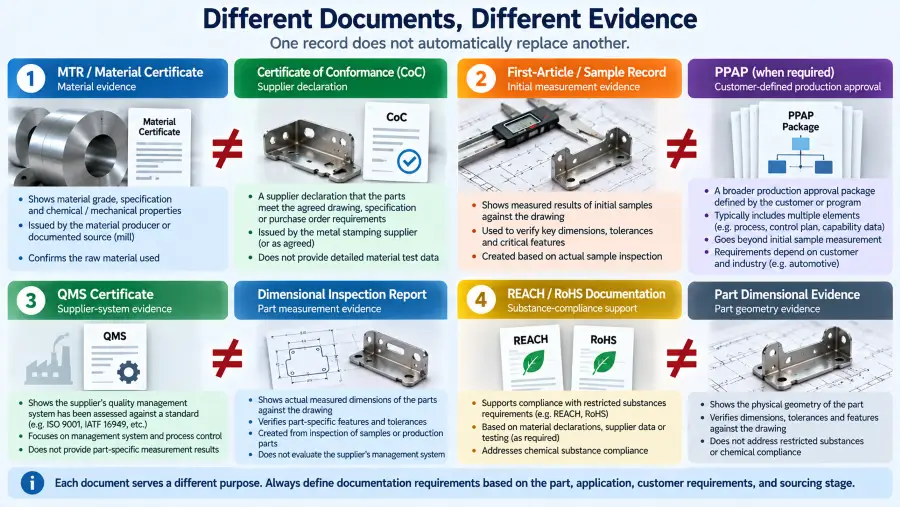
Procurement errors frequently occur when buyers assume one document can substitute for another. The following boundaries should guide documentation planning:
- MTR vs. CoC: An MTR and a CoC serve different purposes and should not be treated as automatic substitutes for one another. For a deeper comparison, see Certificate of Conformance vs Mill Test Report.
- QMS Certificate vs. Dimensional Inspection: A QMS certificate does not automatically replace part-specific dimensional inspection evidence.
- First Article Inspection vs. PPAP: A first-article or sample inspection record does not substitute for a customer-required PPAP submission.
- PPAP vs. Ongoing Records: PPAP approval does not automatically replace ongoing production records or shipment-specific declarations where separately required.
- Substance Documentation vs. Part Conformance: REACH- or RoHS-related documentation supports substance-compliance evaluation; it does not verify drawing dimensions or unrelated mechanical properties.
- IMDS vs. Quality Records: An IMDS submission supports automotive material-data reporting; it does not replace MTRs, CoCs, dimensional inspection, or QMS certification.
Documentation for Outsourced Secondary Processes
Many custom metal stamping projects require secondary surface treatments—such as electroplating, powder coating, heat treatment, or painting—to meet drawing specifications. Because specialized finishing operations are coordinated through partner facilities where required, documentation for these processes requires careful planning:
- Tracing Finish Data: Finishing certificates, processing sheets, or test records from the relevant provider may document specified secondary-process requirements such as plating thickness or passivation type.
- Supplier Coordination: Where applicable, the stamping supplier can coordinate the outsourced process and review available partner documentation against the specified project requirements.
- Procurement Rule: Buyers should specify finishing standards and required documentation (such as plating thickness verification or coating certs) during the RFQ stage so finishing partners can prepare the necessary records.
What Can Metal Stamp Factory Provide or Coordinate?
Metal Stamp Factory is the export brand of Xiamen Yichong Precision Hardware Manufacturing Co., Ltd., based in Xiamen, China. Established in 2014, the business focuses on drawing-driven custom metal stamping and OEM production.
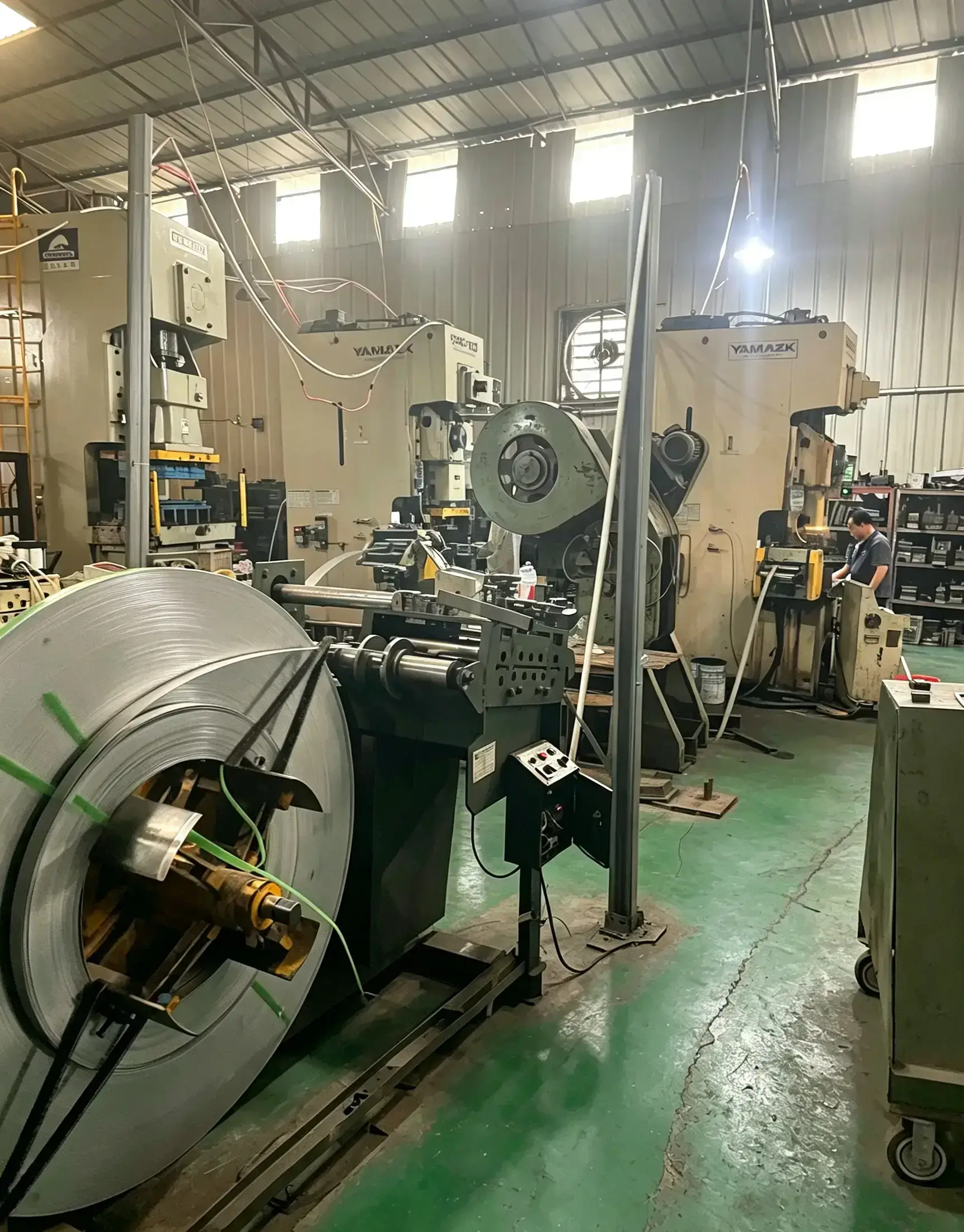
Our in-house operations include custom metal stamping capabilities, progressive die stamping, punching, forming, bending, tooling design, complete die assembly, die tryout, and production process adjustment. Individual die components requiring CNC machining, wire EDM, or other specialized machining operations are produced by external machining partners based on our tooling designs. After the machined components return, our team completes die assembly, installs the tooling on our stamping presses, conducts test production, and adjusts the tooling and process before production is finalized.
Secondary finishing operations, including electroplating, powder coating, painting, and heat treatment, are coordinated through partner facilities where required.
To support customer documentation requirements on a project-by-project basis, our general project workflow may include:
- Reviewing customer engineering drawings, material specifications, and dimensional tolerances during initial project evaluation.
- Reviewing available supplier Mill Test Reports or material certificates from raw-material sources where provided.
- Preparing first-article and dimensional inspection records using conventional measuring tools, including vernier calipers, micrometers, and height gauges. Periodic production sampling can also be performed according to the agreed inspection requirements to monitor dimensional consistency and identify potential changes associated with tooling wear.
- Preparing supplier declarations or Certificates of Conformance (CoCs) where required against an agreed scope.
- Coordinating secondary operations—such as electroplating, powder coating, heat treatment, and painting—through partner facilities where required.
- Coordinating independent testing through external laboratories or inspection resources when specified by the customer.
Important Operational Boundaries:
- PPAP requirements, submission level, and required elements depend on the customer or program and should be confirmed during RFQ review.
- IMDS submission responsibility, required data, and routing should be confirmed during RFQ review for applicable automotive projects.
- Aerospace-specific FAI requirements, including AS9102 where applicable, should not be assumed unless separately specified and supported.
- Metal Stamp Factory is NOT currently certified to ISO 9001, IATF 16949, or AS9100. If a project contractually requires QMS certification as a mandatory supplier-qualification condition, buyers must identify that requirement during RFQ review before tooling or production commitments are made.
Common Documentation Mistakes OEM Buyers Should Avoid
- Requesting Every Document by Default: Blanketing RFQs with universal paperwork demands that do not align with part risk or application requirements.
- Defining Documentation After Tooling Starts: Introducing compliance requirements after progressive dies are cut and trial samples are produced.
- Confusing Issuer and Source: Assuming a stamping factory generates raw material mill test reports or independent laboratory test data.
- Treating an MTR as a CoC: Expecting a raw steel coil certificate to serve as a finished-part shipment declaration.
- Treating an FAI as a PPAP: Assuming a standard dimensional sample report fulfills formal automotive PPAP requirements.
- Treating QMS Certification as Part Approval: Believing that a supplier’s quality management system certificate eliminates the need for part-level drawing inspection.
- Ignoring Outsourced-Process Documentation: Failing to specify plating, coating, or heat-treat documentation requirements before production begins.
- Adding Special Test Requirements Too Late: Requesting specialized third-party laboratory testing after manufacturing is already underway.
Master OEM Buyer Documentation Checklist
Procurement and quality teams can use this structured checklist across the sourcing lifecycle:
RFQ Stage
- Identify program-level QMS certification requirements (ISO 9001, IATF 16949, AS9100, or whether certification is not a mandatory supplier-qualification condition).
- Review drawing notes and technical specifications for mandatory material standards and finishing callouts.
- Determine whether PPAP, IMDS, REACH, RoHS, or other project-specific documentation is required by the customer, market, program, or contract.
- Clarify inspection reporting formats and sample submission expectations.
Tooling & Material Planning Stage
- Verify raw-material specifications and confirm whether MTRs are required for production lots.
- Review tooling design and manufacturing feasibility against drawing tolerances.
- Confirm the material documentation source and availability where traceability or certification is required.
Sample Approval Stage
- Inspect agreed sample features against the applicable drawing and tolerance requirements using suitable measuring equipment.
- Review first-article / sample inspection reports against the agreed drawing and inspection requirements.
- Submit preliminary documentation packages for customer evaluation.
Production Stage
- Coordinate outsourced secondary processes (plating, coating, heat treatment) with partner facilities.
- Review available secondary-process records against applicable drawing callouts and project requirements.
- Maintain agreed production inspection records where required by the project.
Shipment Stage
- Issue Certificates of Conformance (CoCs) matching purchase order numbers and part revisions where required.
- Attach required MTRs, dimensional reports, or secondary process certs to the shipment documentation package.
- Confirm that all customer-specific delivery and portal requirements are satisfied.
Technical & Sourcing Consultation
If your engineering or procurement team is planning a new custom metal stamping project and needs to evaluate manufacturing feasibility, material specifications, tooling requirements, or project-specific documentation deliverables, send us your engineering drawings and quality requirements. Our technical team can review your specifications and documentation expectations before production planning begins.
Common Questions About Metal Stamping Supplier Documentation
What compliance documents should an OEM buyer request from a metal stamping supplier?
OEM buyers should request documentation based on the part drawing, material specification, end-use application, customer requirements, purchase-order terms, and sourcing stage. Depending on the project, this may include CoCs, MTRs or material certificates, dimensional inspection records, first-article or sample inspection records, secondary-process documentation, and program-specific deliverables such as PPAP or IMDS.
Does every metal stamping order require an MTR and CoC?
No. Whether an MTR, CoC, both, or neither is required depends on the drawing, material specification, customer requirements, purchase-order terms, and agreed documentation plan for the project.
Who should provide the material certificate for stamped metal parts?
Raw-material MTRs or material certificates originate from the material producer or documented supply chain. Where required and available, the stamping supplier can pass the relevant material documentation to the buyer as part of the project records.
Can a Certificate of Conformance replace a Mill Test Report?
Not automatically. A CoC is a supplier or manufacturer declaration against an identified scope of requirements, while an MTR or material certificate provides raw-material identification and available test information. The two records serve different purposes.
Is a First Article Inspection report the same as PPAP?
No. A first-article or sample inspection record provides measured evidence for the agreed initial part features. A PPAP submission is a broader production-approval package whose required level and elements depend on the applicable customer or program.
When should PPAP, IMDS, REACH, or RoHS documentation be specified?
These requirements should be identified as early as possible during RFQ and supplier review. Whether they apply depends on the customer, market, program, product, regulatory obligations, and contract rather than being universal for every stamping project.
What documentation can a metal stamping supplier provide for outsourced plating, coating, or heat treatment?
For outsourced secondary processes coordinated through partner facilities, the stamping supplier may obtain and pass along available finishing certificates, processing sheets, or test records from the relevant provider where those documents are required for the project.