Founder of Metal Stamp Factory with more than 25 years of hands-on experience in tooling development, metal stamping, and OEM production.
When procurement teams source custom hardware for global products, a generic statement like “RoHS compliant” is rarely enough to pass a quality audit. For an OEM buyer, ensuring RoHS compliance for stamped metal components requires looking beyond general supplier assurances and understanding how European Union chemical restrictions apply to physical hardware.
The Restriction of Hazardous Substances (RoHS) Directive focuses on electrical and electronic equipment (EEE), and its requirements are commonly passed down through the supply chain to component suppliers. When a stamped component is intended for equipment within the RoHS scope, the buyer must consider the relevant homogeneous materials in the finished configuration rather than treating the part as one undifferentiated mass. This can include the metal substrate together with plating, passivation, paint, or other added material layers.
Establishing clear compliance evidence depends on matching the documentation to the actual finished component configuration. While a raw material certificate from a steel or copper mill provides essential substrate composition data, it does not automatically cover secondary finishing processes applied later in production. OEM buyers must know what documentation to request, how to evaluate supplier declarations, and how to define compliance expectations before tooling is released.
RoHS Compliance for Stamped Metal Components: Quick Answer
RoHS compliance for stamped metal components is evaluated at the homogeneous material level rather than the total weight of the finished part. Restricted substances—including lead, mercury, cadmium, hexavalent chromium, specific flame retardants, and phthalates—must not exceed the applicable maximum concentration values in each relevant homogeneous material.
A Mill Test Certificate (MTC) supports the chemical composition of the base metal substrate, but it does not prove compliance for secondary plating, conversion coatings, or paint. OEM buyers must verify that both the base alloy and all applied surface finishes meet the applicable restrictions under Directive 2011/65/EU as amended by Directive (EU) 2015/863, backed by traceable supplier declarations and technical documentation.
Table 1: RoHS Quick Reference for OEM Buyers
| Compliance Question | Legal / Technical Reality | Practical Impact for OEM Buyers |
|---|---|---|
| Does RoHS apply to every stamped metal part? | No. RoHS applies to EEE within its legal scope. A mechanical component used outside that scope is not automatically subject to RoHS, although a customer may still impose RoHS requirements contractually. | Buyers must confirm the end-use and whether RoHS requirements need to be passed down to component suppliers. |
| What is the legal assessment basis? | Concentration limits are calculated per homogeneous material, not per finished component weight. | Thin plating, coating, and other distinct material layers may need separate homogeneous-material evaluation rather than being averaged into the total part weight. |
| What is the standard concentration limit? | 0.1% by weight (1,000 ppm) for 9 of the 10 restricted substances. | Most restricted substances must remain at or below 0.1% w/w in every homogeneous layer. |
| What is the concentration limit for Cadmium? | 0.01% by weight (100 ppm). | Cadmium carries a much stricter concentration ceiling than lead, mercury, or hexavalent chromium. |
| Does a raw material MTC prove finished part compliance? | No. An MTC covers only the unformed raw sheet or coil substrate. | Secondary surface treatments (zinc plating, chromate passivation, paint) require separate finishing compliance evidence. |
| Is third-party lab testing mandatory for every shipment? | No. RoHS does not establish a universal requirement for third-party testing of every batch or shipment. | Analytical testing can be used as supporting evidence when risk, documentation gaps, or customer requirements justify it. |
| Are plating and coatings relevant to RoHS? | Yes. Metallic plating, conversion films, and organic coatings may represent distinct homogeneous materials that need to be considered separately. | Restricted substances in passivation, coating, or other added material systems can affect the finished-part review. |
| Can exemptions apply? | Yes. RoHS includes exemptions that may permit certain uses of restricted substances under defined conditions. | If an exemption is relied upon, identify the exact exemption and verify its applicability and current status. |
Does RoHS Apply to Every Stamped Metal Component?
No. RoHS is not a blanket requirement for every metal stamping simply because the part is made from metal or supplied to an OEM. The Directive applies to electrical and electronic equipment (EEE) within its scope, while component-level requirements are commonly passed down through drawings, purchase specifications, supplier agreements, and technical documentation. For OEM buyers managing multiple regulatory requirements, RoHS should be considered within the broader framework of metal stamping certifications and compliance requirements.
A purely structural or mechanical stamping used in a non-EEE application is not automatically subject to RoHS. By contrast, a stamped bracket, terminal, shield, or contact intended for an electrical appliance, industrial control equipment, telecommunications equipment, or other applicable EEE may need to meet the OEM’s RoHS requirements as part of the finished product compliance process.
Because a custom metal stamping supplier normally works from the buyer’s drawing and specification, the supplier may not know the final regulatory status of the end product unless the buyer states it. RoHS requirements should therefore be defined before quotation and tooling release rather than added only at shipment.
Buyer Note
A RoHS request should define more than “RoHS compliant.” The buyer should identify the end-use, exact base material, surface finish, applicable directive requirement, required supplier documentation, and whether any exemption or testing evidence is expected.
What Does “Homogeneous Material” Mean Under RoHS?
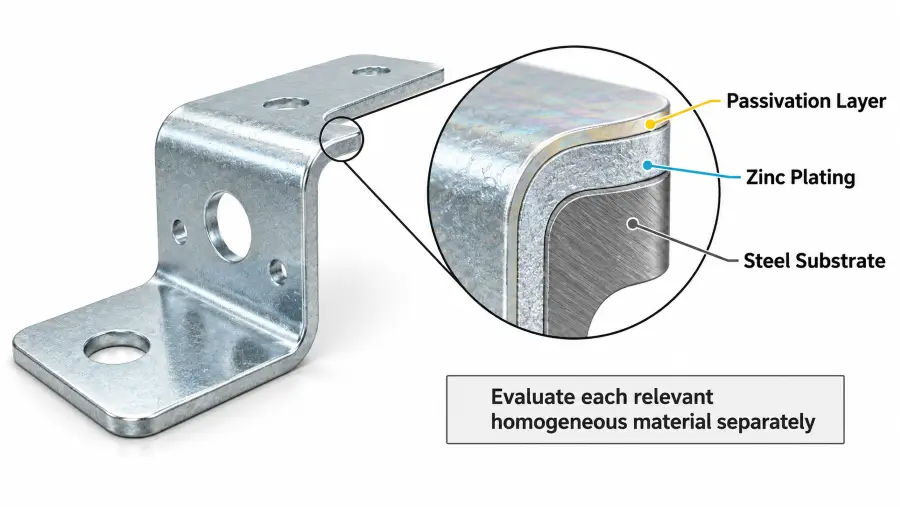
The foundation of RoHS evaluation is the concept of homogeneous material. Directive 2011/65/EU defines a homogeneous material as a material of uniform composition throughout, or a combination of materials that cannot be mechanically disjointed into different materials by actions such as unscrewing, cutting, crushing, grinding, or abrasive processes.
Why the Whole Part Weight Is Not the Denominator
The concentration limit is not calculated by averaging a restricted substance across the total weight of a finished stamping. A heavy steel substrate cannot be used to dilute the concentration of a restricted substance present in a separate plating or coating material.
For OEM buyers, the practical question is therefore not only “What is the part made from?” but also “What distinct materials remain in the finished configuration?” A plated or coated stamping may contain more than one homogeneous material, and each relevant material must be considered against the applicable RoHS concentration limit.
How This Applies to Stamped and Plated Parts
The examples below show how common stamped components may contain one or more relevant material layers in the finished configuration.
| Component Description | Typical Finished Construction | Materials to Consider in the RoHS Review |
|---|---|---|
| Bare Brass Terminal | Unplated brass stamping | Brass substrate |
| Nickel-Plated Brass Terminal | Brass substrate with nickel plating | Brass substrate + nickel-plated surface layer |
| Zinc-Plated Steel Bracket | Steel substrate with zinc finish and, where applicable, a conversion/passivation system | Steel substrate + zinc layer + relevant conversion/passivation material where applicable |
| Painted Stamped Enclosure | Formed sheet metal with pretreatment and organic coating | Metal substrate + relevant pretreatment/coating materials |
The exact homogeneous-material breakdown depends on the actual finish system and how the materials can be mechanically separated. The buyer should therefore review the specified finished construction rather than rely on a generic process name.
Manufacturing Note
A plated stamped part should not be treated as one undifferentiated material. For example, a brass terminal with nickel plating includes the brass substrate and the plated surface layer, and each relevant homogeneous material should be considered separately when reviewing RoHS concentration limits.
What Are the RoHS Restricted Substances and Concentration Limits?
Under Directive 2011/65/EU as amended by Directive (EU) 2015/863, ten restricted substances have maximum concentration values at the homogeneous-material level.
Table 3: RoHS Restricted Substances and Concentration Thresholds
| Restricted Substance | Chemical Symbol / Abbreviation | Maximum Concentration Value (MCV) | Typical Relevance to Stamped Components |
|---|---|---|---|
| Lead | Pb | 0.1% by weight (1,000 ppm) | May be relevant in certain metal alloys or solder-related materials. |
| Mercury | Hg | 0.1% by weight (1,000 ppm) | Generally low relevance to conventional metal stampings; review where project-specific materials require it. |
| Cadmium | Cd | 0.01% by weight (100 ppm) | May be relevant to certain plating/coating systems or material impurities. |
| Hexavalent Chromium | Cr(VI) | 0.1% by weight (1,000 ppm) | Relevant to some conversion/passivation systems. |
| Polybrominated Biphenyls | PBB | 0.1% by weight (1,000 ppm) | More relevant where polymeric, organic, insulating, adhesive, or coating materials are included. |
| Polybrominated Diphenyl Ethers | PBDE | 0.1% by weight (1,000 ppm) | More relevant where polymeric, organic, insulating, adhesive, or coating materials are included. |
| Bis(2-ethylhexyl) phthalate | DEHP | 0.1% by weight (1,000 ppm) | More relevant where polymeric, organic, insulating, adhesive, or coating materials are included. |
| Butyl benzyl phthalate | BBP | 0.1% by weight (1,000 ppm) | More relevant where polymeric, organic, insulating, adhesive, or coating materials are included. |
| Dibutyl phthalate | DBP | 0.1% by weight (1,000 ppm) | More relevant where polymeric, organic, insulating, adhesive, or coating materials are included. |
| Diisobutyl phthalate | DIBP | 0.1% by weight (1,000 ppm) | More relevant where polymeric, organic, insulating, adhesive, or coating materials are included. |
Nine of the ten restricted substances have a maximum concentration value of 0.1% (1,000 ppm) by weight in each homogeneous material. Cadmium has a stricter limit of 0.01% (100 ppm).
Why Base-Metal Documentation Alone Is Not Enough
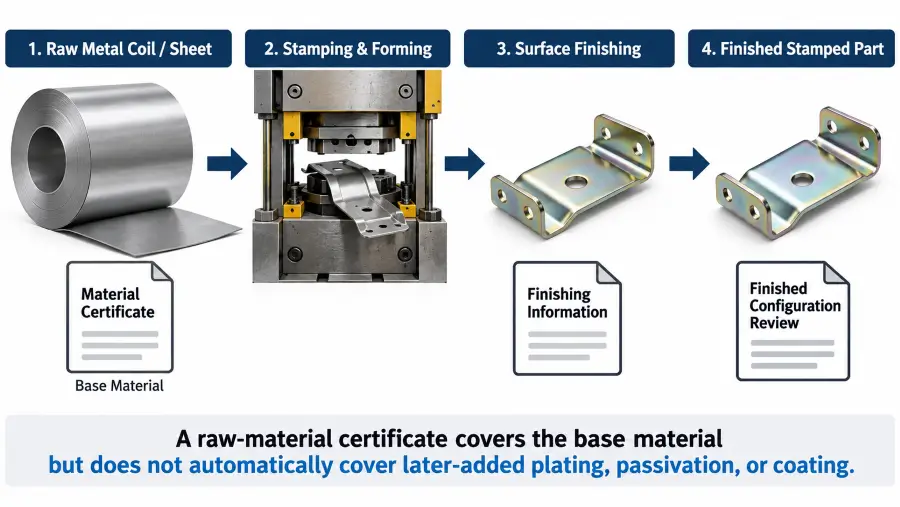
An MTC or material certificate typically provides information about the specified raw material, such as grade, chemical composition, heat or lot identification, and—depending on the document—mechanical properties.
That information is useful for validating the metal substrate, but it does not automatically cover the finished stamped component after secondary processing. Plating, passivation, conversion coating, paint, or powder coating can add materials that were not part of the original mill document.
For an uncoated stamping, the raw-material documentation may form an important part of the RoHS evidence package. For a plated or coated stamping, additional finishing information is normally needed so the documentation matches the actual finished configuration.
Engineering Note
A material certificate can support the composition of the metal substrate, but it does not automatically verify the RoHS status of later-added plating, passivation, coating, or other finishing layers.
How Plating and Surface Finishes Affect RoHS Review
Secondary finishing is an important part of RoHS review for custom stampings because the finished part may contain materials that are not covered by the raw-metal certificate. Buyers should define the complete metal stamping surface finish and obtain documentation that corresponds to the actual production configuration.
Zinc Plating and Passivation
For zinc-plated steel parts, the review should include both the zinc finish and any specified conversion or passivation system. Hexavalent chromium is one of the RoHS restricted substances, so the finish documentation should address the applicable chromium restriction and any additional customer requirement.
Trivalent-chromium and chromium-free systems are commonly used as alternatives where hexavalent chromium restrictions must be met. The actual finish should be verified against the applicable RoHS limit and customer specification rather than judged only by color or visual appearance.
Nickel Plating
Nickel is not one of the ten RoHS restricted substances, but a nickel-plated surface still needs to be included in the finished-part documentation review. The finishing documentation should support the actual plated surface and confirm that relevant RoHS restrictions are addressed.
Tin Plating
Tin plating is commonly used in RoHS-controlled applications, but the finished plating system and any alloying elements, underlayers, additives, or associated materials should still match the specified compliance requirements. The process name alone should not be treated as proof of finished-part compliance.
Paint and Powder Coating
Paint, e-coating, and powder coating add organic material systems to the stamped substrate. Where these finishes are present, the supplier documentation should cover the specified coating system and address relevant restricted substances, particularly where polymeric or organic materials are involved.
RoHS 2 vs. “RoHS 3”: What Should OEM Buyers Reference?
Directive 2011/65/EU is the core recast RoHS Directive and is commonly called RoHS 2. Directive (EU) 2015/863 amended Annex II by adding four phthalates—DEHP, BBP, DBP, and DIBP—to the restricted-substance list.
“RoHS 3” is widely used as industry shorthand for the ten-substance framework, but it is not a completely separate replacement directive in the same sense. For procurement documents and supplier declarations, a clearer legal reference is:
Directive 2011/65/EU as amended by Directive (EU) 2015/863
Where a customer requires a broader or differently worded citation, the RFQ should state that requirement explicitly.
How Should RoHS Exemptions Be Handled?
RoHS includes exemptions for specific uses of restricted substances where the legal conditions for that exemption are met. These exemptions are not blanket permissions: applicability can depend on the substance, material or application, product category, and current regulatory status.
For OEM buyers, the practical rule is simple: if the compliance position relies on an exemption, identify the exact exemption and verify that it applies to the specific project. A supplier should not simply write “exempt” without stating the basis.
Lead-containing copper alloys are one example where an exemption may be relevant. Because RoHS exemptions can be amended, renewed, narrowed, or expire, their current status should be verified when a project depends on one.
What Makes a Useful RoHS Supplier Declaration?
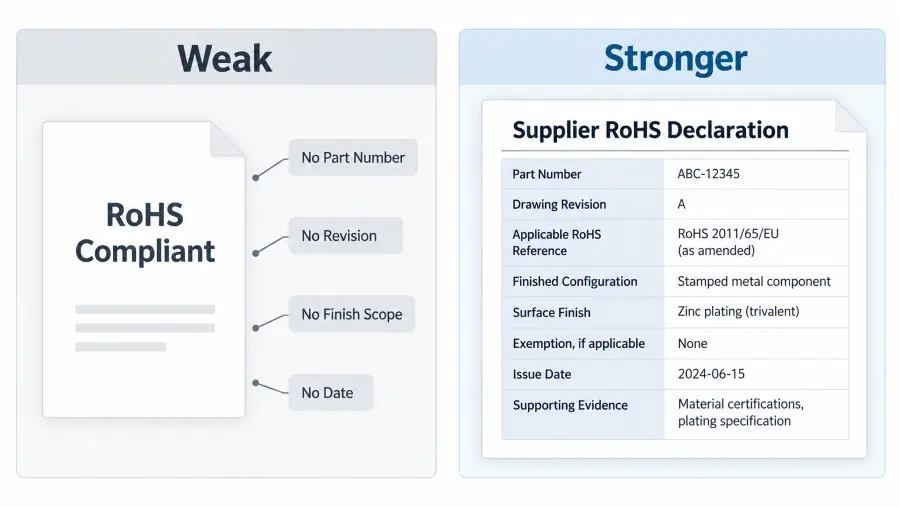
A generic statement such as “all our products are RoHS compliant” gives an OEM buyer very little information about the actual component being purchased. A stronger document links the compliance statement to the specific part and finished configuration.
Table 4: Weak vs. Stronger RoHS Documentation
| Documentation Feature | Weak / Limited Statement | Stronger / More Useful Documentation |
|---|---|---|
| Part Identification | Generic company-wide claim | Specific part number or defined part family; drawing revision where relevant |
| Finished Scope | Raw material only | Finished configuration, including relevant plating/coating scope |
| Directive Reference | “RoHS compliant” only | Applicable RoHS legal reference stated clearly |
| Restricted-Substance Scope | Not stated | Restricted-substance scope clearly identified |
| Exemption Status | Silent or simply says “exempt” | Exact applicable exemption identified where relied upon |
| Document Control | Undated / no responsible issuer | Issue date and responsible company/issuer identified |
| Supporting Evidence | None identified | Material, finishing, or analytical evidence referenced where appropriate |
A part-specific supplier RoHS declaration can be useful evidence, but its value depends on scope, traceability, and the supporting information behind it. It should not be treated as a substitute for all other technical evidence in every project.
Is Third-Party RoHS Testing Always Required?
No. RoHS does not create a universal rule that every component or every shipment must undergo third-party laboratory testing.
Technical evidence can include supplier declarations, raw-material information, finishing documentation, and analytical data where appropriate. Additional testing may be justified when supplier information is incomplete, a material or finish presents higher uncertainty, documentation conflicts, or the customer’s own compliance procedure requires verification.
XRF screening can be useful for rapid screening of certain elemental substances, but it has limitations—for example, total chromium screening does not by itself distinguish trivalent chromium from hexavalent chromium. Where further verification is required, appropriate laboratory methods from the IEC 62321 family may be used.
The practical goal is not “test everything,” but to match the level of verification to the material risk, documentation quality, and customer requirement.
How Does EN IEC 63000 Relate to Supplier Documentation?
EN IEC 63000:2018 provides a framework for technical documentation used to assess electrical and electronic products with respect to restricted substances.
For sourcing teams, the useful principle is that compliance evidence can come from different sources rather than from one universal “RoHS certificate.” Depending on material risk and supplier-information quality, technical documentation may rely on different combinations of supplier declarations, material information, finishing documentation, and analytical test data.
Higher-risk or insufficiently documented materials may justify additional verification. Using a structured documentation approach can help support a more complete compliance file, but the exact evidence required should still be defined by the OEM’s product, risk assessment, and compliance process.
RoHS Responsibilities: Finished-Product Company vs. Component Supplier
RoHS responsibilities should be understood according to the role each company plays in the actual supply chain. A component supplier and the company responsible for the finished EEE do not perform the same compliance function.
Finished-Product / Economic-Operator Role
The manufacturer and other relevant economic operators for the finished EEE are responsible for meeting the applicable RoHS conformity obligations associated with their role. Exactly which obligations apply depends on the product and the legal role of each party in the supply chain.
This article does not attempt to provide a complete CE-marking or EU economic-operator guide.
Component Supplier Support Role
A non-EU component supplier such as a custom stamping factory normally supports the compliance process by providing accurate material, finish, and supplier documentation. This may include raw-material certificates, part-specific supplier RoHS declarations, finishing information, and additional supporting evidence when the project requires it.
The legal obligations for the finished EEE depend on the role of the manufacturer, importer, distributor, or other economic operator under the applicable supply chain. For the stamping supplier, the practical priority is to ensure that the information provided matches the actual material and finished surface specification.
How Should OEM Buyers Define RoHS Requirements at the RFQ Stage?
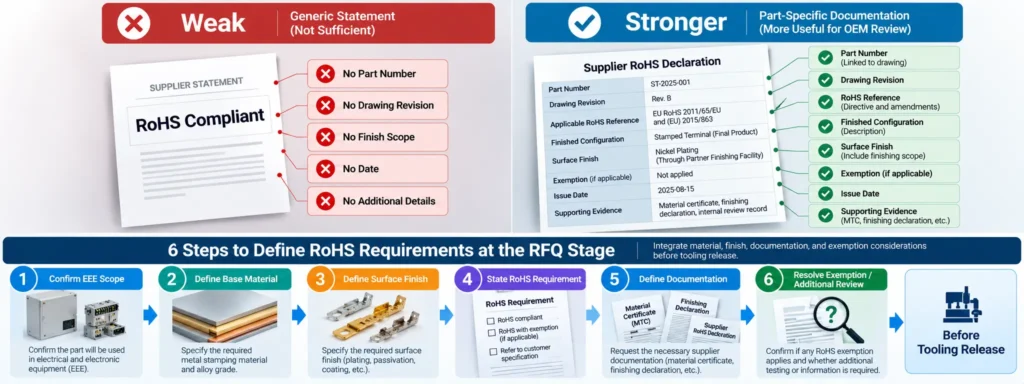
RoHS documentation problems are easier to prevent before tooling release than to solve at shipment. A buyer should define the compliance requirement together with the drawing, material, and surface-finish specification.
6-Step RFQ Compliance Integration Process
- Confirm the end market and EEE context. State whether the component is intended for equipment that must meet RoHS requirements.
- Define the exact base material. Specify the required metal stamping materials and exact alloy or material grade on the drawing.
- Define the complete surface finish. State the plating or coating type, passivation or conversion system where applicable, appearance requirements, and any customer-specific restricted-substance requirements.
- State the required RoHS reference. Where appropriate, specify Directive 2011/65/EU as amended by Directive (EU) 2015/863.
- Define the documentation deliverables. State whether the buyer expects a part-specific supplier RoHS declaration, material certificate, finishing declaration, test report, or other evidence.
- Resolve exemptions and testing before tooling release. If an exemption or additional analytical verification is relevant, agree on it before production tooling is authorized.
A short RFQ statement such as “RoHS required” may be enough to start the discussion, but it is not enough to define the evidence package for a complex plated or coated stamping.
How Metal Stamp Factory Reviews RoHS Requirements for Custom Stampings
At Metal Stamp Factory, RoHS-related requirements are reviewed together with the drawing, base material, surface finish, and customer documentation requirements before tooling release.
For a stamped component, we first confirm the specified metal material and whether any plating, coating, passivation, or other secondary finish will be added after stamping. This is important because a material certificate for the raw coil or sheet does not automatically cover the finished surface treatment.
Metal Stamp Factory was established in 2014 in Xiamen, China. Its core in-house manufacturing operations include drawing-driven custom metal stamping, progressive die stamping, punching, forming, bending, and tooling development. Project quality checks include material and MTC review, first article inspection, and dimensional inspection using vernier calipers, micrometers, and height gauges, as required by the drawing and customer specification.
Where surface finishing is required—such as electroplating, powder coating, or heat treatment—the work is coordinated through partner facilities rather than represented as an in-house core stamping operation. Relevant finishing declarations or other supporting information can be requested from the applicable process supplier when required by the customer or project.
Our role is to help connect the manufacturing specification with the documentation requested by the buyer. The exact evidence required should be defined before production rather than requested only at shipment.
Real Manufacturing Example: Brass Electrical Socket Terminals with Nickel and Tin Plating
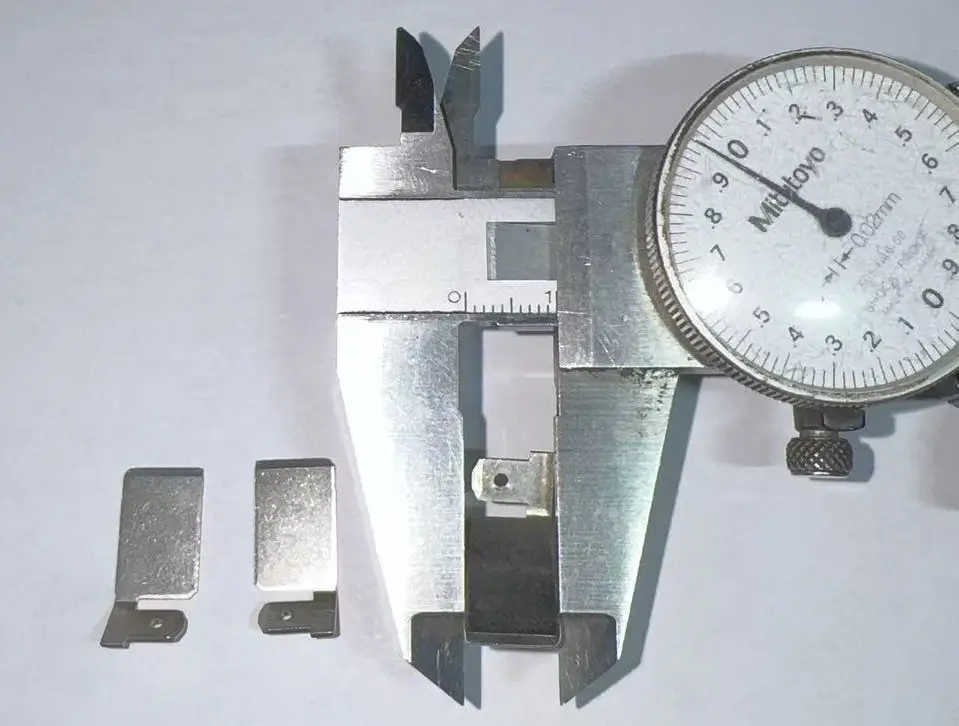
Metal Stamp Factory has produced brass terminal components used as internal conductive contacts in household electrical sockets and similar everyday electrical products. The parts include left- and right-side contact pieces as well as male and female terminal forms.
The terminals were manufactured from brass and finished with nickel plating followed by tin plating. The surface finishing was completed through a partner finishing facility.
Only finished samples remain from this project, so there is no unplated-versus-plated comparison photo available. The image below shows the finished terminals during dimensional inspection.
We do not have a verified record showing that RoHS compliance was a specific customer requirement for this project, so it should not be presented as a certified RoHS case.
However, the example illustrates an important documentation point: for a finished terminal with a brass substrate, nickel underlayer, and tin finish, the documentation should reflect the actual layered construction rather than treating the component as one undifferentiated material record.
OEM Buyer RoHS Checklist for Stamped Metal Components
Use this checklist when defining or reviewing a stamped component for a RoHS-controlled supply chain:
- Confirm the end-use and scope. Is the component intended for EEE or another project where RoHS has been contractually specified?
- Specify the exact base material. Make sure the drawing and purchasing documents identify the required alloy or grade.
- Identify the relevant homogeneous materials. Consider the substrate and any plating, passivation, coating, adhesive, insulating, or other added material where applicable.
- Define the complete surface treatment. State the finish system and any customer-specific restricted-substance requirements.
- State the RoHS reference. Use the legal reference required by the project rather than relying only on informal “RoHS 3” wording.
- Check exemption use. If an exemption is relied upon, identify the exact exemption and verify its current applicability.
- Define the documentation package. Decide whether the project requires a part-specific supplier RoHS declaration, MTC/material certificate, finishing declaration, or analytical evidence.
- Complete the review before tooling release. Resolve material, finish, exemption, and testing questions before production starts.
Common RoHS Sourcing Mistakes
- Assuming All Metal Parts Automatically Fall Under RoHS: Failing to distinguish between regulated Electrical and Electronic Equipment (EEE) components and non-regulated structural hardware.
- Averaging Substance Concentrations Across the Whole Component: Calculating restricted substance percentages against the total mass of the finished stamping rather than evaluating each homogeneous material layer independently.
- Treating a Raw Material MTC as Finished-Part Compliance: Relying solely on a mill test certificate for raw sheet metal while ignoring post-stamping electroplating, passivation, or paint coatings.
- Overlooking Chromate Passivation Chemistry: Specifying a generic finish without confirming how the applicable RoHS chromium restriction and any customer-specific Cr(VI)-free requirement will be addressed.
- Assuming Third-Party Laboratory Testing Is Always Mandatory: Assuming costly batch-level third-party testing is always necessary regardless of material risk, documentation quality, or customer requirement.
- Accepting Vague “RoHS Compliant” Statements: Accepting generic, company-wide letterhead claims that lack specific OEM part numbers, drawing revisions, or directive references.
- Citing “RoHS 3” Inaccurately: Using informal industry shorthand in official procurement contracts instead of citing Directive 2011/65/EU as amended by Directive (EU) 2015/863.
- Confusing RoHS with REACH Regulations: Treating RoHS and REACH compliance for metal stamping parts as interchangeable standards rather than recognizing that the two frameworks use different regulatory mechanisms, thresholds, and documentation requirements.
Technical & Sourcing Consultation
If your engineering or procurement team is preparing a custom stamped component for a RoHS-controlled supply chain, send us the drawing, material specification, surface-finish requirements, and required compliance documentation. We can review the manufacturing and documentation requirements before quotation and tooling release.
Common RoHS Compliance Questions from OEM Buyers
Does RoHS apply to every stamped metal component?
No. RoHS relevance depends on the equipment and supply-chain context in which the stamped component is used. A metal stamping is not automatically subject to RoHS simply because it is a metal part; the buyer should confirm whether it is intended for applicable EEE or whether RoHS has otherwise been specified contractually.
What is a homogeneous material under RoHS?
A homogeneous material is a material of uniform composition throughout, or a combination of materials that cannot be mechanically disjointed into different materials. For a stamped component, the substrate and distinct plating or coating materials may need to be considered separately rather than averaged across the total part weight.
Can an MTC prove RoHS compliance for a plated stamped part?
No. An MTC supports the raw metal substrate. Additional finishing evidence is normally needed where plating, passivation, or coatings are present so that the documentation matches the actual finished configuration.
Is third-party testing mandatory for RoHS-compliant metal parts?
No. There is no universal requirement to third-party test every component or shipment. Technical documentation may include supplier information, material declarations, finishing documentation, and analytical evidence where appropriate. Testing is commonly used when risk, documentation gaps, or customer requirements justify additional verification.
What should a RoHS supplier declaration contain?
A useful part-specific supplier RoHS declaration should clearly identify the part or product scope, state the applicable RoHS reference, address the finished configuration, identify any exemption relied upon, and include appropriate document control such as issue date and responsible issuer. Supporting material or finishing evidence may also be needed depending on the project.
How should RoHS requirements be specified in an RFQ?
State the end-use or market context, exact base material, complete surface finish, required RoHS reference, expected supplier documentation, and any exemption or testing requirement. Resolve these points before tooling release wherever possible.