Founder of Metal Stamp Factory with more than 25 years of hands-on experience in tooling development, metal stamping, and OEM production.
When OEM buyers request quality documentation for custom stamped parts, the word “certificate” can mean very different things. A supplier declaration, a raw-material test report, a dimensional inspection record, and a regulatory declaration may all support a purchasing decision, but they do not answer the same question.
Understanding certificate of conformance vs mill test report requirements helps buyers define the right deliverables before production begins. The practical question is not simply, “Which certificate should I ask for?” It is:
What do I need to verify, and which document actually provides that evidence?
A Certificate of Conformance (CoC) is generally used as a supplier or manufacturer declaration against specified requirements. A Mill Test Report (MTR) is primarily raw-material documentation containing material information and test data where applicable. Depending on the project, a buyer may require one, the other, both, or additional inspection and compliance records.
Certificate of Conformance vs Mill Test Report: Quick Answer
A Certificate of Conformance (CoC) generally states that an identified product, shipment, order, or service conforms to specified requirements.
A Mill Test Report (MTR) provides information about the raw material used for production and may include material grade, chemical composition, mechanical properties, dimensions, and traceability identifiers depending on the applicable material standard and purchasing requirement.
The two documents are not automatically interchangeable.
Table 1: Quick Comparison for OEM Buyers
| Buyer Question | Certificate of Conformance (CoC) | Mill Test Report (MTR / MTC) |
|---|---|---|
| Main purpose | Supplier/manufacturer declaration against specified requirements | Raw-material information and reported test data |
| Typical scope | Product, shipment, order, or other identified requirement set | Raw material covered by the report or certificate |
| Chemistry / mechanical data | Not necessarily included | Commonly included where required |
| Finished-part dimensional results | Not automatically included | Not intended to report finished stamped-part dimensions |
| Material traceability information | May reference agreed identifiers | May include heat, coil, lot, or other material identifiers |
| Regulatory compliance evidence | Not automatic | Not automatic |
| Automatically replaces the other document? | No | No |
The right document depends on what the buyer needs to verify. A document name alone is not enough; the required scope, evidence, traceability, and timing should be defined in the RFQ, purchase order, drawing, or other applicable purchasing requirement.
What Is a Certificate of Conformance (CoC)?
A Certificate of Conformance is generally a document in which a supplier or manufacturer declares that an identified product, shipment, order, or service conforms to specified requirements.
In broader conformity-assessment terminology, ISO describes a supplier’s declaration of conformity as a first-party attestation made by the supplier against specified requirements.
The exact format and required content can vary by customer, industry, contract, jurisdiction, and quality system. For that reason, buyers should avoid assuming that every document called a “CoC” contains the same information.
What a CoC May Include
Depending on the purchasing requirement, a CoC may identify items such as:
- supplier or manufacturer name
- customer or purchase order reference
- part number or product description
- drawing or specification revision
- shipment, lot, or batch reference
- quantity
- statement of conformance
- issue date
- authorized signature or electronic approval where required
The important point is not whether every CoC contains all of these fields. The important point is whether the document clearly identifies what is being declared and which requirements the declaration covers.
What a CoC Does Not Automatically Prove
A CoC does not automatically provide:
- raw-material test values such as chemistry, tensile strength, yield strength, or elongation
- detailed material traceability unless required identifiers or supporting records are part of the agreed documentation package
- dimensional inspection results
- first article measurement data
- secondary-process test data such as plating-thickness or corrosion-performance results
- finished-part RoHS compliance for stamped metal components or REACH compliance for metal stamping parts unless the required regulatory evidence is separately defined and supported
A conformity declaration and an inspection report answer different questions. If measurement data, material test data, process evidence, or regulatory documentation is required, those records should be requested explicitly.
What Is a Mill Test Report (MTR)?
A Mill Test Report (MTR), often referred to as a Mill Test Certificate (MTC), is raw-material documentation supplied by the mill or other responsible material source. In commercial sourcing, buyers may also use the broader term “material certificate,” so the required document content should be clearly specified.
Depending on the document type, material, applicable standard, and purchasing requirement, an MTR may include:
- material grade
- applicable material standard
- chemical composition
- mechanical properties
- dimensions
- coating information
- heat, coil, lot, or other material identifiers
For a detailed explanation of how to read and verify these fields, including material identifiers and coil traceability, see our mill test report for metal stamping guide.
An MTR is primarily evidence about the raw material. It does not automatically declare conformity of the finished stamped component, finished dimensions, or post-stamping secondary operations.
Certificate of Conformance vs Mill Test Report: Key Differences
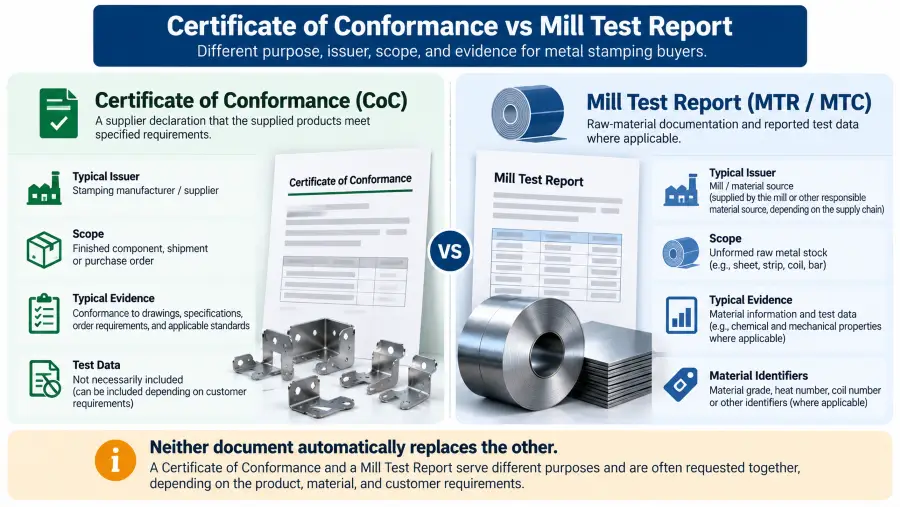
The clearest way to compare a CoC and an MTR is to look at the question each document is intended to answer.
Table 2: CoC vs MTR Comparison
| Comparison | Certificate of Conformance (CoC) | Mill Test Report (MTR / MTC) |
|---|---|---|
| Core question | Does the identified supply conform to the stated requirements? | What raw-material information and test data are reported for the material? |
| Typical issuer | Supplier or manufacturer responsible for the declared scope | Mill, material producer, or other responsible material source |
| Document type | Declaration | Material report / certificate |
| Typical scope | Product, shipment, order, or requirement set | Raw material covered by the document |
| Material test data | Not necessarily | Commonly included where applicable |
| Finished-part measurement data | Not automatically | Not its purpose |
| Secondary-process coverage | May reference secondary-process requirements if included in the declared scope | Generally does not document post-stamping operations |
| Material identifiers | May be referenced if required | Commonly included where applicable |
| Regulatory evidence | Does not automatically establish regulatory compliance | Does not automatically establish finished-part regulatory compliance |
| Can replace the other? | Not automatically | Not automatically |
This distinction is especially important in custom metal stamping because a single order can involve several evidence layers: raw-material documentation, dimensional inspection, secondary processing, shipment documentation, and regulatory declarations.
When the customer requires a broader structured part-approval package rather than individual shipment or material documents alone, PPAP for metal stamping parts should be reviewed separately.
When Should a Metal Stamping Buyer Request a CoC?
A buyer may request a CoC when the purchasing requirement calls for a supplier or manufacturer declaration against identified requirements.
Typical situations include:
- Purchase Order and Revision Control
The buyer wants the supplied parts or shipment tied to a specific PO, part number, drawing revision, or specification. - Shipment-Level Declaration
The buyer’s receiving or quality procedure requires a formal supplier statement with the shipment. - Defined Process Requirements
The purchase specification requires the supplier to declare that identified manufacturing or secondary-process requirements were addressed. - Customer-Specific Quality Requirements
The buyer’s internal quality system or supplier manual requires a CoC as part of the agreed documentation package.
A CoC should not be requested simply because it sounds like a stronger document. It should be requested because the buyer has a defined conformance statement that needs to be made.
When Should a Buyer Request an MTR?
A buyer may request an MTR when the project requires documented information about the raw material.
Typical reasons include:
- The Drawing or PO Requires Material Documentation
The project specifies that a material certificate or MTR must be supplied. - Reported Material Properties Are Required
The buyer needs documented chemistry, mechanical properties, or other material data. - Material Identity Must Be Supported
The buyer needs evidence of the specified grade, standard, or other raw-material designation. - Material Traceability Is Required
The project requires a defined relationship between the material documentation and the material supplied for production.
If the purchasing requirement goes beyond document selection and into detailed MTR interpretation, our detailed MTR guide explains how OEM buyers read and verify a mill test report for metal stamping.
When Might Buyers Request Both a CoC and an MTR?
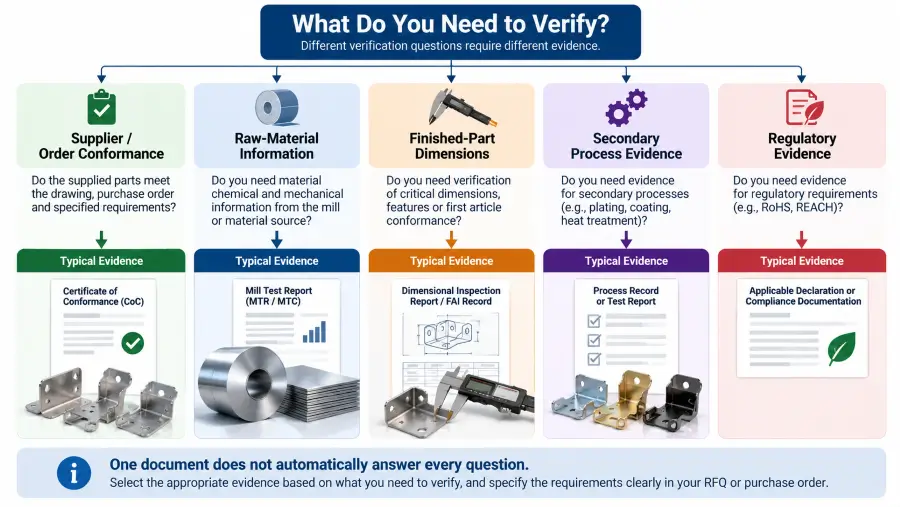
Some buyers may request both documents because they need two different forms of evidence:
- a CoC for a supplier or manufacturer declaration against identified requirements
- an MTR for supporting raw-material information and test data
The need for both should come from the project requirement, not from a blanket rule.
Table 3: When Both Documents May Be Useful
| Buyer Need | CoC | MTR | Other Evidence That May Also Be Required |
|---|---|---|---|
| Supplier declaration against identified purchase requirements | May be required | Does not replace the declaration | Inspection or process records where specified |
| Raw-material data plus shipment-level declaration | May be required | May be required | Defined traceability records where required |
| Finished-part dimensional evidence | Does not replace measurement records | Does not provide finished-part measurements | Dimensional inspection / FAI record |
| Regulatory or secondary-process evidence | Does not automatically establish compliance | Does not automatically establish finished-part compliance | Relevant declarations, process records, or test reports |
The correct purchasing approach is to separate each verification question and assign the appropriate evidence to it.
Why One Document Does Not Automatically Replace the Other
A common sourcing mistake is to treat all “certificates” as equivalent.
An MTR and a CoC normally serve different purposes:
- An MTR does not automatically replace a CoC because raw-material documentation and a supplier declaration address different requirements.
- A CoC does not automatically replace an MTR because a declaration does not necessarily contain the raw-material test data or identifiers required by the purchasing specification.
Before accepting any document, buyers should ask:
- What exactly is being declared or reported?
- Who issued the document?
- Which PO, drawing, material, shipment, or specification does it relate to?
- Does it contain a declaration, actual test data, or both?
- Is traceability required?
- Are separate inspection, process, or regulatory records also required?
A document labeled “certificate” is not enough by itself.
Certificate of Conformance, Certificate of Compliance, and Certificate of Conformity
Buyers may encounter the terms Certificate of Conformance, Certificate of Compliance, and Certificate of Conformity in commercial sourcing.
These terms are sometimes used interchangeably, but their exact meaning and required content can vary by customer, industry, contract, jurisdiction, and quality system.
For procurement purposes, the safest rule is:
Define the required document content rather than relying only on the document title.
If a project references a particular standard, document type, or customer specification, that requirement should be stated explicitly instead of assuming that any generic “CoC” will satisfy it.
How to Specify CoC and MTR Requirements in an RFQ or Purchase Order
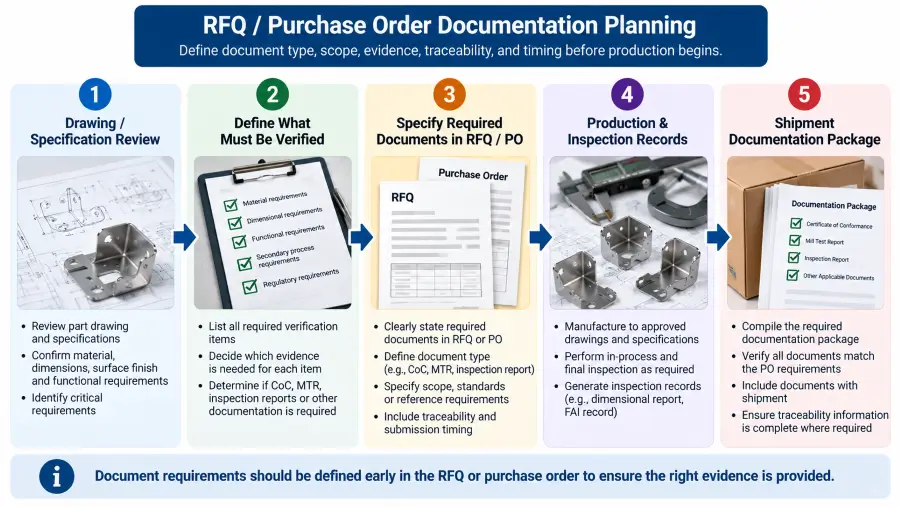
Documentation requirements are easiest to control when they are defined before production begins.
During RFQ and PO preparation, buyers should specify:
- document type
- document scope
- applicable part number or drawing revision
- required material information
- required traceability
- required supporting records
- delivery timing
- whether the document is required with every shipment, lot, or another defined interval
If You Require a Certificate of Conformance
Example wording:
“Certificate of Conformance required with shipment. The certificate should identify the purchase order, part number, applicable drawing revision, shipment or lot as applicable, and state conformity with the specified purchase requirements.”
If You Require a Mill Test Report
Example wording:
“Mill Test Report / material certificate required for the raw material supplied for production. The required material grade, document content, and level of material traceability should be stated in the purchase specification.”
If You Require Both
Example wording:
“Certificate of Conformance and supporting Mill Test Report required with shipment. The required document content, scope, and traceability should be defined in the purchase specification.”
These are general purchasing examples only. Actual wording should be adapted to the customer’s engineering, quality, contractual, and regulatory requirements.
Common CoC and MTR Document-Selection Mistakes
- Requesting Only a Generic “Material Certificate”
The supplier may not know whether the buyer expects a CoC, MTR, inspection report, or another document. - Assuming Every Certificate Contains Test Data
A supplier declaration does not necessarily contain chemistry or mechanical-property results. - Assuming a CoC Replaces an MTR
A declaration may be insufficient when the purchase requirement calls for raw-material test data or material identifiers. - Assuming an MTR Certifies the Finished Part
Raw-material documentation does not establish finished-part dimensions, forming results, or secondary-process quality. - Defining Documentation After Production Has Started
Special document or traceability requirements are easier to support when they are agreed before material purchasing and production. - Failing to Define Traceability Scope
Simply asking for an MTR does not tell the supplier how closely the material document must be linked to the supplied production lot. - Confusing a CoC with an Inspection Report
If actual measurement results are required, the appropriate inspection record should be requested separately. - Assuming a CoC or MTR Automatically Proves RoHS or REACH Compliance
Regulatory evidence should be defined separately according to the applicable product, material, coating, and customer requirements.
For broader document and compliance context, see our guide to metal stamping certifications and compliance requirements.
How Metal Stamp Factory Handles Documentation Requirements
At Metal Stamp Factory in Xiamen, China, documentation requirements are reviewed as part of project planning. Metal Stamp Factory was established in 2014. Our manufacturing capabilities include custom metal stamping, progressive die stamping, punching, forming, bending, tooling development, and OEM production.
For a custom stamping project, our general workflow may include:
- Requirement Review
We review the customer drawing, material specification, purchasing requirements, and requested documentation before production planning. - Material Sourcing and Document Review
Raw material is purchased according to the specified requirements from material suppliers or distributors. Available supplier MTRs or material certificates are reviewed against the purchase requirements where applicable. - First Article and Dimensional Inspection
Trial parts and production features are checked using conventional measuring tools such as vernier calipers, micrometers, and height gauges. First Article Inspection is performed during trial stamping as appropriate to the project. - Secondary Process Coordination
Electroplating, powder coating, heat treatment, and other secondary operations are coordinated through partner facilities where required. - Documentation Planning
Shipment, material, inspection, or other quality-document requirements should be agreed before production so the required document package can be prepared according to the agreed customer requirements.
Where a customer requires independent chemical or mechanical verification, third-party testing can be coordinated through external laboratories or inspection resources as specified. Such testing is external verification and should not be described as an in-house laboratory capability.
Metal Stamp Factory does not publish confidential customer purchase orders, Certificates of Conformance, engineering drawings, or quality records when those documents are subject to confidentiality requirements or NDA obligations. For that reason, this guide uses generalized procurement and manufacturing workflows rather than a fabricated customer CoC example. A CoC should not be assumed to be an automatic deliverable for every order: the issuing party, declared scope, supporting records, and delivery timing must be confirmed against the actual purchasing requirements before the order is accepted.
OEM Buyer CoC vs MTR Decision Checklist
Before releasing a metal stamping RFQ or PO, ask:
- 1. What needs to be verified?
Supplier conformance, raw-material properties, dimensions, secondary processing, regulatory evidence, or a combination? - 2. Is a supplier declaration required?
If yes, define the scope of the CoC. - 3. Is raw-material test data required?
If yes, specify the required MTR or material certificate. - 4. Is material traceability required?
Define the expected relationship between the material documentation and the supplied production material. - 5. Are dimensional results required?
Request the appropriate first-article or dimensional inspection record separately. - 6. Are secondary-process records required?
Define plating, coating, heat-treatment, or other process documentation separately where needed. - 7. Are regulatory declarations required?
Do not assume that a generic CoC or MTR automatically satisfies RoHS, REACH, or other regulatory requirements. - 8. When must each document be provided?
Define whether it is required before production release, with FAI, with each shipment, by lot, or at another agreed stage. - 9. Is the required document content explicitly defined?
Avoid relying only on titles such as “certificate” or “material cert.”
Technical & Sourcing Consultation
If your engineering or procurement team is defining material, inspection, or documentation requirements for a custom stamped component, send us your drawing and purchasing specification. We can review the manufacturing requirements, material requirements, and requested documentation before production planning.
Common Questions About Certificate of Conformance vs Mill Test Report
What is the difference between a CoC and an MTR?
A CoC is generally a supplier or manufacturer declaration that an identified product, shipment, order, or service conforms to specified requirements. An MTR is primarily raw-material documentation that may contain material grade, chemistry, mechanical properties, dimensions, and material identifiers where applicable.
Can a CoC replace an MTR?
Not automatically. A CoC is a declaration against an identified scope, while an MTR provides raw-material information and test data where applicable. If the drawing, PO, or customer specification requires material test data or material identifiers, those requirements should be specified separately.
Can an MTR replace a Certificate of Conformance?
Not automatically. An MTR is primarily raw-material documentation and does not replace a supplier declaration, dimensional inspection record, or secondary-process evidence when those are separately required. Whether a CoC is needed depends on the customer’s purchasing and quality requirements.
Do I need both a CoC and an MTR?
Some buyers may request both when they need two different forms of evidence: a supplier or manufacturer declaration for the identified product or order, and supporting raw-material documentation. The requirement for both should be defined by the customer or project specification rather than assumed for every stamping order.
Is a Certificate of Conformance the same as a Certificate of Compliance?
The terms are sometimes used interchangeably in commercial purchasing, but terminology and required content can vary by customer, industry, contract, jurisdiction, and quality system. Buyers should define the required document content and scope rather than rely only on the title.
What should I write in the RFQ or PO for CoC and MTR requirements?
Specify the exact document or documents required, their scope, the applicable part number or drawing revision, any material or traceability requirements, required supporting records, and when the documents must be provided. Clear requirements at the RFQ or PO stage reduce ambiguity later in the project.