Founder of Metal Stamp Factory with more than 25 years of hands-on experience in tooling development, metal stamping, and OEM production.
Quick Answer
REACH compliance for metal stamping parts is not a single certificate or laboratory test report. OEM buyers need to understand the supplied article, its base material and surface finishes, whether relevant Candidate List substances or Annex XVII restrictions apply, and what information must move through the EU supply chain.
REACH Quick Reference for OEM Buyers
| Compliance Question | Legal / Technical Reality | Practical Impact for OEM Buyers |
|---|---|---|
| Is a stamped metal part considered an “article”? | Typically yes, when the component’s shape, surface, or design determines its function to a greater degree than its chemical composition. | Compliance evaluates the finished, solid component rather than a chemical preparation. |
| Is 0.1% w/w a universal compliance ceiling? | No. The 0.1% weight-by-weight threshold primarily triggers communication and notification obligations for Candidate List SVHCs. | Presence above 0.1% w/w requires disclosure, not an immediate product ban, unless an applicable restriction or other legal requirement says otherwise. |
| Does >0.1% SVHC mean the part is banned? | No. Candidate List status alone does not automatically prohibit an article from being placed on the EU market. Applicable Annex XVII restrictions and other relevant legal requirements must be assessed separately. | Buyers need to distinguish disclosure obligations from specific use restrictions. |
| Does >0.1% SVHC automatically require ECHA notification? | No. Article 7(2) notification applies only if the SVHC exceeds 0.1% w/w and the total quantity of that substance exceeds 1 tonne per producer or importer per year, subject to applicable exemptions. | A component may trigger Article 33 communication without triggering Article 7(2) notification. |
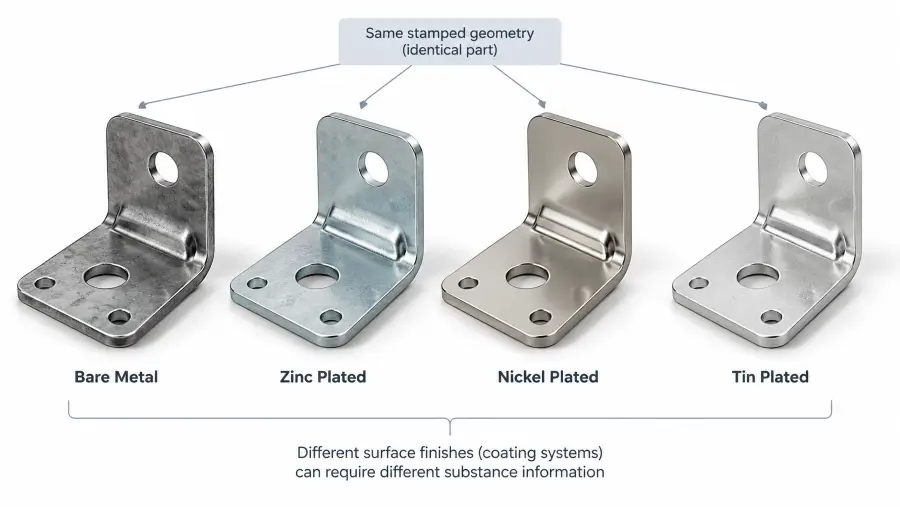
| Should plating and surface finishes be reviewed separately? | Yes. Electroplating, conversion coatings, passivation, paint, and other applied finishes can introduce substances not described by the base-metal documentation. | A raw material report does not by itself establish the compliance status of the finished part. |
| Is there an official “REACH Certificate”? | No. ECHA does not issue a standardized product or factory “REACH certificate.” | Buyers should evaluate the scope and evidence behind supplier declarations rather than rely on a generic certificate label. |
What Does REACH Compliance Mean for Metal Stamping Parts?
For an OEM buyer sourcing custom stampings, REACH compliance refers to satisfying the applicable legal obligations under EU Regulation (EC) No 1907/2006 concerning the Registration, Evaluation, Authorisation and Restriction of Chemicals. Within the broader framework of metal stamping certifications and compliance requirements, REACH specifically addresses chemical-substance obligations that can affect manufactured articles supplied into the European market.
In the context of manufactured goods, a stamped metal component is typically evaluated as an “article.” Meeting applicable REACH requirements does not involve obtaining a standardized, factory-wide accreditation. The review depends on the specific part, material, surface finish, intended use, and the role of the relevant actor in the EU supply chain.
When procurement teams ask an offshore supplier only, “Are your parts REACH compliant?”, the answer can be too broad to support a meaningful review. A bare aluminum stamping, a brass contact, and a zinc-plated steel shield may involve different base materials, surface treatments, and substance information. A useful review should define the exact part scope, identify the complete material and finishing system, and confirm what REACH-specific information the buyer requires.
Buyer Note: A generic supplier statement saying only “REACH compliant” is less useful than a declaration that clearly identifies the relevant product or part scope, the applicable substance-list basis or date, and whether the declared scope includes required surface finishes. Part-number or drawing-revision references are useful OEM document-control practices, although they should not be presented as a universal REACH-mandated document format.
Are Stamped Metal Components “Articles” Under REACH?
How REACH Defines an Article
Under Article 3(3) of REACH, an article is an object that, during production, is given a special shape, surface, or design that determines its function to a greater degree than its chemical composition.
This distinction separates manufactured hardware from substances or mixtures such as liquids, solvents, lubricants, or coatings supplied in chemical form. The legal treatment of a product depends in part on whether it is classified as a substance, mixture, or article.
Why a Stamped Bracket, Clip, Terminal, or Cover Can Remain an Article
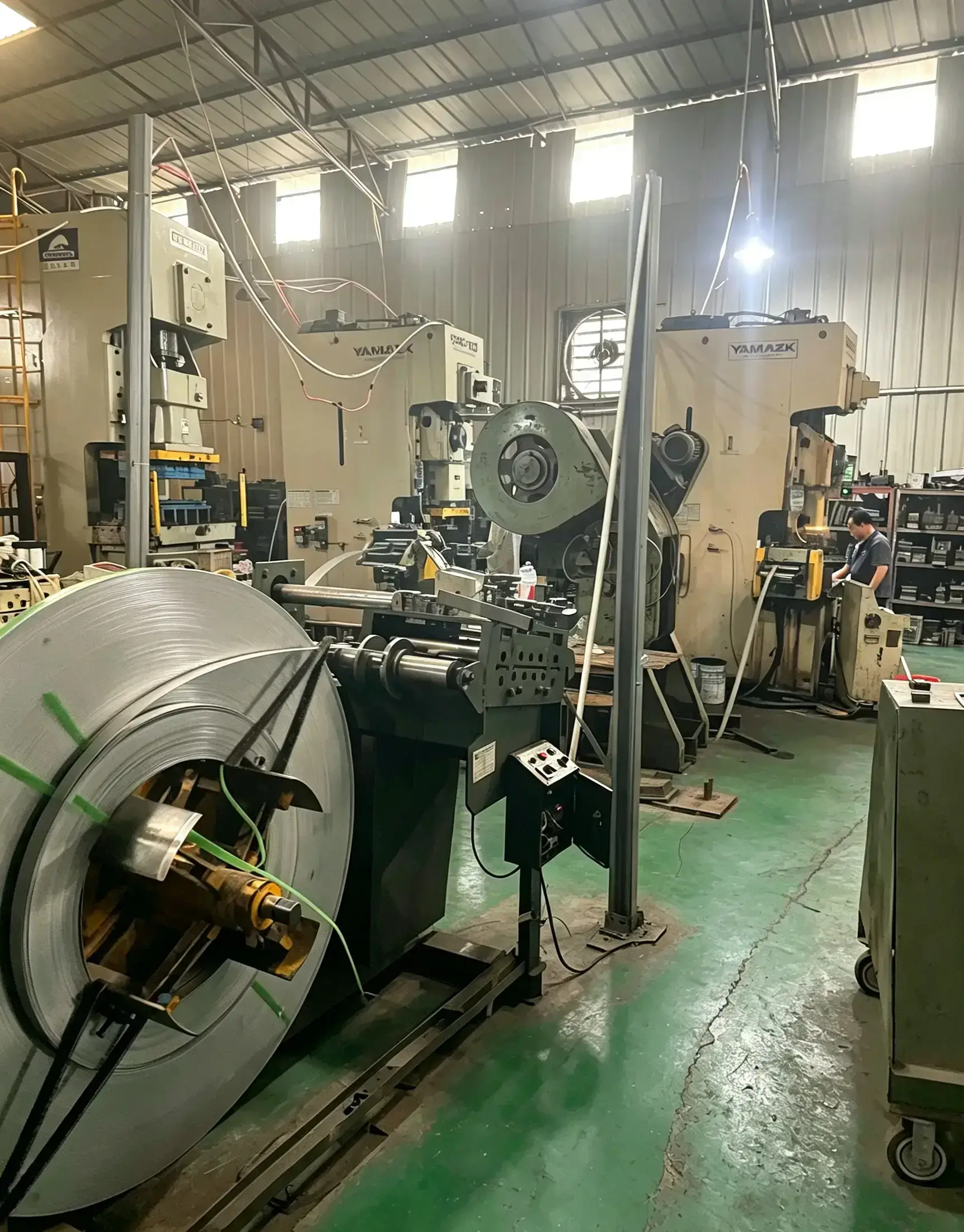
In custom metal stamping, components such as brackets, spring clips, electrical terminals, shields, and structural covers are commonly produced by feeding flat metal coil or sheet into stamping tooling that performs operations such as punching, blanking, bending, and forming.
For many of these components, the final function depends primarily on geometry, dimensions, surface, and structural form. That is why a finished stamped component commonly meets the REACH article definition.
The classification should still reflect the supplied form. A finished solid component supplied to an OEM assembly line can be treated differently from a chemical substance or mixture supplied separately. For standard custom metal stamping projects, the buyer is generally purchasing finished articles.
What Are Candidate List SVHCs and Why Does the 0.1% Threshold Matter?
The European Chemicals Agency (ECHA) maintains the Candidate Listof Substances of Very High Concern (SVHCs), which identifies substances associated with serious health or environmental hazards.
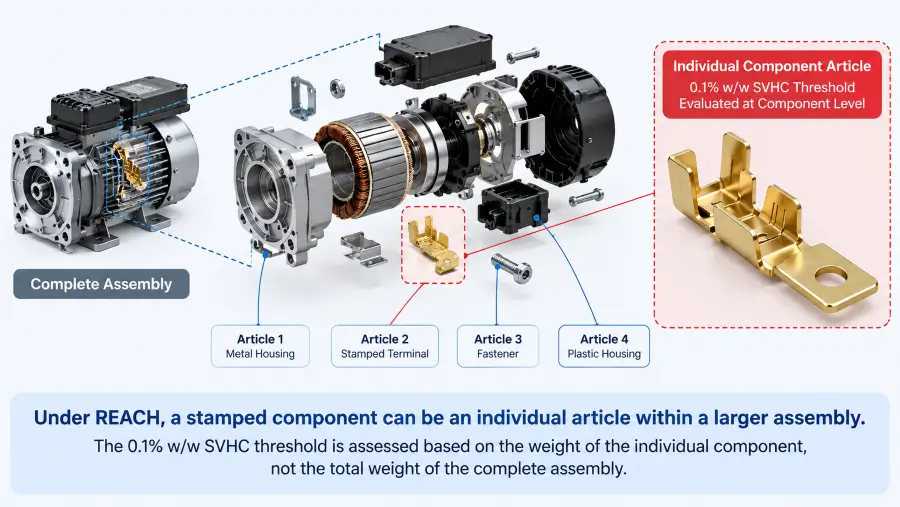
For articles, the 0.1% weight-by-weight (w/w) threshold is important because it can trigger specific information duties. For a component article, the concentration is assessed against the weight of that article rather than automatically against the mass of an entire larger product.
What 0.1% Does Not Mean
Two misunderstandings are common in international sourcing:
- Exceeding 0.1% w/w does not automatically mean the metal part is illegal or banned.
Candidate List status alone does not automatically prohibit an article from being placed on the EU market. Applicable Annex XVII restrictions and other relevant legal requirements must be assessed separately. - Remaining below 0.1% w/w does not automatically satisfy all REACH requirements.
A component can still be subject to an applicable Annex XVII restriction even when no Candidate List SVHC exceeds 0.1% w/w.
How Does the 0.1% Rule Apply to a Component Inside an Assembly?
A key interpretation for complex products is that an article incorporated into a larger object can remain an article. This is often informally summarized as the “Once an Article, Always an Article” principle following the 2015 Court of Justice of the European Union ruling in Case C-106/14.
This matters because the concentration of an SVHC in a small stamped component should not simply be diluted by using the total weight of a much larger machine or assembly as the denominator.
For OEM buyers, the practical lesson is straightforward:
- assess the relevant stamped component as an article in its own right;
- do not average a substance concentration across unrelated parts in the assembly;
- ensure supplier information is detailed enough to identify the component that contains the relevant substance.
Article 33 vs. Article 7(2): What OEM Buyers Need to Distinguish
OEM buyers should distinguish two separate obligations: supply-chain communication under Article 33 and, in certain cases, notification to ECHA under Article 7(2).
Article 33 — Supply-Chain Communication
Article 33 requires a supplier of an article containing a Candidate List SVHC above 0.1% w/w to provide the recipient with sufficient information, available to the supplier, to allow safe use of the article. At minimum, this includes the name of the substance.
This is a supply-chain communication duty. It is different from notification to ECHA.
Article 7(2) — Notification to ECHA
Article 7(2) may require an EU producer or importer of articles to notify ECHA when both of the following conditions are met:
- the Candidate List SVHC is present above 0.1% w/w in the article; and
- the total quantity of that substance in the relevant articles exceeds 1 tonne per producer or importer per year.
Applicable exemptions can also affect whether notification is required.
Article 33 vs. Article 7(2)
| Regulatory Aspect | Article 33 | Article 7(2) |
|---|---|---|
| Primary Purpose | Supply-chain communication and safe-use information | Notification to ECHA |
| Concentration Threshold | >0.1% w/w in the relevant article | >0.1% w/w in the relevant article |
| Tonnage Trigger | No 1-tonne threshold | >1 tonne/year of the substance per producer or importer |
| Main Actor | Relevant supplier of the article | EU producer or importer of articles |
| Practical OEM Implication | Non-EU suppliers are typically expected to provide the material and substance information their EU customers or importers need to fulfil applicable REACH obligations. | EU-side actors must evaluate whether annual tonnage and other conditions trigger notification. |
Candidate List vs. Annex XVII — Why OEM Buyers Must Check Both
A frequent mistake in hardware procurement is assuming that checking the Candidate List is enough to establish REACH compliance. It is not.
Candidate List vs. Annex XVII
| Regulatory Framework | Main Purpose | Trigger / Scope | Practical Action for Stamped Parts |
|---|---|---|---|
| Candidate List | Identifies SVHCs and can trigger communication or related information duties | Relevant Candidate List substance in an article, including the 0.1% w/w threshold for Article 33 | Review materials and finishes and provide required substance information where applicable |
| Annex XVII | Establishes legally binding restrictions on certain substances, mixtures, or articles | Depends on the specific substance, article, use, concentration, or market condition | Verify whether any restriction applies to the material, coating, finish, or intended use |
Annex XVII restrictions are substance- and use-specific and may impose concentration limits, release limits, use conditions, or prohibitions for particular articles.
For an OEM buyer, the key point is that Candidate List review and Annex XVII review serve different purposes. A part can require Candidate List communication without being prohibited, while a separate Annex XVII restriction may impose a specific limit or condition.
Why Base Metal Alone Is Not Enough for a Finished Stamped Part
When sourcing custom metal stampings, procurement teams often request a Mill Test Report or similar raw-material evidence. Such documentation can help verify the chemistry and properties of the starting coil or sheet, but it does not automatically describe substances introduced through later processing.
Engineering Note: For a stamped component with a specified surface finish, review the substrate and the finishing system separately. A raw-material document can help verify the base alloy, while plating or coating information should come from the relevant finishing process. Treating a finished stamped part as “compliant” based only on the raw material can leave an important information gap.
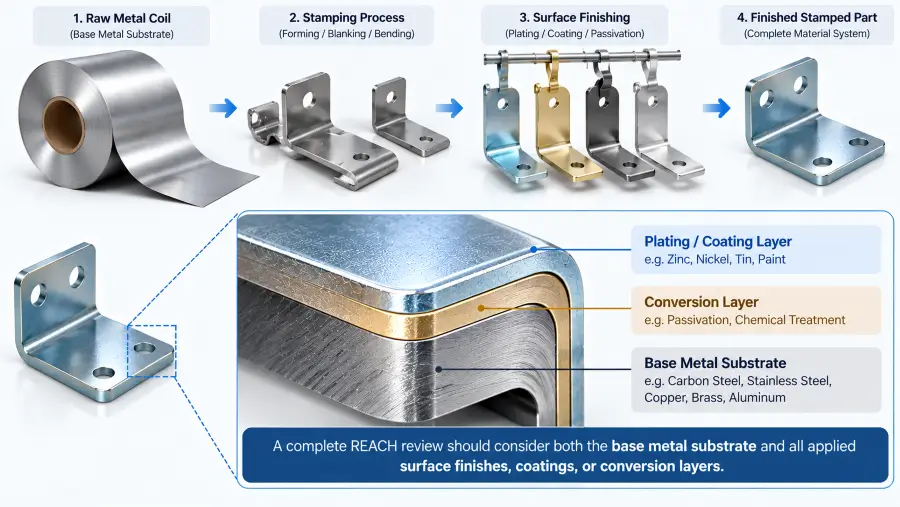
A finished metal stamping may involve several stages: Raw Metal Coil / Sheet → Stamping & Forming → Secondary Finishing → Finished Stamped Part.
The compliance review may therefore need to consider:
- Base material: The selected metal stamping materials can have different alloy chemistries and surface-treatment requirements, and some may contain substances relevant to the Candidate List or an applicable restriction.
- Secondary plating or coating: Electroplating, conversion coatings, passivation, paint, or powder coating can introduce additional chemical systems.
- Processing residues: Processing chemicals such as stamping oils, cleaners, or rust preventatives should be considered where residues may remain on the delivered part.
The practical point is simple: a raw-material document describes the starting material, not automatically the entire finished component.
How Plating and Surface Finishes Can Change the REACH Review
Metal stamping surface finishing and plating can improve corrosion resistance, conductivity, solderability, appearance, or wear performance. For a REACH-related review, the finished surface system should be considered together with the base material.
Electroplating
Common finishes used on stamped carbon steel, stainless steel, copper, or brass can include zinc, nickel, and tin plating.
- Zinc plating: The review should consider the specified plating and post-treatment system, not just the steel substrate.
- Nickel plating: Where the finished article is intended for direct and prolonged skin contact, applicable nickel-release restrictions may need to be checked.
- Tin plating: Buyers should confirm that the full plating and post-treatment system is covered by the supplier information provided.
Passivation and Conversion Coatings
Passivation and conversion treatments can involve different chemical systems depending on the substrate and finish requirement.
Some hexavalent-chromium compounds used historically in conversion or surface-treatment processes are subject to significant REACH controls, including Candidate List and authorisation requirements. Buyers should confirm the actual finishing chemistry rather than infer compliance from finish colour alone.
Paint and Powder Coating
When stamped covers, chassis plates, or structural brackets require liquid paint, e-coating, or powder coating, the applied organic coating becomes part of the finished article.
The buyer should therefore define:
- the coating specification;
- any restricted-substance requirements;
- the documentation expected from the finishing supply chain.
The review should focus on the actual coating system used rather than assuming the base metal alone determines compliance.
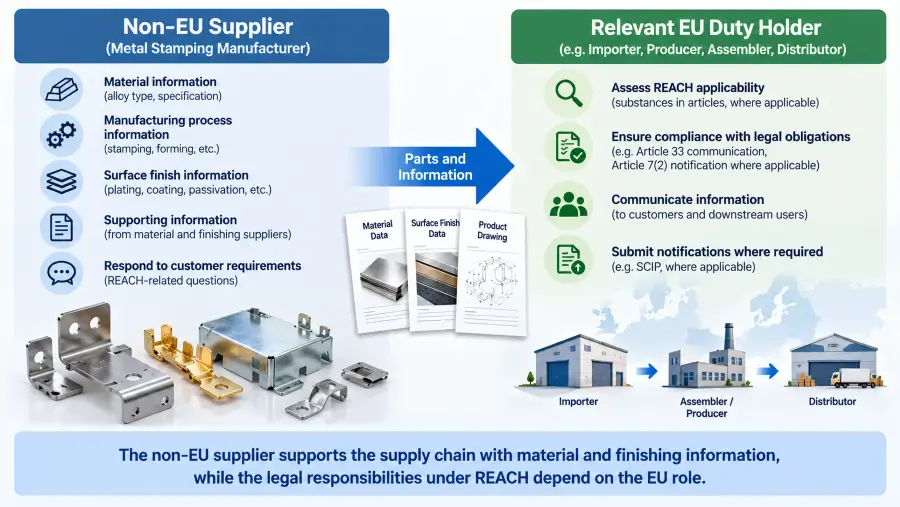
Which REACH Responsibilities Belong to the EU Importer and Which to the Non-EU Supplier?
International sourcing requires a clear distinction between EU legal obligations and the supporting role of an overseas manufacturer.
EU-Side Regulatory Role
For imported articles, the applicable REACH duties depend on the role of the EU-based company placing or supplying the article on the market.
Depending on the transaction and product, an EU importer, producer, assembler, distributor, or other supplier may need to evaluate:
- applicable Annex XVII restrictions;
- Article 33 communication duties;
- Article 7(2) notification conditions;
- related SCIP obligations where applicable.
Non-EU Stamping Supplier Support Role
A non-EU stamping manufacturer is not automatically the EU importer or other EU legal duty holder. Its role is to provide reliable technical and supply-chain information that helps the EU customer meet its obligations.
In practice, a non-EU stamping supplier can support the customer by:
- supporting material traceability and collecting relevant upstream material information when required by the project;
- collecting relevant plating, coating, or finishing information from partner facilities;
- coordinating supplier declarations or supporting documentation where required by the customer;
- arranging or supporting third-party verification when the project or buyer specification requires it.
How Does SCIP Relate to REACH for Stamped Metal Parts?
SCIP stands for Substances of Concern In articles as such or in complex objects (Products).
SCIP is established under the EU Waste Framework Directive. It is not a REACH certification. However, SCIP uses Candidate List substance information as part of its reporting framework.
Where the SCIP obligation applies, the relevant EU producer, assembler, importer, distributor, or other duty holder placing an article on the EU market may need to submit information when the article contains a Candidate List SVHC above 0.1% w/w.
For a non-EU metal stamping supplier, the practical role is usually to provide accurate material, part, and substance information that the EU customer needs for its assessment and any required submission.
What Makes a REACH Declaration Useful for an OEM Buyer?
A declaration is useful only when its scope is clear enough for the buyer to understand which part, material, finish, and Candidate List basis it covers.
Stronger vs. Weaker REACH Documentation
| Documentation Feature | Weak / Limited Statement | Stronger / More Actionable OEM Documentation |
|---|---|---|
| Product & Part Scope | Generic statement such as “all products are REACH compliant” | Clearly identifies the relevant product family, part, purchase order, or other defined scope |
| Material & Finish Coverage | Covers only the raw metal | Clarifies whether the scope includes the complete finished article and relevant surface treatments |
| Candidate List Basis | No list basis or date is stated | Identifies the Candidate List version or date used for the review where applicable |
| SVHC Information | Vague “chemical free” claim | Clearly states whether any Candidate List SVHC above 0.1% w/w is known to be present within the declared scope |
| Document Control | No identifiable issuer or revision control | Includes useful supplier, issue-date, and document-control information appropriate to the customer’s quality system |
Part numbers, drawing revisions, Candidate List dates, and other identifiers can be useful OEM document-control practices, but they should not be presented as universal REACH-mandated declaration fields.
Is Third-Party REACH Testing Always Required?
No. Third-party testing is not mandatory for every metal stamping part or every shipment under REACH.
REACH compliance for articles relies heavily on supply-chain information, substance data, and documentation. Third-party laboratory testing can be useful when:
- supplier information is incomplete;
- a particular material or finish creates uncertainty;
- the OEM customer requires independent verification.
Testing is supporting evidence, not a universal substitute for ongoing supplier and material information management.
How Should OEM Buyers Define REACH Requirements at the RFQ Stage?
For a custom stamped part, regulatory requirements are easier to manage before tooling release than after production parameters have already been fixed.
6-Step RFQ Compliance Integration Process
- Identify the destination market.
Confirm whether the component will enter the EU directly or as part of an EU-bound assembly. - Define the exact base material.
State the required grade, such as carbon steel, stainless steel, SUS304, SUS316, SPCC, aluminum, copper, or brass, as applicable. - Specify the complete surface finish.
Do not stop at “zinc plated.” Define the plating, passivation or conversion-coating requirement, together with any customer restricted-substance requirement. - Agree the REACH-specific documentation.
Depending on the project, this may include a part-specific supplier declaration, base-material information, and relevant finishing documentation. - Clarify whether independent testing is required.
Agree this before first-article approval rather than after production has started. - Close compliance questions before tooling release.
Review material, finish, manufacturability, documentation, and tooling requirements together before the process is fixed.
How Metal Stamp Factory Reviews REACH Requirements for Custom Stampings
At Metal Stamp Factory, we review compliance requirements together with the part drawing rather than treating REACH as a separate certificate request. For a custom stamped component, we first identify the specified base material, material thickness and condition, and then review every required secondary process such as electroplating, passivation, powder coating, painting, or heat treatment.
This matters because the supplied part is more than the raw sheet or coil. A material certificate may help confirm the base-metal chemistry, but it does not automatically describe substances introduced through a later surface treatment. Where finishing processes are handled by partner facilities, relevant finishing information should also be collected when required by the project or compliance review.
For OEM buyers, the most useful approach is to define the material, finish, destination-market requirement, and required supporting evidence before tooling is released. This allows compliance questions to be resolved together with manufacturability and sourcing requirements rather than after the production process has already been fixed.
Metal Stamp Factory was established in 2014 in Xiamen, China. Its core in-house manufacturing work is drawing-driven custom metal stamping, including progressive die stamping, punching, forming, bending, and tooling development. Material review, MTC verification, first article inspection, and dimensional inspection support these operations. Specialized secondary or complementary processes—such as electroplating, powder coating, heat treatment, CNC machining, laser cutting, welding, or wire EDM—are coordinated through partner facilities when specified on customer drawings; they should not be understood as in-house core stamping operations.
Real Manufacturing Example: Brass Electrical Socket Terminals with Nickel and Tin Plating
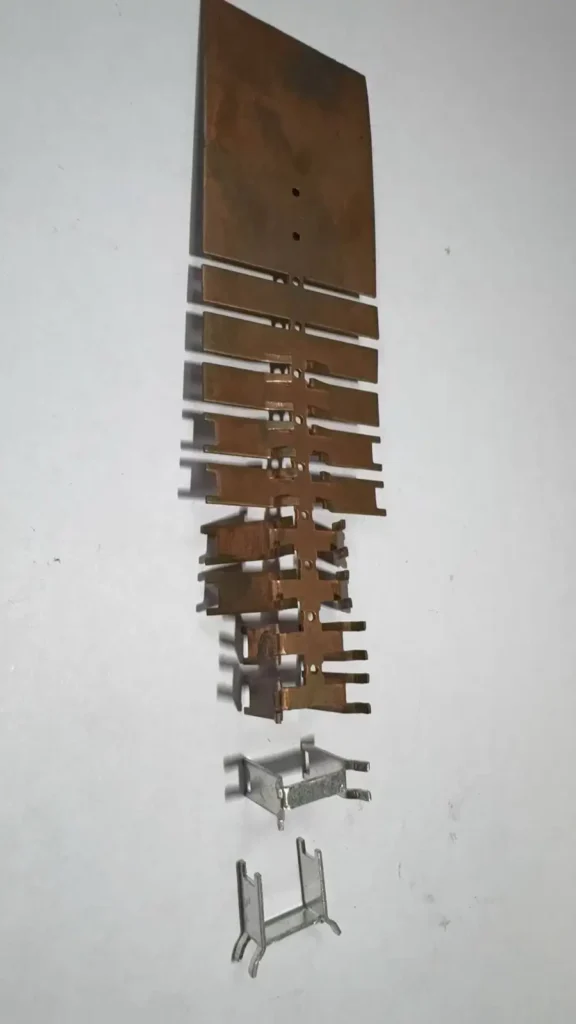
Metal Stamp Factory has produced brass electrical terminal components for power sockets using progressive die stamping. The project included left- and right-side conductive contacts for power sockets, with both male and female terminal forms.
After stamping, the brass terminals received nickel underplating followed by tin plating through a partner finishing facility. The project was supplied to a customer in the United States. We do not have verified records showing that REACH compliance was a specific customer requirement for this order, and no additional REACH compliance documents were requested by the customer.
Although REACH was not confirmed as a customer requirement for this U.S. project, the part illustrates an important sourcing point: the finished component consisted of both a brass substrate and a nickel-plated surface. For the same type of part supplied into the EU market, both would need to be considered when defining the required REACH-related information and supporting documentation.

OEM Buyer REACH Checklist for Metal Stamping Parts
Use this checklist when reviewing a custom stamped component for an EU supply chain:
- Component classification: Confirm whether the supplied item is an article under REACH.
- Base material: Define and verify the specified material.
- Surface finish: Identify every plating, coating, passivation, painting, or other applied finish.
- Regulatory screening: Check the applicable Candidate List information and any relevant Annex XVII restrictions.
- Supply-chain roles: Clarify which EU actor has the relevant legal obligation and what information the non-EU supplier must provide.
- REACH-specific evidence: Define the supplier declarations or supporting information required by the customer.
- SCIP information: Where applicable, collect the material and article information needed by the relevant EU duty holder.
- Pre-tooling sign-off: Resolve material, finish, documentation, and testing requirements before tooling release.
Common REACH Mistakes When Sourcing Stamped Metal Parts
Common sourcing mistakes include:
- asking for a generic “REACH certificate” instead of defining the required part-specific information;
- treating the 0.1% threshold as an automatic product ban;
- reviewing the base metal while ignoring plating, passivation, paint, or other finishes;
- confusing Article 33 communication with Article 7(2) notification;
- averaging a component-level SVHC concentration across a larger assembly;
- waiting until after tooling release to define material or finish compliance requirements;
- treating REACH and RoHS as interchangeable frameworks.
Common REACH Compliance Questions from OEM Buyers
Are metal stamping parts subject to REACH?
Typically yes. A stamped metal component is generally treated as an article when its shape, surface, or design determines its function to a greater degree than its chemical composition. The exact obligations then depend on the substances present, the intended use, and the role of the relevant actors in the EU supply chain.
Does REACH require a certificate for stamped metal parts?
No. ECHA does not issue or mandate a standardized “REACH Certificate” for stamped metal parts. OEM buyers should instead review the scope and evidence behind supplier declarations, material information, finishing documentation, and any supporting test data required for the project.
Does an SVHC above 0.1% mean a metal part is banned in the EU?
No. Candidate List status alone does not automatically prohibit an article from being placed on the EU market. Exceeding the Article 33 threshold can trigger communication duties, while separate Annex XVII restrictions and other applicable legal requirements must also be checked.
Does an SVHC above 0.1% automatically require notification to ECHA?
No. Article 7(2) notification requires more than the concentration threshold. The total quantity of the Candidate List substance must also exceed 1 tonne per producer or importer per year, and applicable exemptions must be considered.
Do plating and coatings need to be included in a REACH review?
Yes. The finished article should be assessed as actually supplied. Base-metal documentation may describe the substrate, but electroplating, passivation, conversion coatings, paint, powder coating, and other applied finishes can introduce additional substances that need to be considered.
Is third-party REACH testing mandatory for every metal stamping part?
No. REACH does not require every part or shipment to undergo third-party testing. Testing is generally used as supporting evidence when supply-chain information is incomplete, when a particular material or finish creates uncertainty, or when the OEM customer requires independent verification.
Technical & Sourcing Consultation
If your engineering or procurement team is preparing a custom metal stamping project for the European market, send us your drawing, material specification, surface finish requirements, and required compliance documentation. We can review the manufacturing requirements before quotation and tooling release.