Founder of Metal Stamp Factory with more than 25 years of hands-on experience in tooling development, metal stamping, and OEM production.
Sourcing custom metal stamping parts for international OEM programs requires navigating a dense landscape of technical standards, quality frameworks, chemical regulations, and part-approval workflows. Sourcing managers and procurement professionals frequently ask a straightforward question: “Which metal stamping certifications does my project require?”
However, searching for a single universal “compliance checklist” often leads to confusion. A stamped component manufactured for an automotive powertrain follows fundamentally different regulatory and quality validation rules than a structural mounting bracket for general industrial equipment or a thin-gauge contact shield used inside a high-voltage electronics enclosure.
A common pitfall in global procurement is “certification soup”—grouping organizational standards, material specifications, environmental laws, and customer approval workflows into a single undifferentiated category. ISO 9001, REACH, RoHS, ASTM material callouts, PPAP packages, and Mill Test Reports (MTRs) are not interchangeable, nor are they equivalent types of “certification.”
The first step in qualifying a metal stamping project is not simply asking which certificates a supplier holds. It is identifying which specific types of compliance apply to the physical part, the raw material, the target market, and the finished assembly. This guide provides an OEM buyer’s framework to classify these requirements, define them during the Request for Quotation (RFQ) stage, and review supporting documentation without delaying project timelines.
What Does “Compliance” Mean in Metal Stamping?
In precision metal manufacturing, “compliance” can be understood across six primary types of requirements:
- Quality Management Systems (QMS): Organizational systems governing process control, documentation, corrective action, and continual improvement.
- Environmental, Restricted-Substance, and Supply-Chain Requirements: Regulatory, chemical-substance, and applicable supply-chain reporting obligations.
- Material and Technical Standards: Engineering specifications defining material grades, properties, dimensions, or other technical requirements.
- Customer-Specific Requirements (CSRs): Project-specific quality, packaging, testing, documentation, or operational requirements defined by the buyer or customer program.
- Part Approval and Industry-Specific Systems: Approval or reporting systems used for customer- or industry-specific project requirements.
- Documentation and Evidence: Material reports, inspection records, declarations, certificates, or other records used to demonstrate conformity.
Compliance extends beyond hanging a quality system certificate on a factory wall. A supplier may operate under a certified quality management system yet still produce a non-compliant component if required material traceability is missing, if a secondary finish fails an applicable restricted-substance requirement, or if required part-validation records are incomplete.
The Main Types of Metal Stamping Certifications and Compliance Requirements
To establish an effective sourcing strategy, OEM buyers should distinguish between six primary types of compliance requirements:
| Compliance Category | What It Covers | Common Examples |
|---|---|---|
| Quality Management Systems | Organization-level quality management and process controls | ISO 9001, IATF 16949, AS9100 |
| Environmental, Restricted-Substance & Supply-Chain Requirements | Chemical restrictions, regulatory obligations, and applicable supply-chain reporting requirements | REACH, RoHS, Conflict Minerals / CMRT |
| Material & Technical Standards | Material grades, properties, specifications, and engineering requirements | ASTM, SAE, EN, DIN, JIS |
| Customer-Specific Requirements | Project-specific quality, packaging, testing, documentation, or operational requirements defined by the buyer | Drawings, supplier manuals, quality agreements, purchase orders |
| Part Approval & Industry Systems | Customer or industry-specific part validation and material reporting | PPAP, IMDS |
| Documentation & Evidence | Records used to demonstrate material, inspection, or conformity requirements | MTR, CoC, inspection reports, declarations |
1. Quality Management System Certifications
Quality Management System (QMS) certifications assess an organization’s framework for process control, risk management, and operational consistency. Common QMS frameworks in metal stamping include:
- ISO 9001: A widely used international standard for quality management systems across manufacturing and other sectors.
- IATF 16949: An automotive quality management system standard used together with applicable customer-specific requirements.
- AS9100: The quality management standard tailored specifically for the aviation, space, and defense industries, placing heightened emphasis on risk management, configuration control, and product safety.
A valid QMS certificate indicates that the certified organization operates a documented quality management system within the stated certification scope. However, holding a QMS certification does not automatically prove that every individual part shipped from that facility meets chemical, environmental, or mechanical drawing callouts.
For a side-by-side comparison of ISO 9001, IATF 16949, and AS9100, see our guide to quality management system standards.
2. Environmental, Restricted-Substance, and Supply-Chain Requirements
Environmental, restricted-substance, and supply-chain requirements may affect the materials, surface finishes, and reporting obligations associated with stamped components. Key frameworks include:
- REACH: For stamped components that qualify as “articles” under REACH, the presence of Candidate List Substances of Very High Concern (SVHCs) can trigger supply-chain communication or other obligations when applicable concentration and regulatory conditions are met.
- RoHS: The Restriction of Hazardous Substances directive restricts specified hazardous substances in electrical and electronic equipment within the Directive’s scope.
- Conflict Minerals (CMRT / 3TG): Supply-chain due-diligence and reporting mechanisms used to collect information about the sourcing of tantalum, tin, tungsten, and gold and support responsible-minerals reporting requirements.
Applicability depends on the end-use application, target geographic market, base alloy selection, and secondary surface treatments (such as electroplating, passivation, or coating).
3. Material and Technical Standards
Technical standards govern the physical properties and alloy chemistry of sheet metal coils used in stamping operations. Common standards organizations include:
- ASTM International: Widely used across North America for specifying steel, aluminum, copper, and brass alloys (e.g., ASTM A1008 for cold-rolled steel).
- EN (European Standards): Defines material designations and technical delivery conditions within European markets (e.g., EN 10130).
- DIN / JIS / SAE: National and industry-specific standards governing metal grades, mechanical temper, and dimensional tolerances.
Specifying an ASTM or DIN material grade on an engineering drawing establishes a technical specification for the raw material. It does not constitute a “supplier certification.”
4. Customer-Specific Requirements
Customer-specific requirements (CSRs) are project-level obligations defined by the buyer, OEM, or customer program. They may appear in engineering drawings, supplier manuals, quality agreements, purchase orders, packaging specifications, or other agreed project documents.
- Drawing and Specification Requirements: Material grades, tolerances, surface finishes, inspection criteria, and other technical callouts.
- Quality and Documentation Requirements: Inspection records, traceability, declarations, approval packages, or shipment documentation requested by the customer.
- Packaging and Operational Requirements: Labeling, packaging, identification, submission timing, or other project-specific instructions.
Customer-specific requirements can add obligations beyond general industry standards or regional regulations and should therefore be confirmed during the RFQ stage.
5. Part Approval and Industry-Specific Systems
Certain industries and customer programs use structured approval or data-reporting systems before or during production:
- PPAP for metal stamping parts (Production Part Approval Process): A structured part-approval framework widely used in automotive supply chains and sometimes required by other customer programs to verify that engineering and production requirements have been understood and addressed.
- IMDS (International Material Data System): An online material data repository used primarily in the automotive supply chain to upload, declare, and manage the material breakdown of individual components.
- For details on the material, coating, purchased-component, and sub-supplier information involved in reporting, see our guide to IMDS for metal stamping parts.
These are project-specific approval or reporting systems used within customer or industry programs; they are not factory-level certifications.
6. Compliance and Material Documentation
Compliance evidence may include documents provided during supplier qualification, sample approval, production, or shipment, depending on the project requirements:
- Mill Test Report (MTR): A material document that typically records information such as the material specification, heat or lot identification, chemical composition, and mechanical properties, depending on the material and report type.
- Certificate of Conformance (CoC): A document issued by the manufacturer or supplier affirming that the delivered parts comply with specified purchase order rules, drawing callouts, and project parameters. For a buyer-level comparison of the two document types, see Certificate of Conformance vs Mill Test Report.
- Inspection Reports: Physical dimensional records, visual inspection logs, or first-article reports detailing actual measured values against drawing tolerances.
Supplier-Level, Material-Level, and Part-Level Requirements Are Different
To avoid procurement errors, sourcing teams should organize compliance into distinct operational levels:
| Requirement Level | What It Applies To | Examples |
|---|---|---|
| Supplier / Organization | Quality management system | ISO 9001, IATF 16949, AS9100 |
| Material | Material specification and properties | ASTM, SAE, EN, material reports |
| Substance / Regulatory | Restricted substances or regulatory obligations | REACH, RoHS where applicable |
| Part / Project | Customer-defined part approval | PPAP where required |
| Supply-Chain Data | Material disclosure and reporting | IMDS where required |
| Documentation | Evidence requested for the project or order | CoC, MTR, inspection or test reports as applicable |
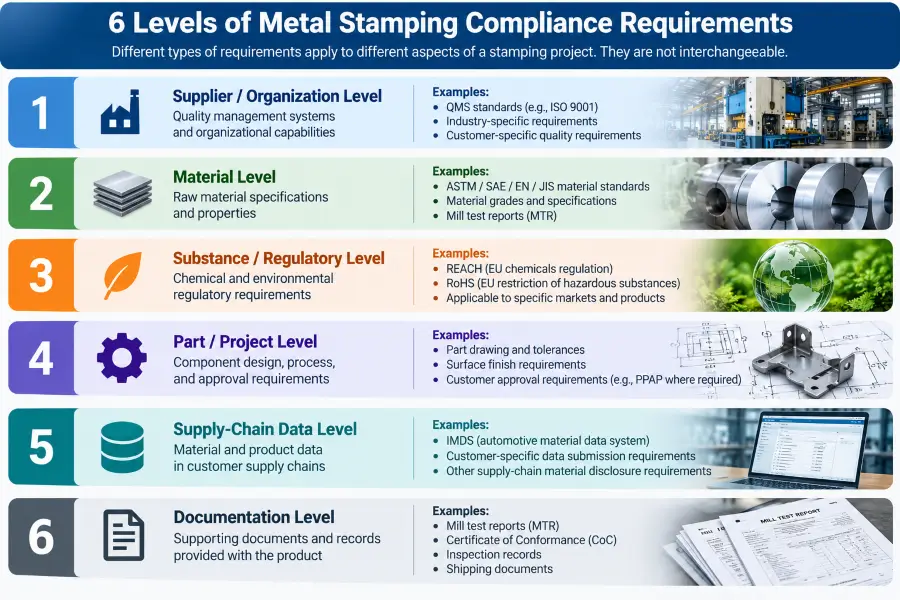
Conflating these levels leads to incomplete RFQs. For instance, requesting an “ISO-certified part” is technically inaccurate: a supplier organization may hold a QMS certificate, the raw material is specified against a technical standard, and the finished part is evaluated through the inspection records or customer approval submissions required by the project. These are separate forms of evidence and should not be treated as interchangeable.
Which Compliance Requirements Apply to Your Stamped Part?
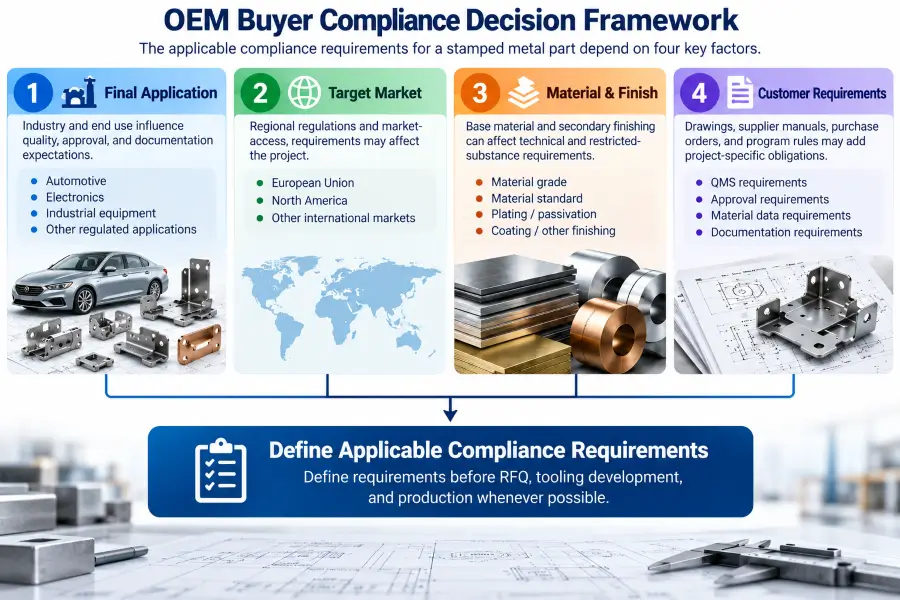
Because compliance parameters vary, buyers should evaluate project requirements using a structured decision framework based on four primary factors:
| Buyer Decision Factor | Questions to Ask | Why It Matters |
|---|---|---|
| Final Application & Industry | Is the part for automotive, aerospace, electronics, general industrial, or another regulated application? | Different industries and customer programs may impose different quality, approval, and documentation requirements. |
| Target Market | Where will the finished product be sold or used? | Regional regulations and market-access requirements may affect the project. |
| Material & Finishing | What base material, plating, passivation, coating, or other finishing is specified? | Compliance can depend on both the raw material and any secondary surface treatment. |
| Customer-Specific Requirements | What do the drawing, supplier manual, quality agreement, or purchase order require? | Customer requirements may go beyond general regulatory or industry expectations. |
What Is the Final Application?
The final application and operating environment can influence the required quality, approval, and documentation controls:
- Automotive Programs: Depending on the customer and program, buyers may specify automotive quality-system requirements, PPAP submissions, IMDS reporting, or additional customer-specific requirements.
- Aerospace & Defense Programs: Depending on the application and customer, sourcing requirements may include tighter material traceability, configuration controls, first-article documentation, or industry-specific supplier qualifications.
- Medical or Other Regulated Applications: Requirements depend heavily on the finished product, material contact conditions, customer specifications, and applicable regulations.
- General Industrial Hardware: Requirements are often project-specific and may range from standard drawing and material documentation to additional QMS, inspection, traceability, or regulatory requirements defined by the buyer.
Where Will the Final Product Be Sold?
Target geographic markets can introduce different regulatory, technical, and customer-specific requirements:
- European Union: For products placed on the EU market, REACH obligations may apply depending on the substance, article, and supply-chain role. RoHS restrictions may also become relevant when the stamped component is incorporated into electrical or electronic equipment within the Directive’s scope.
- North America: Requirements vary widely by industry, customer, and end use. Projects may reference ASTM or SAE material specifications and may also include customer- or sector-specific sourcing, reporting, or compliance requirements.
What Material and Surface Finish Are Specified?
Base metals and secondary surface treatments affect environmental and technical compliance:
- Base Metal: Depending on the drawing, specification, and customer requirements, buyers may request material documentation for carbon steel, stainless steel, aluminum, brass, copper, or other specified alloys.
- Secondary Surface Treatments: Plating, passivation, coating, and other finishing processes can introduce additional material or restricted-substance considerations. Buyers should therefore define the required finish and applicable compliance criteria before production rather than assuming that base-metal documentation alone covers the finished part.
What Does the Customer or OEM Specifically Require?
Customer-specific requirements (CSRs) stated in engineering drawings, quality manuals, purchase orders, or other agreed specifications can add project-specific obligations beyond general industry assumptions. An industrial program may explicitly call for a formal approval submission or third-party testing even if regional legislation does not legally mandate it.
What Should Buyers Define During the RFQ Stage?
Defining compliance criteria before finalizing tooling contracts helps prevent project delays and unbudgeted verification costs. Sourcing managers should specify the following parameters during the initial RFQ:
| RFQ Item | What the Buyer Should Define | Typical Examples |
|---|---|---|
| Base Material | Grade, standard, temper/condition, thickness | ASTM, EN, JIS, SAE |
| Secondary Finish | Finish type and applicable specification | Plating, passivation, coating |
| Regulatory Requirements | Applicable substance or supply-chain requirements | REACH, RoHS, customer declarations |
| Approval Requirements | Required customer approval process | Sample report, FAI, PPAP where required |
| Documentation | Documents required with samples or shipments | MTR, CoC, dimensional reports |
| Traceability | Required material or batch traceability | Heat/lot references, labels, batch records |
How Should Buyers Verify Compliance Claims?
Reviewing compliance documents requires careful verification of evidence rather than relying solely on high-level vendor statements:
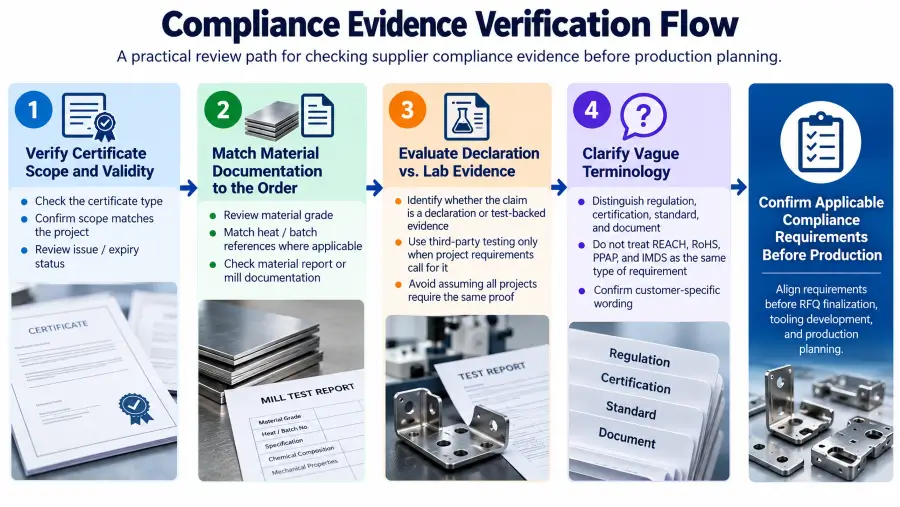
- Verify Certificate Scope and Validity: When reviewing factory quality certificates, verify that the certificate is currently active, issued by an accredited registrar, and explicitly covers the manufacturing site and metal stamping/tooling processes being utilized.
- Match Material Documentation to the Order: Verify that Mill Test Reports (MTRs) reference the applicable heat or lot identification, material grade, chemical analysis, and mechanical properties required by the purchase order, drawing, and material specification.
- Evaluate Declaration vs. Lab Evidence: A supplier’s written Certificate of Conformance (CoC) affirms that parts were produced according to purchase order instructions. When a project or customer requirement calls for independent evidence, buyers may specify appropriate third-party laboratory testing or reports.
- Clarify Vague Terminology: If a vendor claims a part is “REACH certified,” request clarification regarding the specific SVHC candidate list revision evaluated and ask for a formal material declaration or laboratory report supporting the statement.
Common Compliance Mistakes When Sourcing Metal Stampings
- Treating Every Requirement as a “Certification”: Conflating material callouts (ASTM), environmental directives (RoHS), quality management systems (ISO 9001), and part approval tools (PPAP) into a single checklist item creates confusion during vendor evaluations.
- Assuming a QMS Certificate Guarantees Part-Level Compliance: A valid ISO 9001 certificate indicates that the certified organization operates a quality management system within the stated certification scope; it does not automatically establish product-level regulatory compliance.
- Assuming REACH and RoHS Apply Identically: REACH governs chemical substances across broader product categories, whereas RoHS specifically restricts designated hazardous substances in electrical and electronic hardware within its scope.
- Accepting Material Documentation Without Technical Verification: Receiving a generic material sheet without verifying that the chemical composition, temper, and heat numbers match the ordered raw material coil can result in unvetted production runs.
- Postponing Compliance Definitions Until After Tooling: Requesting custom documentation, specialized material declarations, or high-level PPAPs after progressive stamping dies are built can extend lead times and introduce added verification costs.
- Mandating Complex Approval Systems Indiscriminately: Requiring detailed PPAP submissions or IMDS reporting for projects where they are not customer- or program-required can introduce unnecessary administrative overhead.
Metal Stamping Compliance by Requirement Type
The following matrix summarizes how common buyer questions map to specific compliance categories and typical verification deliverables:
| Buyer Question | Compliance Category | Primary Requirement Type | Typical Evidence / Deliverable |
|---|---|---|---|
| Is the supplier’s quality management system verified? | Organizational QMS | Process / System Standard | Applicable certification if required |
| Does the raw material meet engineering specifications? | Material Specification | Technical / Alloy Standard | Material report / MTR as applicable |
| Does the part comply with environmental rules? | Environmental Regulation | Substance Restriction | Declaration or test evidence where applicable |
| Is the part approved for serial production? | Part Approval | Customer Validation Framework | PPAP or customer-defined process |
| Is automotive material entry required? | Material Data | Industry Database System | IMDS where required |
| What documents must accompany shipment? | Order Conformance | Contractual Documentation | Requirements defined in RFQ/PO |
Questions to Ask Before Ordering Custom Metal Stamping Parts
Before releasing a purchase order and launching custom tooling development, sourcing managers should review this practical qualification checklist:
- Final Market & Application: What market and final application will the part enter?
- Material Specifications: Which material specification is required?
- Environmental Mandates: Are REACH or RoHS requirements applicable?
- Quality System Expectations: Does the customer require a specific QMS certification?
- Part Approval Protocol: Is PPAP or IMDS required?
- Required Shipment Documentation: What conformity or material documents are required?
- Laboratory Testing: Is independent testing required?
- Traceability Controls: What level of traceability is required?
- Documentation Schedule: When must documents be submitted?
How Metal Stamp Factory Approaches Compliance Requirements
For custom metal stamping projects, Metal Stamp Factory can review customer drawings, material specifications, and confirmed project requirements before production planning.
- Drawing and Requirement Review: Customer drawings, material specifications, and confirmed project requirements can be reviewed before production planning.
- Material Documentation: Available material reports originate from the raw-material mill or material supplier. We review the supplied document against the purchased material specification; whether a copy can be provided to the buyer depends on the source document and the agreed project requirements.
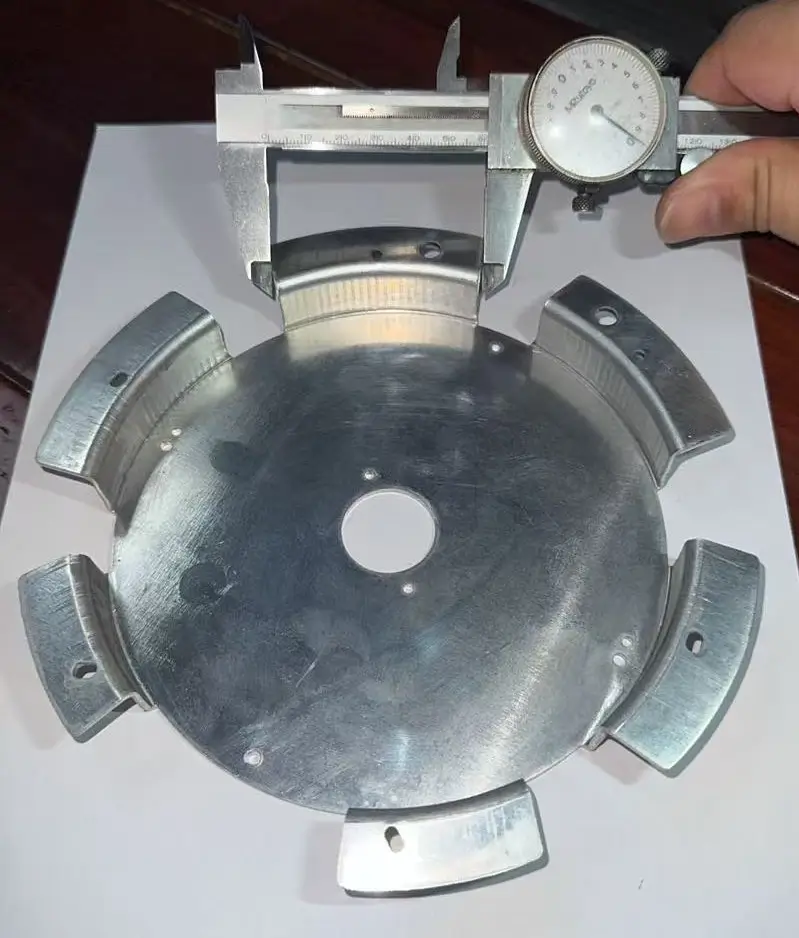
- Inspection: Available metal stamping quality inspection activities include dimensional inspection, visual inspection, burr inspection, and final inspection using tools such as Vernier calipers, micrometers, and height gauges.
- Secondary Processing Coordination: Where secondary processing is required, project requirements can be clarified in advance and coordinated with partner facilities where applicable.
- Documentation Alignment: Required material and inspection documentation should be clarified with the buyer before production so that the agreed project requirements are understood in advance.
Metal Stamp Factory was established in 2014 in Xiamen, China. The business focuses on drawing-driven custom metal stamping and precision hardware manufacturing. Its founder, Shengtong Chen, began learning mold making and metal stamping at the age of 17 and has accumulated more than 25 years of hands-on experience in tooling development, metal stamping, and OEM production. The founder’s industry experience should be distinguished from the company’s establishment date.
Final Takeaway
Achieving compliance when sourcing custom metal stampings requires systematic planning. A practical compliance-planning approach can be organized into four steps:
- Identify Applicable Frameworks: Distinguish between factory-level QMS standards, raw material technical specs, environmental regulations, and part approval packages.
- Define Expectations Early: Include material grades, surface finishing parameters, and documentation requirements directly within the initial RFQ package.
- Specify Supporting Deliverables: State clearly which documents—such as MTRs, CoCs, or dimensional logs—must accompany sample approvals and serial production shipments.
- Verify Conformance Records: Review supporting material and inspection evidence against drawing callouts prior to authorizing full production release.
Need Help Reviewing Compliance Requirements for Your Stamped Part?
Send us your part drawing, material specifications, target application, target market, and any customer-specific compliance requirements. We can review the available project information and clarify material, inspection, documentation, and secondary-processing requirements before production planning.
Frequently Asked Questions
What certifications should a metal stamping supplier have?
There is no universal certification package for every metal stamping supplier. The appropriate requirements depend on the end application, customer program, target market, and contractual requirements. A buyer may require a specific QMS certification such as ISO 9001, IATF 16949, or AS9100 for certain projects, but applicability should be confirmed for the actual program rather than assumed from the part type alone.
Is REACH or RoHS a certification for metal stamping parts?
Neither REACH nor RoHS is a factory certification. REACH is a European Union chemical regulation governing substances of concern in articles, while RoHS is a directive restricting specific hazardous substances in electrical and electronic equipment. Evidence may include supplier declarations, material information, or test reports depending on the applicable requirement, customer, and supply-chain role; neither framework should be treated simply as a factory-level certification.
Does every stamped metal part require PPAP?
No. PPAP is a part-approval process widely associated with automotive supply chains and may also be required by other customers or programs. Whether it is required depends on the specific customer and project.
What is the difference between a material standard and a supplier certification?
A material standard (such as an ASTM, DIN, or EN specification) can define requirements for material composition, mechanical properties, condition, dimensions, or other technical characteristics of the raw material. A supplier certification such as ISO 9001 relates to the manufacturer’s quality management system. In short, a material standard applies to the material specification, while a QMS certification applies to the organization’s management system.
What compliance documents should buyers request from a metal stamping supplier?
Common documentation requested during sourcing may include Mill Test Reports (MTRs) or other material reports supporting the specified material grade and relevant heat or lot information, Certificates of Conformance (CoCs), dimensional inspection records, and environmental or material declarations where applicable. The exact document package should be defined by the drawing, purchase order, customer requirements, and target application.
For a broader overview of the documents buyers may request, see our guide to compliance documents for metal stamping suppliers.
When should compliance requirements be confirmed for a metal stamping project?
Compliance requirements should be defined during the RFQ and quotation stage whenever possible, before tooling development begins. Early agreement on material, finishing, approval, testing, and documentation requirements helps reduce later changes, delays, and unexpected costs.