Quick answer: genuine 304 stainless steel can rust when microscopic iron particles from a carbon-steel forming tool get embedded in the surface during manufacturing — this is called free iron contamination, and it’s a processing issue, not a sign of fake material.
Why does 304 stainless steel rust? Genuine 304 stainless steel can rust — even when the material certificate is real, the mill test report is clean, and nothing about the alloy itself is wrong. We saw this firsthand on a small-bore tube component, and the cause had nothing to do with the steel being fake.
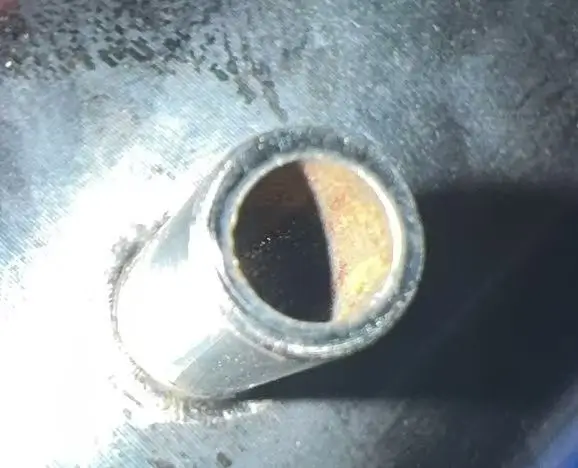
Same genuine 304 tube — one side already rusting inside the bore, the other still clean. The steel didn’t change; something inside the bore did.
Why Does 304 Stainless Steel Rust? It’s Not a Bad Batch of Steel
This part was a 304 stainless steel tube, roughly 4.5mm internal diameter, welded to another stainless component after cutting to size. The raw material was genuine mill stock, and the bore itself had never been touched by a cutting tool after forming — it was left exactly as the forming process produced it.
Within about a month in service, rust appeared inside the bore. Not on the outside, which had been electropolished after welding — inside, where nobody had looked closely.
How Iron Gets Into a Stainless Steel Part During Manufacturing
The likely cause is a well-documented phenomenon called free iron contamination. When a stainless steel bore this narrow is expanded or shaped using a carbon steel die or mandrel, friction between the tool and the workpiece can leave microscopic iron particles embedded in the stainless surface. Those transferred iron particles can corrode independently of the surrounding stainless steel surface, creating visible rust even when the base material itself is genuine 304 stainless steel.
Electropolishing the outside of the part afterward can improve the exterior surface and remove surface contamination there. However, on a very small internal bore, the effectiveness of the treatment may be limited by the part geometry and process setup, leaving internal surface contamination insufficiently addressed.
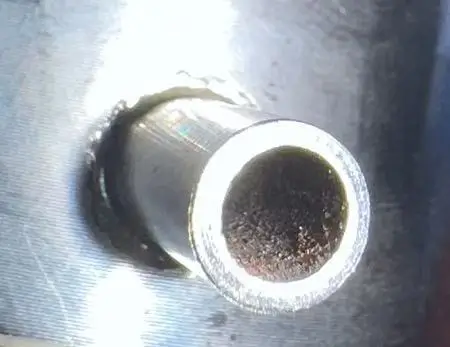
A closer look at the bore surface — this texture is what free iron contamination looks like once it starts to corrode.
What We Found When We Tested It
To investigate whether the corrosion behavior was related to the bulk material or the bore surface condition, we evaluated a separate batch through salt spray testing. The bore showed earlier corrosion than the surrounding stainless surface. This observation was consistent with our suspected surface-contamination mechanism, although salt spray testing alone does not identify the specific contaminant or prove the root cause.
The Fix: Machining Before Electropolishing
The solution was straightforward once the suspected cause was identified: take a light lathe pass across the internal bore surface to remove the affected surface layer, then electropolish the part afterward. In this case, mechanically removing the affected bore surface before the final surface treatment addressed the suspected contamination source rather than treating only the visible rust.
Why This Matters If You’re Sourcing Small-Bore Stainless Parts
If your part has a narrow stainless steel bore that gets formed, expanded, or shaped using a steel tool, ask your supplier how the internal bore surface is cleaned, machined, or otherwise treated before the final surface-finishing step. For small internal features, it is important to evaluate the bore itself rather than assuming that an exterior finishing treatment has also addressed the internal surface.
If material grade is a separate concern for your project, our guide on stainless steel grade verification covers how to confirm you’re getting genuine 304 or 316 in the first place — a related but different question from the surface contamination issue described here.
Frequently Asked Questions
Does this mean my 304 stainless steel part is fake? No. Free iron contamination is a manufacturing byproduct, not proof of material substitution. The base material can be 100% genuine 304 while still showing surface rust caused by contamination from a forming tool.
Can passivation alone fix this problem? Not necessarily. The effectiveness of passivation or other surface treatments depends on the contamination, part geometry, and process conditions. In our case, the affected internal bore surface was mechanically removed before the final surface treatment.
How do I know if my supplier is checking for this? Ask directly how internal bore surfaces are cleaned, machined, or otherwise treated before the final surface-finishing step, rather than asking only whether the exterior receives a finishing treatment.
Related Reading
How to Verify Stainless Steel Grade (200 vs 300 Series, 304 vs 316)