Founder of Metal Stamp Factory with more than 25 years of hands-on experience in tooling development, metal stamping, and OEM production.
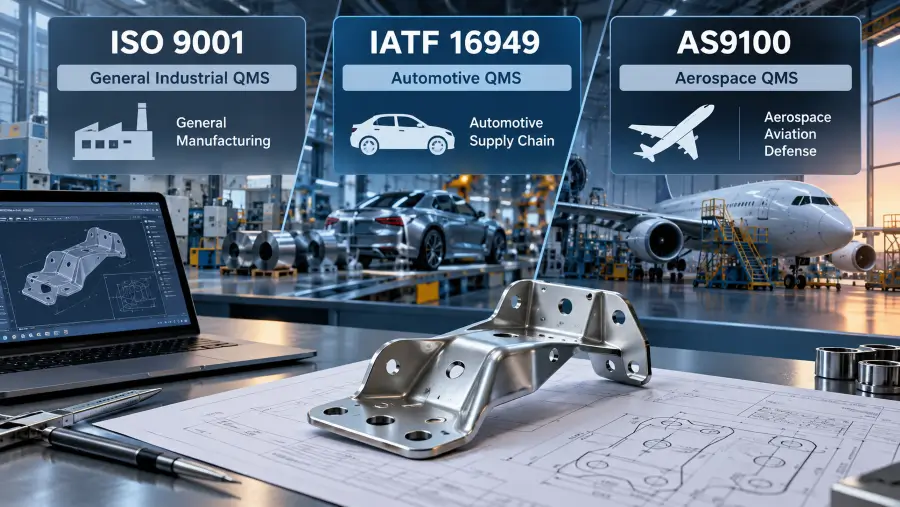
When sourcing custom metal stamped components, procurement engineers, OEM buyers, and supplier quality teams frequently review supplier credentials as part of their vendor-vetting process. Supplier proposals or company profiles may reference quality management system (QMS) standards such as ISO 9001, IATF 16949, or AS9100.
For sourcing managers, evaluating these standards involves more than checking whether a company holds a certificate. Different industries impose distinct risk profiles, supply chain controls, and verification requirements. Understanding ISO 9001 vs IATF 16949 vs AS9100 helps procurement teams determine what each standard actually governs, when a specific certification is required, how to verify a supplier’s certificate scope, and how QMS certifications differ from part-level quality evidence like material certificates, dimensional reports, and production part approvals.
ISO 9001 vs IATF 16949 vs AS9100: Quick Answer
Quality management system standards establish the organizational frameworks that manufacturers use to control processes, maintain document control, manage corrective actions, and address customer requirements. However, they serve different industrial markets and carry distinct compliance expectations.
Table 1: Quick Reference Guide for Metal Stamping Buyers
| Comparison Element | ISO 9001 | IATF 16949 | AS9100 |
|---|---|---|---|
| Primary Industry Context | General industrial, commercial, and broad manufacturing sectors. | Automotive supply chains and customer-specific automotive programs. | Aviation, space, and defense supply chains. |
| Relationship to ISO 9001 | General quality management system standard. | Built on ISO 9001 requirements with additional automotive-specific requirements; buyers should verify the applicable edition and customer requirements. | Built on ISO 9001 requirements with additional aviation, space, and defense requirements; buyers should verify the applicable edition and customer requirements. |
| Typical Buyer Use | May be specified for general industrial supplier qualification where a formal QMS certificate is required. | May be required when an automotive customer, program, or supplier-approval process specifies IATF 16949 certification. | May be required when an aviation, space, or defense customer or program specifies AS9100 certification. |
| Certifies Individual Stamped Parts? | No. The certification applies to a defined quality management system and scope, not to individual stamped parts. | No. The certification applies to a defined quality management system and scope, not to individual stamped parts. | No. The certification applies to a defined quality management system and scope, not to individual stamped parts. |
| Replaces Part-Level Deliverables? | No. Does not replace PPAP, MTRs, CoCs, IMDS, or First Article Inspection reports. | No. Does not replace PPAP, MTRs, CoCs, IMDS, or First Article Inspection reports. | No. Does not replace PPAP, MTRs, CoCs, IMDS, or First Article Inspection reports. |
| Site & Scope Verification Needed? | Yes. Buyers should verify the applicable legal entity, manufacturing site coverage, and certification scope. | Yes. Buyers should verify the applicable legal entity, manufacturing site coverage, and certification scope. | Yes. Buyers should verify the applicable legal entity, manufacturing site coverage, and certification scope. |
What Is ISO 9001 for a Metal Stamping Supplier?
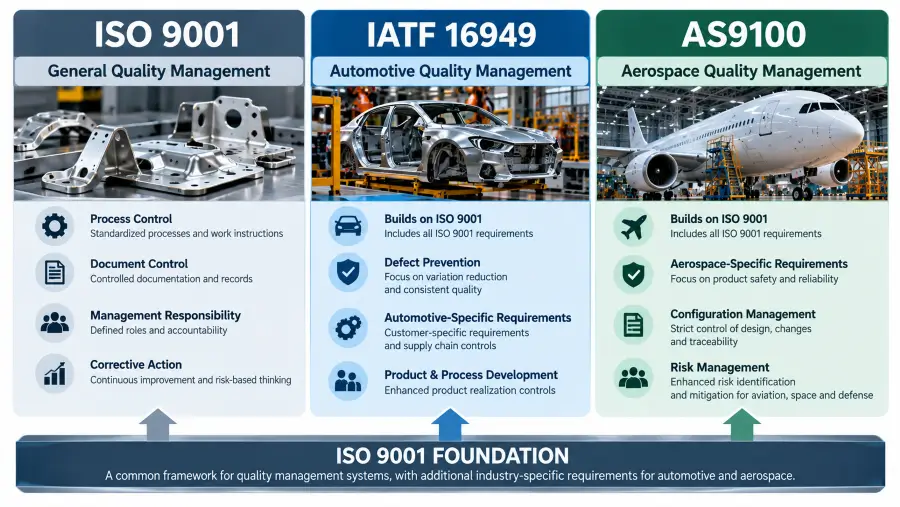
ISO 9001 is a globally recognized standard for quality management systems. It provides a structured framework for organizations to demonstrate their ability to consistently provide products and services that meet customer and applicable statutory and regulatory requirements.
In a custom metal stamping environment, an ISO 9001-certified quality management system may include controls such as:
- Process Control: Establishing standard operating procedures for tool setting, press operation, and secondary coordination.
- Document and Revision Control: Ensuring that production lines work from the latest approved customer engineering drawings and revision levels.
- Corrective Action and Risk-Based Thinking: Investigating nonconformities, addressing causes, and using risk-based controls to reduce recurrence and prevent quality problems.
- Customer Requirements Review: Evaluating drawing specs, material requirements, and commercial terms before accepting an order.
A valid ISO 9001 certificate issued through an appropriate third-party certification process provides evidence that the defined quality management system has been assessed against the standard. It does not guarantee that every manufactured part is defect-free or conforms to every drawing requirement.
What Is IATF 16949 for Automotive Metal Stamping?
IATF 16949 is an automotive quality management system standard developed by the International Automotive Task Force (IATF). The current IATF 16949:2016 edition is designed to be used together with ISO 9001:2015 and adds automotive-specific quality-management requirements for organizations within its applicable automotive supply-chain scope.
In automotive manufacturing, customer-specific requirements, high-volume production, process variation, and supply-chain controls can create demanding quality-management expectations. IATF 16949 places strong emphasis on:
- Defect Prevention: Proactive risk identification and reduction strategies across manufacturing processes.
- Variation Reduction: Controlling manufacturing variation and process performance in serial production.
- Supply-Chain Quality Controls: Managing external suppliers, material mills, and subcontracted finishing operations.
- Customer-Specific Requirements (CSRs): Integrating individual automotive OEM mandates into daily factory operations.
Not every automotive stamping project automatically requires an IATF 16949-certified supplier. Whether certification is required depends on the customer, program, supplier-approval process, and contractual requirements.
What Is AS9100 for Aerospace Metal Stamping?
IAQG 9100 quality management system requirements are used in aviation, space, and defense supply chains. In the United States, the 9100 aerospace quality-management standard is commonly published as AS9100. It adds sector-specific requirements in areas such as risk, product safety, configuration management, and operational control.
Aerospace programs can involve demanding safety, traceability, configuration, and customer-specific requirements. AS9100 places particular emphasis on:
- Risk Management: Structured identification and treatment of operational and product-related risks.
- Product Safety: Managing product-safety requirements throughout applicable product-realization activities.
- Configuration Management: Controlling applicable design configurations, revisions, and engineering changes.
- Traceability and Control: Maintaining identification and traceability controls to the extent required by the product, process, customer, and applicable program requirements.
Whether AS9100 certification is required depends on the applicable customer, program, supplier-approval process, and contractual requirements.
Which Certification Should a Metal Stamping Buyer Require?
Selecting the appropriate certification requirement depends on the end-use application, customer and program requirements, contractual terms, and the purchasing organization’s supplier-qualification policy.
General Industrial and Commercial Metal Stamping
For general industrial applications—such as electrical enclosures, solar mounting brackets, architectural hardware, or commercial appliances—some procurement teams specify ISO 9001 as a supplier-qualification requirement. Others may use different qualification criteria depending on internal policy, project risk, customer requirements, and contract terms. ISO 9001 should therefore be treated as a project-specific sourcing requirement rather than a universal rule for every stamped part.
Automotive Metal Stamping
When sourcing stamped components for automotive applications, sourcing teams must verify whether the OEM, Tier 1 program, or customer quality manual requires IATF 16949. If a program explicitly specifies IATF 16949 certification as a condition of supplier onboarding, procurement engineers must confirm that prospective suppliers meet that qualification before committing to tooling or serial production.
Aerospace Metal Stamping
For aviation, space, or defense hardware, some customers and programs require AS9100 as part of supplier qualification. If AS9100 is a mandatory program or contractual requirement, a supplier that does not hold the required certification may not qualify for that sourcing opportunity, regardless of its general stamping capabilities.
Does a QMS Certificate Guarantee That a Stamped Part Conforms?
No. A management system certificate does not guarantee that an individual manufactured part conforms to drawing specifications.
Procurement teams must maintain a clear distinction between:
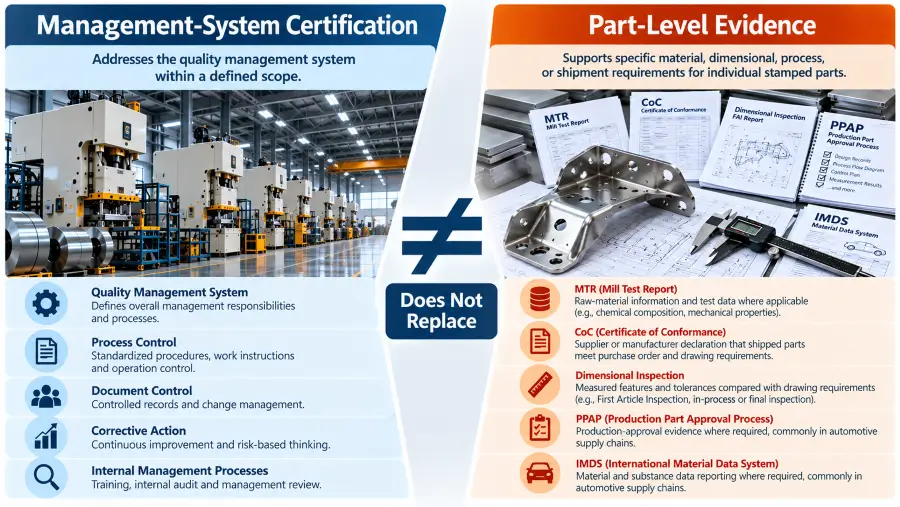
- Management-System Certification: Provides evidence that a defined quality management system has been assessed against the applicable standard.
- Part-Specific Quality Evidence: Provides evidence relevant to whether a specific part, sample, or production lot meets defined drawing, material, inspection, or purchase-order requirements.
A QMS certificate does not replace part-specific evidence. Depending on the project and customer requirements, supporting records may include:
- Drawing Compliance & Dimensional Inspection: Checking measured features against the applicable drawing and tolerance requirements.
- Material Test Reports (MTRs): Providing raw-material information and test results where applicable.
- Certificates of Conformance (CoCs): Providing a supplier or manufacturer declaration against an identified scope of requirements.
- Production Part Approval Process (PPAP): Providing production-approval evidence where PPAP is required by the customer or program.
- IMDS Material Data Sheets: Reporting automotive material and substance information where IMDS is required.
- REACH and RoHS Documentation: Supporting applicable material or substance compliance requirements where requested.
Management-system certification addresses how a defined quality system is managed within its certified scope; part-level records address specific material, dimensional, process, or shipment requirements.
What Should Buyers Verify on a Supplier’s Certificate?
When a supplier submits a quality certificate during the onboarding or RFQ stage, procurement engineers should verify the document rather than relying on the certificate title alone. A practical certificate review can include:
- Applicable Standard and Edition: Confirm the applicable standard and edition or revision, such as ISO 9001, IATF 16949, or AS9100, as shown on the certificate.
- Legal Company Entity Name: Verify that the company name on the certificate matches the legal contracting entity and vendor database.
- Manufacturing Site Address: Check the physical street address listed on the certificate.
- Certificate Scope: Read the detailed scope description to ensure it covers the supplier’s actual manufacturing activities (e.g., custom metal stamping and tooling development) rather than just distribution or design.
- Certificate Number: Note the unique certificate identification number.
- Certification Body: Identify the certification body responsible for issuing the certificate.
- Validity / Status Information: Check the available validity, issue, expiry, suspension, or status information as applicable.
- Production Site Coverage: Confirm that the site that will actually manufacture the parts is included within the applicable certificate coverage or site schedule.
- Relevant Scope Details: Review any scope limitations or site-specific details that affect the intended manufacturing activity.
- Independent Verification Where Available: Where appropriate, cross-check certificate or site status through an applicable recognized certification or industry database, such as the OASIS aerospace supplier information system where relevant.
Why Manufacturing Site and Certificate Scope Matter
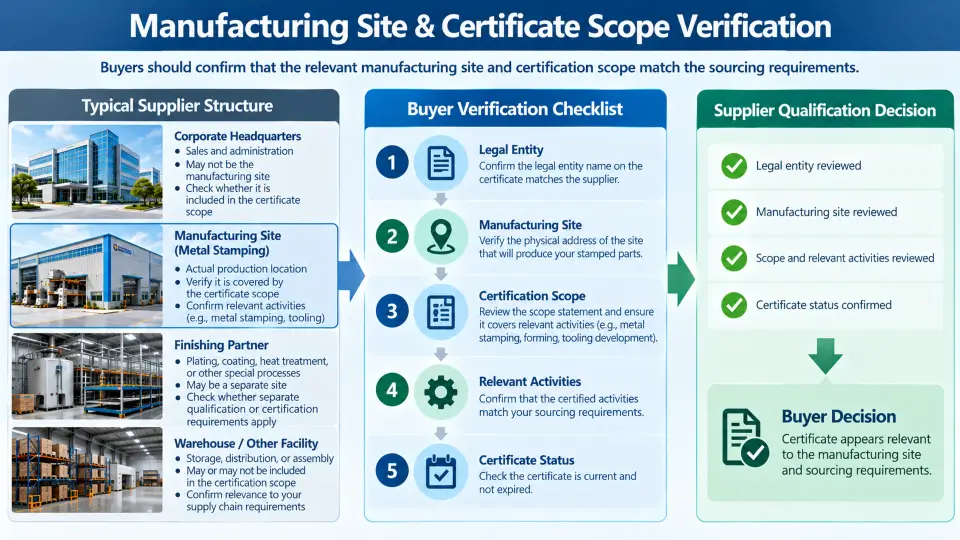
In global contract manufacturing, supply chains often span multiple locations. A supplier might maintain a corporate headquarters in one city, a sales office in another, a metal stamping factory on a different campus, and a plating partner across town.
A common oversight during vendor vetting is assuming that if a corporate entity holds an ISO 9001 certificate, every facility associated with that company is automatically certified.
Procurement teams should verify that:
- The manufacturing site that will actually produce the stamped parts is covered by the relevant certificate.
- The certificate scope is consistent with the activities relevant to the sourcing project rather than being limited to unrelated functions.
- Outsourced secondary operations—such as electroplating, powder coating, heat treatment, or painting—are understood separately, including which organization performs the work and whether any separate qualification or certification requirement applies to that partner facility.
ISO 9001 vs IATF 16949 vs AS9100 vs Part-Level Documentation
To clarify the boundary between management-system certification and part-specific documentation, the following table summarizes their different roles:
Table 2: QMS Certifications vs. Part-Level Deliverables
| Record / Document Type | What It Governs | Who Issues It | Replaces QMS Certification? |
|---|---|---|---|
| ISO 9001 / IATF 16949 / AS9100 | Quality management system within the defined certified organization, site, and scope. | Certification body through the applicable certification process. | N/A (management-system certification). |
| Mill Test Report (MTR) | Raw-material identification and test information where applicable. | Material producer or other documented supply-chain source, depending on the record. | No. An MTR does not replace a required QMS certificate. |
| Certificate of Conformance (CoC) | Supplier or manufacturer declaration against an identified scope of requirements. | Supplier or manufacturer responsible for the declaration. | No. A CoC does not replace a required QMS certificate. |
| PPAP Documentation Package | Production-approval evidence defined by the applicable customer or program requirements. | Supplier submits the required PPAP evidence to the customer. | No. PPAP does not replace a required QMS certificate. |
| IMDS Material Data Sheet | Automotive material and substance information for a component or assembly. | Submitted through IMDS by the responsible supply-chain party where required. | No. IMDS does not replace a required QMS certificate. |
| Dimensional Inspection / FAI | Part-specific dimensional verification against applicable drawing requirements. | Supplier or inspection resource, depending on the project. | No. Dimensional or first-article records do not replace a required QMS certificate. |
What Should Buyers Put in the RFQ or Purchase Order?
Establishing clear quality expectations during the Request for Quotation (RFQ) and purchase-order planning stage can reduce misunderstandings before tooling or production commitments are made.
When drafting an RFQ or purchase contract, procurement teams should specify:
- Required Standard: State explicitly whether ISO 9001, IATF 16949, AS9100, or no specific QMS certification is required for the project.
- Mandatory vs. Preferred Status: Clarify whether certification is a mandatory supplier-qualification condition or a preferred evaluation criterion.
- Manufacturing Site Requirements: Designate the specific approved production facility authorized to manufacture the parts.
- Certificate Verification Expectations: Where certification is required, specify whether the buyer needs a current certificate copy, scope details, or other verification information during bid review.
- Part-Level Deliverables: Detail all required inspection reports, MTRs, CoCs, PPAP elements, or IMDS submissions required for the specific component.
- Customer-Specific Requirements: Reference any applicable industry or OEM standards governing the program.
- Change Notification Rules: Define expectations for notifying the buyer of any material, tooling, or process changes.
Can a Buyer Use a Metal Stamping Supplier Without These Certifications?
Yes in some projects, no in others.
Evaluating a supplier that does not hold one of these certifications depends on the customer, program, contractual, and internal supplier-qualification requirements:
- Case 1: When Certification Is Mandatory: If the customer, program, or corporate supplier-qualification policy requires a specific QMS certification, a supplier without that certification may not qualify unless the buyer has an approved exception or alternative qualification path.
- Case 2: When Certification Is Not Mandatory: If the project does not require a specific QMS certificate, procurement teams may evaluate the supplier against the project’s actual qualification criteria, such as manufacturing capability, engineering review, sample inspection, material documentation, and other customer-defined requirements. These checks do not substitute for a certificate when certification is mandatory.
Metal Stamp Factory Certification Status and Quality Documentation
Transparency regarding manufacturing capabilities and credentials is essential for effective project planning.
Metal Stamp Factory is not currently certified to ISO 9001, IATF 16949, or AS9100.
Metal Stamp Factory is the export brand of Xiamen Yichong Precision Hardware Manufacturing Co., Ltd., based in Xiamen, China. Established in 2014, the business focuses on custom drawing-driven metal stamping and OEM production.
Our in-house manufacturing and engineering work includes custom metal stamping capabilities, progressive die stamping, punching, forming, bending, tooling design, complete die assembly, die tryout, and production process adjustment. Individual die components requiring CNC machining, wire EDM, or other specialized machining operations are manufactured by external machining partners based on our tooling designs. The returned components are assembled in-house, and tooling is installed, tested, and adjusted on our stamping presses before production.
Our general project workflow may include:
- Requirement Review: Evaluating customer engineering drawings, material specifications, and dimensional tolerances before production planning.
- Material Documentation Review: Reviewing available supplier Mill Test Reports or material certificates against specified material requirements where provided.
- Dimensional Inspection: Checking trial parts and selected production features against approved engineering drawings using vernier calipers, micrometers, and height gauges. First-piece inspection and periodic production sampling are used according to the agreed inspection requirements.
- Secondary Process Coordination: Electroplating, powder coating, heat treatment, painting, and other secondary operations are coordinated through partner facilities where required.
If a project contractually requires ISO 9001, IATF 16949, or AS9100 certification as a mandatory supplier-qualification condition, buyers should identify that requirement during RFQ review before tooling or production commitments are made.
Common Certification Mistakes in Metal Stamping Sourcing
- Assuming Certification Guarantees Every Part: Believing that a certified QMS eliminates the possibility of dimensional non-conformances or drawing misinterpretations.
- Assuming Every Automotive Project Requires IATF 16949: Treating automotive end use alone as proof that IATF 16949 is mandatory without checking the applicable customer, program, or supplier-qualification requirements.
- Assuming Every Aerospace Project Requires AS9100: Treating aerospace or defense context alone as proof that AS9100 is mandatory without checking the applicable customer, program, or contractual requirements.
- Checking the Certificate Name but Not the Manufacturing Site: Failing to verify whether the manufacturing site that will produce the parts is covered by the applicable certificate.
- Ignoring Certificate Scope Limitations: Accepting a certificate without confirming that its defined scope is relevant to the manufacturing activities and site involved in the sourcing project.
- Assuming Part-Level Records Replace QMS Certification: Believing that MTRs, CoCs, PPAP documentation, or other part-level records substitute for a required QMS certificate.
- Waiting Until After Tooling to Clarify Certification Requirements: Discovering supplier-qualification conflicts only after tooling or production commitments have already been made.
Buyer Checklist Before Awarding a Metal Stamping Program
Before issuing a production purchase order or releasing press tooling for a custom stamping project, procurement and quality teams should complete this verification checklist:
- 1. Identify Program QMS Requirements: Determine whether the end-use application or customer contract mandates ISO 9001, IATF 16949, AS9100, or no formal QMS certification.
- 2. Request Supplier Quality Credentials: Where certification is required, obtain the current certificate and relevant scope information during RFQ review.
- 3. Verify Certificate Status and Issuer: Check the certificate’s current status, validity information, and issuing certification body using appropriate available sources.
- 4. Verify Manufacturing Site Coverage: Confirm that the facility that will actually produce the stamped parts is covered by the relevant certificate.
- 5. Review Certificate Scope Details: Confirm that the defined certification scope is relevant to the manufacturing activities involved in the sourcing project.
- 6. Define Part-Level Quality Deliverables: Specify required documentation (such as MTRs, CoCs, FAI reports, PPAP packages, or IMDS entries) independently of factory QMS status.
- 7. Establish Secondary Process Controls: Clarify how outsourced finishing operations (plating, coating, painting) will be coordinated and verified.
- 8. Set Inspection and Acceptance Protocols: Define dimensional inspection methods, agreed measurement requirements, and sample approval milestones.
- 9. Align RFQ and PO Requirements: Record the agreed quality requirements, site restrictions, documentation expectations, and supplier-qualification conditions in the applicable sourcing and purchasing documents.
- 10. Confirm Change Management Rules: Establish clear communication protocols for reviewing engineering changes, material substitutions, or tooling modifications.
Technical & Sourcing Consultation
If your engineering or procurement team is planning a new custom metal stamping project and needs to evaluate manufacturing feasibility, material specifications, tooling requirements, or quality documentation deliverables, send us your engineering drawings and project requirements. Our technical team can review your specifications and quality expectations before production planning begins.
Common Questions About ISO 9001, IATF 16949, and AS9100 for Metal Stamping
What is the difference between ISO 9001, IATF 16949, and AS9100?
ISO 9001 is an international standard for quality management systems across general manufacturing. IATF 16949:2016 is designed to be used together with ISO 9001:2015 and adds automotive-specific requirements focused on defect prevention and supply-chain control. AS9100 applies the 9100-series aerospace quality-management framework and adds aviation, space, and defense-specific controls addressing risk, product safety, and configuration management.
Does every metal stamping supplier need ISO 9001 certification?
No. ISO 9001 is a common supplier-qualification requirement in many industrial sourcing programs, but whether it is required depends on the buyer’s internal supplier-approval rules, customer requirements, and contract terms.
Does every automotive metal stamping supplier need IATF 16949?
No. Whether IATF 16949 is required depends on the applicable OEM, Tier customer, program, supplier-approval process, and contractual requirements. If it is a mandatory supplier-qualification condition, a supplier without the required certification may not qualify.
Does every aerospace metal stamping supplier need AS9100?
No. Whether AS9100 is required depends on the applicable customer, aerospace or defense program, supplier-approval process, and contractual requirements. If AS9100 is mandatory for supplier qualification, a supplier without the required certification may not qualify.
Does ISO 9001, IATF 16949, or AS9100 guarantee that a stamped part meets the drawing?
No. A QMS certificate provides evidence that a defined management system has been assessed against the applicable standard and scope. It does not test or guarantee individual stamped parts. Part conformity must be evaluated using the inspection, material, approval, and other records required for the specific project.
What should buyers check on a supplier’s quality certificate?
Buyers should verify the applicable standard, legal entity name, manufacturing site information, certification scope, certificate number, certification body, available validity or status information, and whether the production site is covered by the applicable certification.
Can a buyer use a metal stamping supplier that is not ISO 9001, IATF 16949, or AS9100 certified?
Yes, in some projects. If the customer or program does not require a specific QMS certification, the buyer may evaluate the supplier against the project’s own qualification criteria. If ISO 9001, IATF 16949, or AS9100 is a mandatory supplier-qualification requirement, inspection records or manufacturing capability do not substitute for the required certificate.